

Key Takeaways
Start here
Why Skincare Feels Complicated (And Why It Doesn't Have to Be)
Next
Understanding Your Skin Before You Buy Anything
Then
The Core Three: Cleanse, Moisturize, Protect
Build on it
Ingredients Beginners Should Know
Apply it
Building the Habit: Morning and Evening Routines
Refine
Common Beginner Mistakes to Sidestep
Why Skincare Feels Complicated (And Why It Doesn't Have to Be)
Walk through any pharmacy skincare aisle and the volume of options is genuinely overwhelming. Serums, essences, exfoliants, toners, oils — each product positioned as essential. For someone starting from zero, the noise makes it easy to either overspend on things you don't need or give up before beginning.
The good news: effective skincare for most people is simple. The science behind it doesn't require fluency in chemistry. What it does require is understanding a few principles — what your skin is, what it needs, and how everyday habits either support or undermine it. This guide cuts to that foundation so you can start with clarity rather than confusion.
Our plain-language breakdown of each skincare step is a useful companion once you've established the basics covered here.
Understanding Your Skin Before You Buy Anything
Skincare products are formulated with different skin types in mind. Buying without knowing yours is guesswork. The four common categories:
- Oily: Skin produces excess sebum, leaving a shine — especially through the nose and forehead. Pores may appear enlarged.
- Dry: Skin feels tight, rough, or flaky. It may look dull and react sensitively to harsh cleansers.
- Combination: An oily T-zone (forehead, nose, chin) with normal or dry cheeks. The most common type.
- Sensitive: Skin reacts easily to products, temperature changes, or environmental triggers — redness, stinging, or itching are common signals.
A reliable way to assess your type: wash your face with a gentle cleanser, pat dry, and wait 30 minutes without applying anything. Notice where your skin feels tight (dry), where it shines (oily), or whether it feels comfortable overall (normal). This gives you a useful baseline. Understanding the role of the skin barrier helps explain why matching products to your type matters so much.
Sebum
The natural oil produced by glands in your skin. It helps lubricate and protect skin, but overproduction can contribute to a shiny appearance or clogged pores.
Skin barrier
The outermost layer of skin that acts as a protective shield, keeping moisture in and irritants out. A healthy barrier is central to comfortable, resilient skin.
Humectant
An ingredient that draws water from the environment or deeper skin layers to the surface, helping skin stay hydrated. Glycerin and hyaluronic acid are common examples.
Transepidermal water loss (TEWL)
The process by which water evaporates from the skin's surface into the surrounding air. Moisturizers help reduce TEWL by forming a protective layer on the skin.
Broad-spectrum SPF
A sunscreen rating indicating protection against both UVA rays (linked to aging) and UVB rays (linked to burning). SPF 30 or higher broad-spectrum is generally recommended for daily use.
Non-comedogenic
A label used to indicate that a product's formula is designed to avoid blocking pores. Useful for those prone to breakouts, though individual skin responses still vary.
The Core Three: Cleanse, Moisturize, Protect
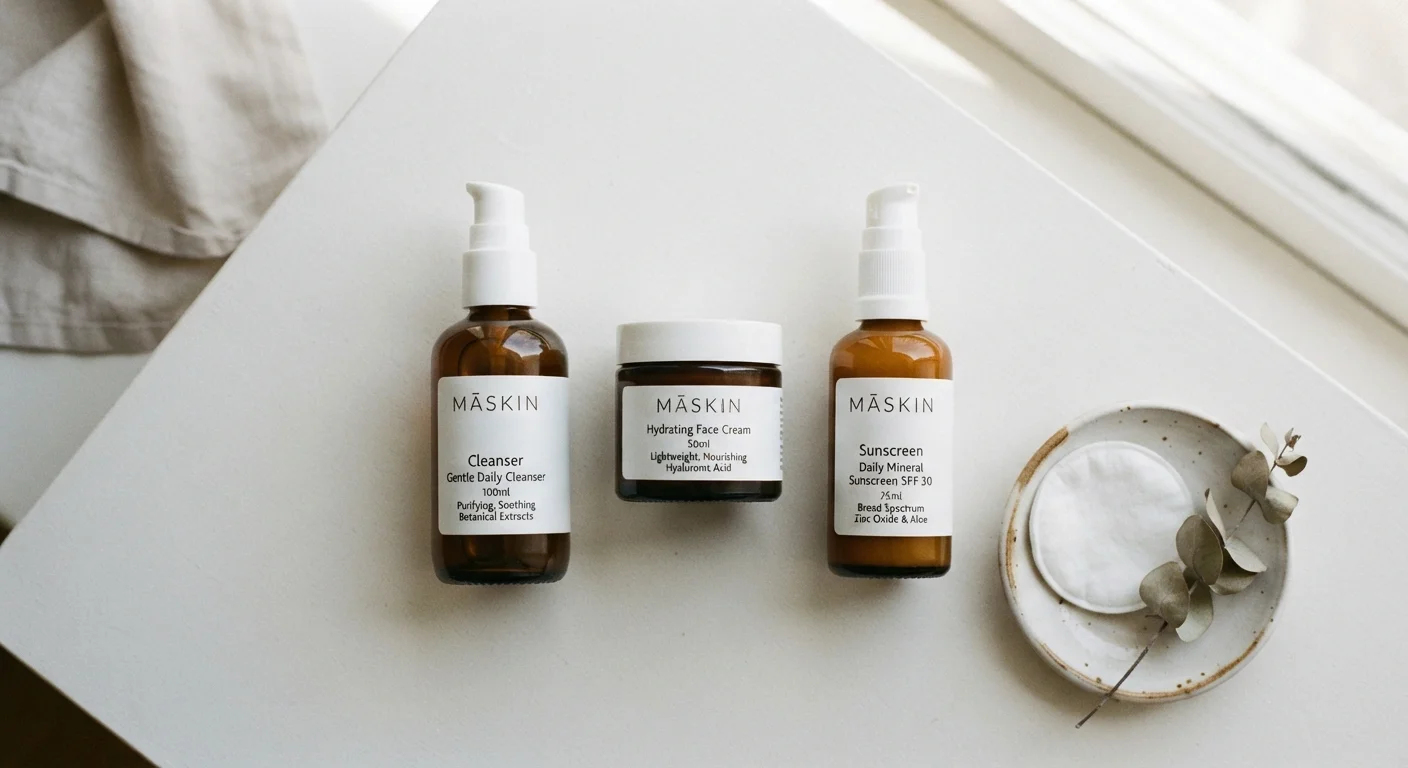
Before exploring anything else, establish these three non-negotiables:
Cleanser
Cleansing removes dirt, excess oil, and pollutants that accumulate on skin throughout the day. For most beginners, a gentle, fragrance-free formula works well across skin types. Avoid anything labeled as antibacterial for daily use — it's often unnecessarily harsh. Over-cleansing is a common beginner mistake that strips the skin's natural oils and can trigger increased oiliness or irritation in response.
Moisturizer
Every skin type benefits from hydration — even oily skin. Moisturizer helps maintain the skin barrier by sealing in water and reducing transepidermal water loss. Oily skin types do well with lightweight, gel-based formulas; dry skin benefits from richer creams. Look for humectants like glycerin or hyaluronic acid, which draw water to the skin.
Sunscreen
Broad-spectrum SPF 30 or higher is the most evidence-backed tool for preventing premature skin aging and supporting long-term skin health. Apply it as the final step of your morning routine. This single product, used consistently, does more for skin over time than most active ingredient treatments combined.
Ingredients Beginners Should Know
You don't need to memorize every ingredient label — but a handful of terms will help you read products more confidently. Our grooming ingredients reference covers these in more depth, but here are the most relevant for beginners:
- Hyaluronic acid: A humectant that attracts and retains water in the skin. Found in many moisturizers and serums.
- Niacinamide: A form of vitamin B3 that can help with uneven tone, excess oil, and mild redness. Generally well-tolerated.
- Retinoids: Vitamin A derivatives that support cell turnover. Effective but require a gradual introduction — not recommended as a starting step.
- Ceramides: Lipids naturally present in the skin barrier. Products containing ceramides help reinforce that barrier, especially useful for dry or sensitive skin.
- Chemical vs. mineral sunscreen filters: Mineral filters (zinc oxide, titanium dioxide) sit on top of skin and physically block UV rays. Chemical filters absorb UV and convert it to heat. Both are effective when used correctly.
As a beginner, prioritize understanding what a product is meant to do before focusing on its ingredient list.
Building the Habit: Morning and Evening Routines
Consistency is what produces visible change — not the sophistication of your products. Two brief routines per day, repeated daily, outperform an elaborate routine done sporadically.
Morning
- Rinse or gently cleanse
- Apply moisturizer
- Apply sunscreen as the final step
Evening
- Cleanse (more important at night to clear the day's buildup)
- Apply moisturizer
Once this foundation feels automatic — usually after four to six weeks — you can consider adding a targeted treatment like a serum. When you do, introduce one new product at a time, spaced at least two weeks apart, so you can identify how your skin responds. Our guide on layering products in the right order explains how to sequence additional steps when you're ready.
If budget is a real consideration, effective skincare doesn't require a full shelf of products — the three-step core is genuinely sufficient for most people starting out.
Make It Effortless to Stay Consistent
Keep your products somewhere you'll see them — next to your toothbrush or on the bathroom counter. The easier the routine is to access, the more likely it becomes automatic. A three-product routine that takes under two minutes removes the friction that leads most beginners to stop.
Common Beginner Mistakes to Sidestep
Most early skincare frustrations trace back to a short list of avoidable missteps:
- Switching products too quickly. Skin needs time to adjust. Giving up on a product after one week rarely gives you useful information.
- Using too many new products at once. If your skin reacts, you'll have no idea which product caused it. Introduce one at a time.
- Skipping sunscreen on cloudy days. UV radiation penetrates cloud cover. A consistent daily habit is more protective than situational use.
- Assuming expensive means better. Price is not a reliable proxy for efficacy. Formulation and ingredients matter more than brand prestige.
- Treating skincare as a quick fix. Even well-matched routines require weeks to show meaningful results. Managing expectations prevents premature abandonment.
Skincare is ultimately a long-term practice. Starting simple, staying consistent, and adjusting based on how your skin actually responds — not on trend cycles — is the approach most likely to serve you well over time.
This article is for general informational purposes only and does not constitute medical or dermatological advice. Consult a qualified healthcare or skincare professional if you have specific skin concerns or conditions.