

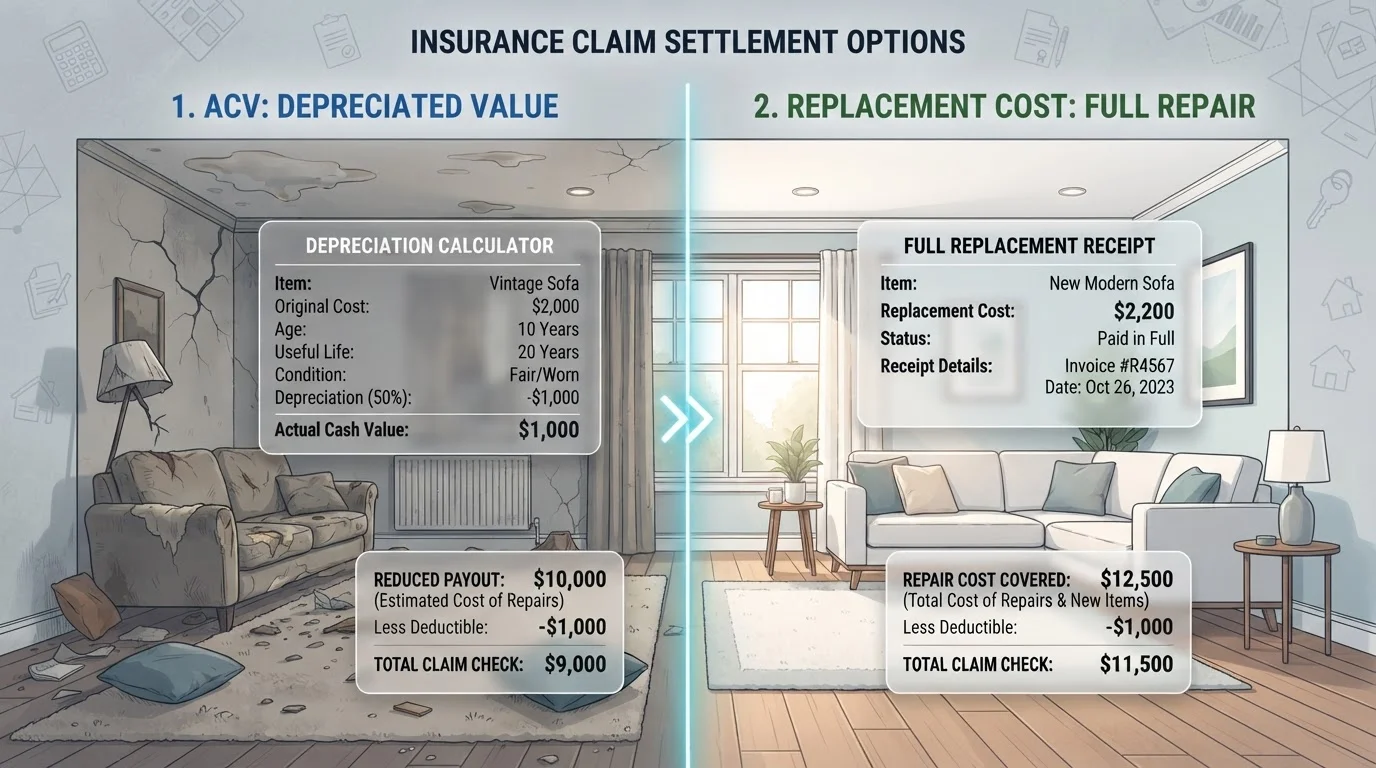
Key Takeaways
Option A
Actual Cash Value (ACV)
The depreciation-adjusted payout option.
Best for: Policyholders seeking lower premiums who can absorb the gap between depreciated value and replacement cost out of pocket.
Option B
Replacement Cost Value (RCV)
The full-repair, no-depreciation coverage option.
Best for: Homeowners and renters who want their insurer to cover the actual cost of restoring or replacing damaged property at today's prices.
If you want predictable, full reimbursement after a major loss
Replacement Cost Value (RCV)
RCV eliminates the depreciation penalty, meaning you can restore your property without covering a large gap from your own savings.
If you're focused on keeping monthly premiums as low as possible
Actual Cash Value (ACV)
ACV policies typically cost less upfront, though you should be prepared to cover the difference between the depreciated payout and actual repair costs.
If your property is older or already heavily depreciated
Replacement Cost Value (RCV)
Older items depreciate significantly, so an ACV payout on an aging roof or appliances may barely cover a fraction of replacement costs.
If you have substantial emergency savings and insure lower-value items
Actual Cash Value (ACV)
When the assets you're insuring have modest value and you can self-fund the depreciation gap, the premium savings from ACV coverage may make financial sense.
What These Two Terms Actually Mean
When you file a claim, your insurer doesn't automatically hand over the full cost to make things right - it pays based on the valuation method written into your policy. There are two common approaches: Actual Cash Value (ACV) and Replacement Cost Value (RCV). Understanding the difference before a loss occurs is one of the most practical steps you can take as a policyholder.
Actual Cash Value is calculated by taking the replacement cost of an item and subtracting depreciation - the reduction in value that comes from age, wear, and obsolescence. If your five-year-old laptop is stolen, the insurer estimates what that same model is worth today in its used condition, not what a brand-new equivalent would cost.
Replacement Cost Value, by contrast, pays what it would cost to repair or replace the damaged item with a comparable new one at current market prices, without deducting for depreciation. That stolen laptop would be reimbursed based on the cost of a comparable new model.
Both terms appear in home, renters, and auto insurance policies. The valuation method can apply to the structure of your home, your personal belongings, or both - and the two sections of a single policy can sometimes use different methods, so it pays to read carefully. To understand the full structure of what a policy covers, see The Insurance Policy Landscape.
How the Numbers Play Out in Real Scenarios
The dollar difference between ACV and RCV can be substantial. Consider a roof that costs $15,000 to replace and is ten years into a 20-year expected lifespan. Under an ACV policy, the insurer may calculate 50% depreciation and pay out $7,500 - leaving you responsible for the remaining $7,500. Under an RCV policy, the insurer covers the full $15,000 (minus your deductible).
| Criterion | Actual Cash Value (ACV) | Replacement Cost Value (RCV) |
|---|---|---|
| How payout is calculated | Replacement cost minus depreciation | Current cost to repair or replace new |
| Depreciation deducted | Yes | No |
| Typical premium cost | Lower | Higher |
| Out-of-pocket gap at claim time | Potentially large | Minimal (subject to deductible and limits) |
| Best suited for | Lower premiums, newer or low-value items | Full recovery, older or high-value property |
| Payout timing | Single payment after claim approval | Often two-step: ACV first, then recoverable depreciation |
The same logic applies to personal property. A refrigerator purchased for $1,200 seven years ago might receive an ACV payout of $400 because of depreciation, even though a comparable replacement today costs $1,400. RCV coverage would reimburse the $1,400.
It's worth noting that many RCV policies include a two-step process: the insurer first pays the ACV amount, then releases the remaining depreciation - sometimes called the recoverable depreciation - only after you submit documentation proving repairs or replacement were completed. If you never make the repairs, you keep only the ACV portion. This is an important detail that surprises many policyholders at claim time, and it's one of the coverage gaps people discover only after a claim.
Premium Costs, Trade-Offs, and What to Check in Your Policy
RCV coverage generally costs more than ACV coverage because the insurer takes on greater financial exposure. The premium difference varies by property type, age, and location, but it's a real cost to weigh against the protection gained. Think of it similarly to the trade-off explained in Premium vs. Deductible: paying more upfront changes what you recover when something goes wrong.
Check Both Your Structure and Contents Coverage
Home insurance policies often apply different valuation methods to the dwelling (the physical structure) and personal property (your belongings). It's common to have RCV on the structure and ACV on contents, or vice versa. Read both sections of your policy separately and confirm the valuation method for each. If anything is unclear, your insurer or a licensed agent is required to explain your policy terms.
To find out which method your policy uses, look for language like "actual cash value," "replacement cost," or "depreciation" in the declarations page or the property coverage section of your policy documents. If the language is unclear, ask your agent directly - in writing, if possible.
Also check whether your coverage limits are high enough to cover full replacement costs. An RCV policy is only as useful as the limit it's tied to. If your home is insured for $200,000 but would cost $320,000 to rebuild, even RCV coverage leaves a serious gap. Periodically reviewing your limits - especially after renovations or significant purchases - keeps your protection current. For guidance on when it might make sense to handle smaller losses without involving your insurer at all, see When to Pay Out of Pocket Instead of Filing a Claim.
This article is for general informational purposes only and does not constitute insurance, financial, or legal advice. Coverage terms, valuation methods, and claim outcomes vary by policy and provider. Always review your actual policy documents and consult a licensed insurance professional for guidance specific to your situation.