

Key Takeaways
Why Order Actually Matters
Skincare products are formulated with specific molecular weights, pH levels, and delivery systems. When you apply them out of sequence, a thicker, occlusive formula can physically block a lighter serum from contacting the skin surface — meaning the active ingredients you paid for never fully penetrate where they're needed.
The skin's outermost layer, the stratum corneum, acts as a selective barrier. Lighter, water-based formulas have smaller molecules better equipped to pass through it. Once a heavier cream or oil sits on top, that window of access effectively closes. This isn't a marketing claim — it reflects how the skin's barrier function and product viscosity interact.
Understanding this principle also clarifies why some routines feel ineffective despite containing good ingredients. If you're curious about what each product category is actually designed to accomplish, our breakdown of cleansers, toners, serums, and moisturizers covers the purpose behind each step in plain language.
The One Rule That Covers Most Situations
Thin to thick. That's it. Start with your lightest, most watery formulas and work toward your densest, most occlusive products. This single principle correctly sequences the majority of routines without requiring you to memorize individual product categories.
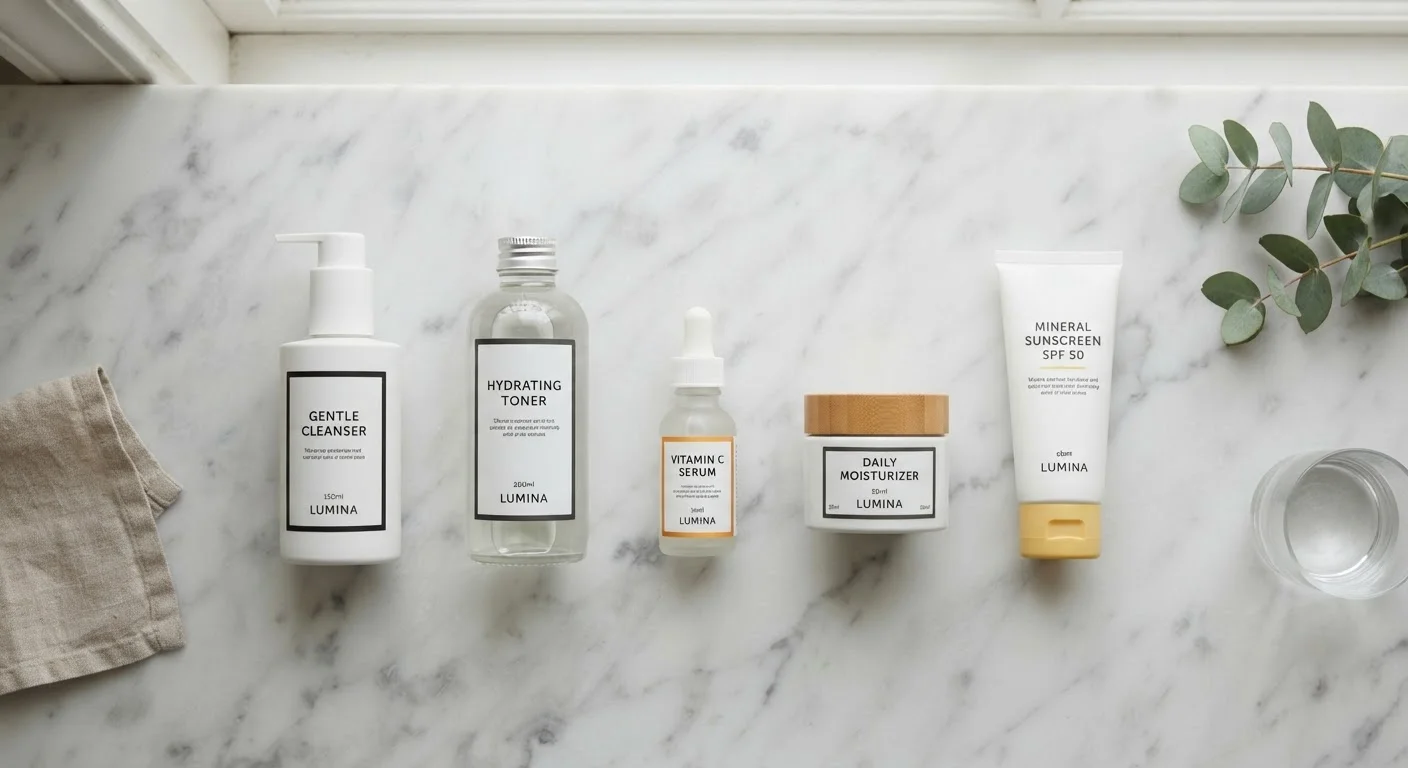
A typical morning lineup following this logic looks like: rinse or gentle cleanser → toner or essence → serum → moisturizer → sunscreen. At night, sunscreen is removed and you may swap in a richer treatment or facial oil at the end. For a deeper comparison of how AM and PM sequences differ, see our article on morning vs. night skincare routines.
The Thin-to-Thick Rule Is Your Anchor
When in doubt about where a new product fits, compare its texture to what you're already using. If it's lighter than your serum, it goes before; if it's heavier than your moisturizer, it goes after. This simple check handles most situations without requiring detailed product knowledge.
The thin-to-thick rule also helps you troubleshoot when adding a new product — ask yourself where it fits on the consistency spectrum, and slot it in accordingly.
Tools and Products You'll Need
Gentle Cleanser
Removes residue and prepares a clean surface for all subsequent products to absorb properly.
Toner or Essence
Adds a lightweight layer of hydration and can help balance skin pH after cleansing.
Serum
Delivers concentrated active ingredients — the step where most targeted treatment happens.
Moisturizer
Reinforces the skin barrier and seals in lighter layers applied underneath.
Broad-Spectrum Sunscreen (SPF 30 or higher)
Protects skin from UV damage and is the final step in every morning routine.
Facial Oil
Provides additional occlusion; applied after moisturizer when used, due to its density.
You don't need every category listed. A minimal but correctly ordered routine — cleanser, moisturizer, sunscreen — is more effective than a ten-step routine applied in the wrong sequence. If budget is a consideration, our guide on building a routine on a tight budget outlines which steps deliver the most value.
What you will need
Common Layering Mistakes to Avoid
Even with the thin-to-thick rule in mind, a few patterns trip people up consistently.
- Skipping wait time: Rushing immediately to the next product before the previous one has absorbed can cause pilling — that unpleasant balling up of product on the skin's surface. A 30- to 60-second pause between steps is usually sufficient.
- Applying facial oil before serum: Oils are occlusive and should come after water-based serums, not before. An oil applied first creates a barrier that prevents serums from absorbing.
- Misplacing SPF: Sunscreen is always the final step in a morning routine. Applying anything on top of it — including a moisturizer — can dilute the protective film and reduce its effectiveness.
- Mixing incompatible actives in the same layer: Some ingredient combinations are fine when used in the correct order; others can cause irritation or reduce each other's efficacy. Our article on ingredient interactions to know before mixing actives addresses common pairings in detail.
Never Apply Sunscreen Beneath Other Products
Sunscreen is a leave-on product engineered to sit on the skin's surface as a final protective layer. Applying a moisturizer, serum, or any other product over it reduces its effectiveness. In a morning routine, sunscreen is always the last step — with no exceptions.