

Key Takeaways
The Mechanics Behind the Markdown
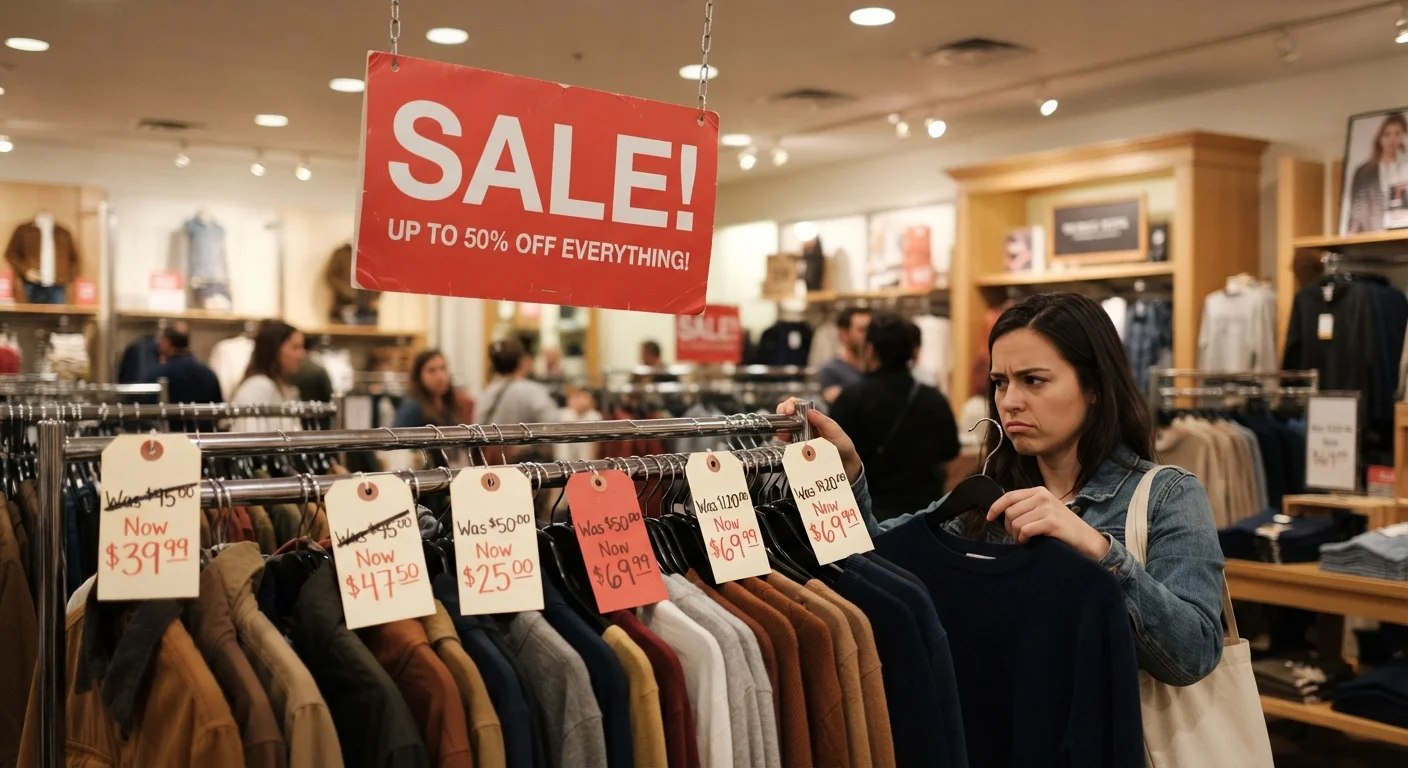
Walk through any retailer - physical or digital - and you'll see them everywhere: prices crossed out, percentages slashed, tags screaming savings. The psychology here is deliberate. Retailers know that the human brain evaluates price in relative terms, not absolute ones. Showing a $40 item next to a crossed-out $80 doesn't just present information - it creates a feeling of gain before you've spent a cent.
This is called anchor pricing: setting a high reference point so that any lower number looks attractive by comparison. The anchor doesn't have to be a price the retailer ever expected to collect. It just has to be plausible enough that shoppers accept it as a baseline.
The result is that "sale" becomes a presentation layer, not a reliable signal of value. Understanding a few core myths about sale pricing can help you evaluate what's actually happening in the numbers. For context on how this interacts with where you shop, see our look at how pricing varies between in-store and online channels.
Myth
The crossed-out price is what the item used to cost, so the sale price is a real saving.
Fact
Reference prices are often set artificially high and may not reflect any price the item was meaningfully sold at.
US retailers are permitted to display a "compare at" or "was" price, but guidelines from the Federal Trade Commission indicate that such prices should reflect a price at which the item was actually offered for a substantial period. In practice, enforcement is inconsistent, and some retailers set reference prices at a level they rarely or never charge. Investigative reporting and academic research have documented cases where "original" prices appear to have been set primarily to make the discounted price look attractive rather than to reflect real prior transactions. Before accepting a crossed-out price at face value, it's worth checking whether the item carries a comparable price elsewhere or has a publicly traceable price history.
Myth
A bigger discount percentage always means a better deal.
Fact
Discount percentages are calculated from reference prices, which vary widely - making the percentage itself an unreliable measure.
If a retailer sets a reference price of $200 for an item that competitors sell routinely for $90, a "55% off" sale price of $90 isn't a deal - it's the market price with extra framing. Percentage savings only mean something when the starting price is itself reasonable and verifiable. Comparing the final sale price directly to prices at other retailers or to an item's documented price history is a more reliable method than comparing percentages. This is especially relevant for categories like furniture, bedding, and electronics, where reference pricing practices vary considerably.
Myth
Limited-time sale countdowns mean the price will actually go up when the timer expires.
Fact
Many countdown timers on retailer websites reset automatically and the sale price continues after the timer reaches zero.
Manufactured urgency is one of the most documented tactics in digital retail. Countdown timers, "only X left in stock" notices, and "ends tonight" messaging are designed to compress the time a shopper spends evaluating a purchase. Consumer behavior research has consistently found that time pressure reduces comparison shopping and increases impulsive buying decisions. If a sale is genuinely time-limited, the retailer has an interest in making that verifiable - but many "flash sales" run indefinitely or recur so frequently that the urgency framing is largely cosmetic. Pausing before purchasing and returning to check the price the following day is a simple test. For more on how environmental cues push shoppers toward faster decisions, see retail features designed to trigger impulse purchases.
Myth
If a sale price is lower than the reference price, you're paying less than normal.
Fact
You're paying less than the stated reference price, which may itself be inflated - the sale price could be the item's everyday price elsewhere.
The comparison point matters. A sale price that undercuts an inflated reference price may still be above what the same item costs at another retailer without any promotional framing. This is particularly common in categories where consumers have less familiarity with typical price ranges - home goods, jewelry, and specialty kitchen equipment are areas where reference price inflation has been noted by consumer advocates. The practical check is straightforward: look up the identical or equivalent item at two or three other sources before treating the sale price as validated. The label "sale" describes the relationship between two numbers on the same tag, not between the sale price and the market.
How to Check Whether a Discount Is Real
Spotting inflated reference prices takes a small amount of habit, not expertise. A few approaches that work reliably:
- Track price history. Several browser tools and websites maintain historical price data for online retailers. If an item was "$99" for one week before a sale and $59 for the three months prior, the reference price is doing more work than the discount is.
- Calculate the unit price. Sale packaging sometimes changes quantity or size while keeping the discount framing. Our guide on unit price math explains exactly how to use shelf labels to cut through this.
- Ignore the timer. Countdown clocks on sale pages frequently reset. The urgency is manufactured. If the item is genuinely a limited quantity, that's a different claim - and one worth verifying independently.
- Compare the actual price, not the discount percentage. A 50% discount on an inflated reference price may still cost more than a competitor's everyday price on the same item.
Don't Let a Sale Price Skip Your Normal Evaluation
A sale tag can shift attention from "do I need this and is it good quality?" to "how much am I saving?" - which is a different question entirely. Before purchasing, apply the same quality and fit criteria you'd use at full price. A discount doesn't change whether a product is right for your needs. For help evaluating product quality independent of price framing, our piece on when brand labels matter and when they don't is a useful companion read.
Retailers aren't obligated to make this easy. But pricing tactics, including misleading reference prices, are subject to consumer protection guidelines from the Federal Trade Commission (FTC) in the US. Knowing that "Was $X" claims can draw regulatory scrutiny is useful context when evaluating whether a reference price seems credible. For a broader look at when advertised prices carry legal weight, see why the price tag isn't always the final word.
None of this means avoiding sales altogether - genuine markdowns do happen, particularly when retailers clear seasonal inventory. Our overview of how seasonal pricing cycles work can help you identify when timing actually works in your favor.