

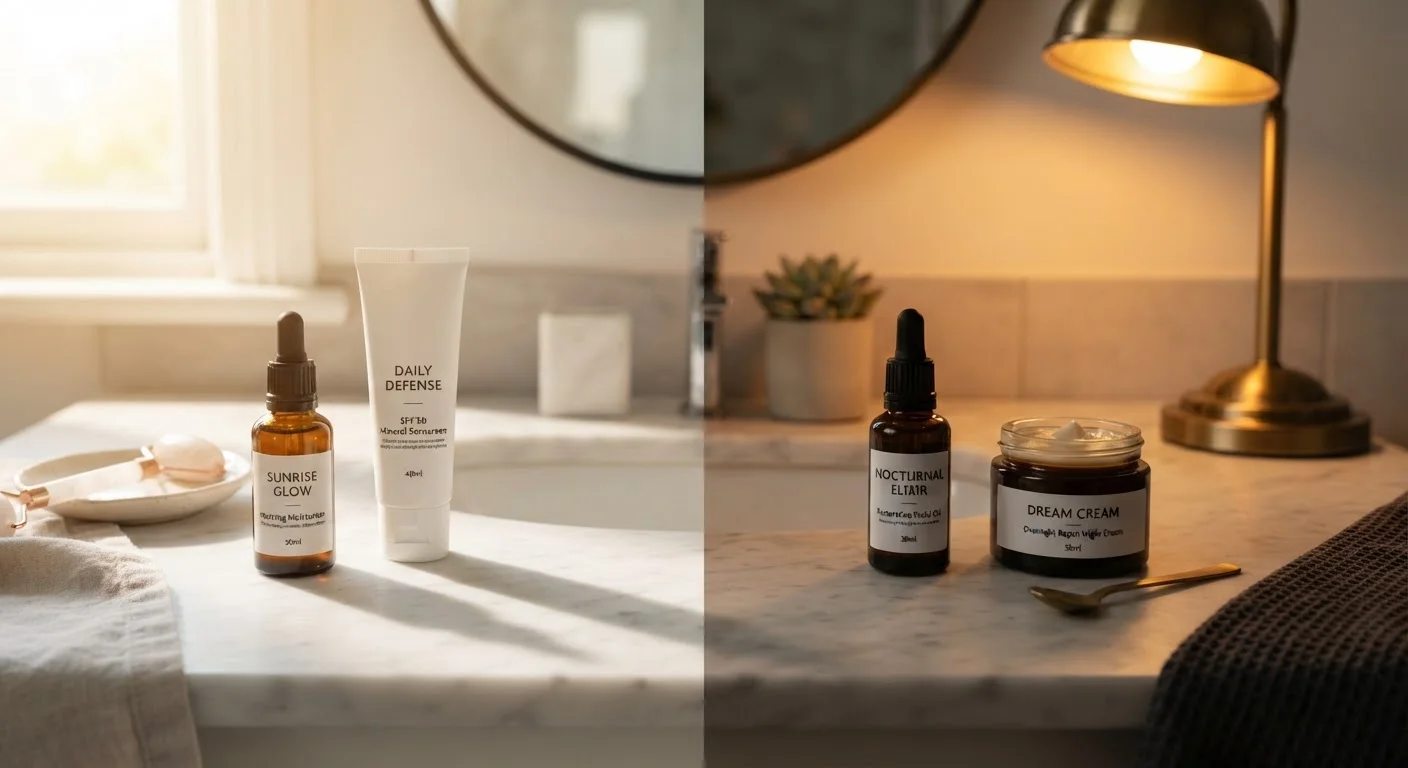
Key Takeaways
Option A
Morning Skincare Routine
The protective, defense-first approach.
Best for: Shielding skin from UV exposure, environmental pollutants, and oxidative stress throughout the day.
Option B
Night Skincare Routine
The restorative, repair-focused regimen.
Best for: Supporting the skin's natural overnight renewal cycle with richer, more active ingredients.
If you want to prevent sun damage and premature aging
Morning Skincare Routine
A consistent morning routine with SPF is the single most evidence-backed step for reducing long-term photodamage. Antioxidants like vitamin C further reinforce daytime defense.
If you want to address texture, dark spots, or fine lines
Night Skincare Routine
Actives such as retinoids and exfoliating acids work best overnight, when there's no sun exposure risk and skin is in its natural repair phase.
If you have limited time and can only commit to one thorough routine
Morning Skincare Routine
Sunscreen applied in the morning provides protective benefits that accumulate over years. It's the highest-leverage habit in any skincare regimen.
If you have dry or sensitive skin needing extra nourishment
Night Skincare Routine
Evening allows time for richer emollients and barrier-repair ingredients to absorb deeply without disrupting daytime makeup application.
Why Your Skin Behaves Differently at Different Times of Day
Skin is not a static organ — it follows a circadian rhythm that influences how it behaves hour by hour. During the day, the skin prioritizes barrier function: it produces more sebum, tightens pores slightly, and maintains defenses against external aggressors like UV radiation, pollution, and free radicals. At night, that mode shifts toward repair. Cell turnover accelerates, collagen synthesis increases, and the skin is more receptive to active ingredients.
This biological pattern is the reason why morning and night routines call for a fundamentally different product approach — not just a matter of preference, but of timing ingredients to match what the skin is already doing. For a broader introduction to building either routine, see our first-timer's complete skincare starting point.
Morning Routine: Defense as the Default
The core purpose of a morning routine is protection. Every product choice should support that goal.
Cleanser: A gentle, low-stripping cleanser removes overnight product residue and any sweat without disrupting the skin barrier. Harsh cleansers can compromise the skin's ability to defend itself throughout the day.
Antioxidant serum: Ingredients like vitamin C (ascorbic acid) help neutralize free radicals generated by UV exposure and pollution. They work synergistically with sunscreen rather than replacing it. Curious how vitamin C compares to other brightening actives? Our guide on niacinamide vs. vitamin C breaks down the differences.
Moisturizer: A lightweight, hydrating formula keeps skin comfortable without feeling heavy under makeup or sunscreen. Look for humectants like hyaluronic acid or glycerin.
Sunscreen (SPF 30 or higher): This is the non-negotiable anchor of any morning routine. Broad-spectrum sun protection guards against both UVA (aging) and UVB (burning) rays. Applying it daily — even on cloudy days — is one of the most durable investments in long-term skin health.
| Criterion | Morning Routine | Night Routine |
|---|---|---|
| Primary goal | Protection from UV and pollution | Repair and cellular renewal |
| Sunscreen required | Yes — essential step | No — not applicable |
| Retinoids / exfoliating acids | Avoid or use with caution | Ideal timing for these actives |
| Cleanser approach | Single gentle cleanse | Double cleanse if wearing SPF/makeup |
| Moisturizer texture | Lightweight, non-occlusive | Richer, barrier-supportive |
| Antioxidant serum | Highly recommended (e.g. vitamin C) | Optional; peptides more relevant |
| Routine length | Typically shorter | Can be more involved |
Night Routine: Repair and Renewal
Evening skincare operates on a different logic. With no UV exposure to worry about, the focus shifts to ingredients that actively improve skin over time — many of which would cause problems if worn in daylight.
Double cleanse (if wearing SPF or makeup): An oil-based cleanser first breaks down sunscreen and makeup effectively; a water-based cleanser follows to remove remaining impurities. This two-step approach is gentler and more thorough than a single aggressive wash. It's also worth keeping in mind that a heavy or disruptive nighttime routine can affect sleep onset — our article on evening habits that undermine sleep covers related factors worth knowing.
Active treatments: Retinoids (vitamin A derivatives), exfoliating acids (AHAs like glycolic acid, BHAs like salicylic acid), and peptides are best used at night. Retinoids in particular increase photosensitivity, making daytime use inadvisable without very careful SPF follow-up. Nighttime avoids that complication entirely.
Richer moisturizer or facial oil: Skin loses more water overnight — a process called transepidermal water loss (TEWL). Heavier emollients and occlusive ingredients help seal moisture in and support the skin barrier during this window.
For guidance on sequencing these products correctly, see our guide to layering skincare products in the right order.
A Note on Ingredient Photosensitivity
Certain ingredients — particularly retinoids and alpha-hydroxy acids (AHAs) — can make skin more sensitive to UV radiation. This doesn't mean they're unsafe, but it does mean they're better suited to evening use when sun exposure is not a factor. If you do use these ingredients, applying a high-SPF sunscreen every morning becomes even more important. This is general educational information; consult a dermatologist if you have questions about specific ingredients for your skin type.
What Both Routines Share — and Where They Diverge
Both routines start with cleansing and end with moisturizer. That shared structure matters: it protects the skin barrier morning and night, regardless of what active treatments sit in between. Beyond those two bookends, the routines diverge sharply in purpose, product weight, and ingredient selection.
If resources are limited and a full dual routine isn't realistic, building a routine on a tight budget offers practical guidance on prioritizing the steps that matter most.
~2x
Rate of cell turnover during sleep vs. daytime
Dermatological research indicates that skin cell renewal increases significantly during sleep, underlining the importance of nighttime actives.
SPF 30+
Minimum recommended daily sun protection
The American Academy of Dermatology recommends broad-spectrum SPF 30 or higher every day, regardless of weather or skin tone.
25–30%
Increase in transepidermal water loss overnight
Studies on skin barrier function suggest that water loss through the skin surface rises during sleep, supporting the use of occlusive moisturizers at night.