

| Governing Agency | Federal Trade Commission (FTC) |
| Label Color | Bright yellow |
| Energy Unit Shown | Kilowatt-hours (kWh) per year |
| Cost Estimate Basis | National average electricity rate (set by U.S. DOE) |
| Appliances Excluded | Small countertop appliances (toasters, coffee makers, etc.) |
| ENERGY STAR Certifier | U.S. Environmental Protection Agency (EPA) |
What the EnergyGuide Label Is - and Who Requires It
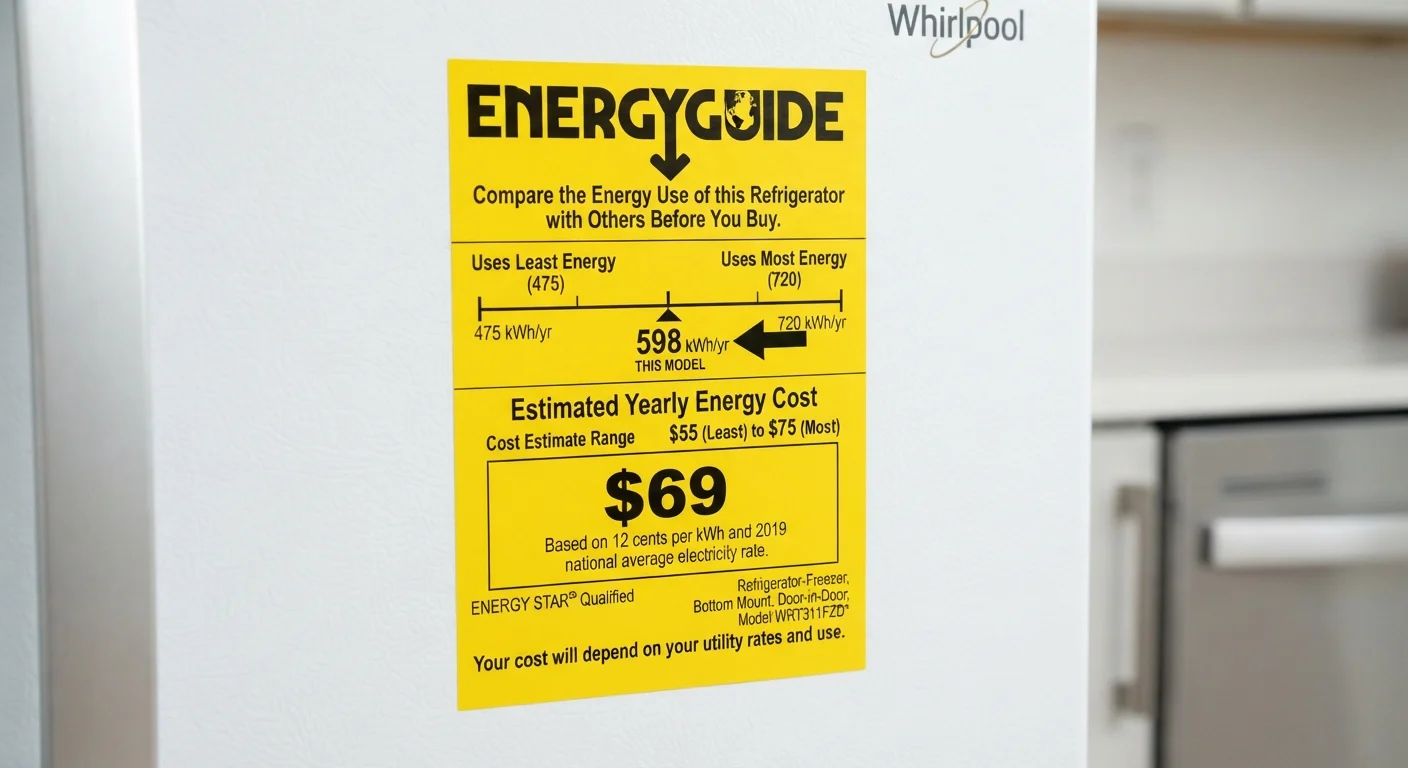
The bright yellow EnergyGuide label is a federally mandated disclosure required by the Federal Trade Commission (FTC) on most major household appliances sold in the United States. Its purpose is simple: give shoppers a standardized, side-by-side way to compare the estimated energy use and operating cost of different models before buying.
Covered appliances include refrigerators, dishwashers, washing machines, dryers, water heaters, air conditioners, furnaces, heat pumps, and certain televisions. Not everything carries the label - small countertop appliances like toasters and coffee makers are excluded - but any appliance category regulated by the FTC must display it prominently.
Understanding the label lets you factor in long-term operating costs, not just the sticker price. For a deeper look at those downstream expenses, see the hidden costs of running household appliances.
EnergyGuide Label
A bright yellow label required by the U.S. Federal Trade Commission on most major home appliances. It discloses estimated annual energy consumption and operating cost to support comparison shopping.
Kilowatt-hour (kWh)
The standard unit of electrical energy used on utility bills and EnergyGuide labels. One kWh equals the energy used by a 1,000-watt device running for one hour.
ENERGY STAR®
A voluntary efficiency certification program run by the U.S. Environmental Protection Agency. Appliances earning this designation meet energy-use thresholds set above the federal minimum.
Comparison Scale
The horizontal bar on an EnergyGuide label that shows where a specific model falls among all similar models tested, ranging from lowest to highest energy use.
Estimated Yearly Energy Cost
A dollar estimate on the EnergyGuide label of what it will cost to operate an appliance for one year, calculated using a national average utility rate set by the U.S. Department of Energy.
Breaking Down Each Section of the Label
Every EnergyGuide label follows the same layout. Here's what each part communicates:
- Appliance type and key specs: The top of the label identifies the product category (e.g., "Refrigerator") and lists the specific features used in testing - capacity, configuration, and any relevant settings. This matters because you're comparing apples to apples only when specs align.
- Estimated yearly energy cost: The large dollar figure in the center estimates what you'll spend annually to run this appliance, based on a national average electricity rate set by the U.S. Department of Energy. Your actual cost will vary based on your local utility rates and usage habits.
- Estimated yearly electricity use (kWh): Below or near the cost figure, the label states annual kilowatt-hour (kWh) consumption. This number is useful if you want to calculate costs using your own utility rate - just multiply your rate per kWh by the listed annual kWh.
- Comparison scale: A horizontal bar shows where this model falls relative to others in its category - from models that use the least energy on the left to those that use the most on the right. A marker indicates where this unit lands on that spectrum.
- ENERGY STAR® notice: If the appliance meets the Environmental Protection Agency's efficiency threshold, an ENERGY STAR logo appears on the label. Not all appliances qualify, and absence of the logo doesn't mean a product is inefficient - it may simply fall just below the program's cutoff.
| Governing Agency | Federal Trade Commission (FTC) |
| Label Color | Bright yellow |
| Energy Unit Shown | Kilowatt-hours (kWh) per year |
| Cost Estimate Basis | National average electricity rate (set by U.S. DOE) |
| Appliances Excluded | Small countertop appliances (toasters, coffee makers, etc.) |
| ENERGY STAR Certifier | U.S. Environmental Protection Agency (EPA) |
Room-by-Room: What to Focus On
The label's most useful number shifts depending on which appliance you're evaluating. Here's a quick room-by-room reference:
Kitchen
Refrigerators: Focus on the kWh figure. Fridges run 24/7, so even small differences in annual consumption compound over a 10-15 year lifespan. Check that the comparison scale reflects the same capacity and configuration (side-by-side vs. top-freezer, for example).
Dishwashers: Estimated yearly cost is most useful here. Dishwashers vary significantly based on wash cycle selection; the label assumes a standard usage pattern, so heavy users should mentally adjust upward.
Laundry Room
Washing machines: The label reflects both water heating and motor use. Front-loading models typically appear further left on the comparison scale than top-loaders in the same capacity class.
Dryers: Gas dryers often show a lower annual energy cost than electric models; make sure you're comparing within the same fuel type for a fair read. If you're also thinking about cooling systems and their energy ratings, how cooling systems differ in efficiency is a useful reference.
Utility / Mechanical Room
Water heaters: These often carry the highest operating cost on the label of any single appliance. Compare the kWh or BTU figure carefully; tankless and heat-pump models typically sit far left on the scale.
For broader guidance on evaluating quality before purchase - not just operating cost - a room-by-room build quality guide covers what to look for physically.
Reading product labels accurately is a transferable skill. The same analytical habits apply whether you're decoding a skincare product label or a pet food label.