

Key Takeaways
Our Verdict
No single system is universally superior - each serves a different situation well. Central air makes sense for larger homes with existing ductwork. Mini-splits are the practical choice for homes without ducts or for targeted room-by-room control. Window units remain a workable low-barrier option for renters or single-room needs.
| Best for | Recommended |
|---|---|
| Whole-home cooling in a ducted house | Central Air Conditioning |
| Ductless homes or multi-zone comfort control | Mini-Split System |
| Renters or single-room cooling on a limited budget | Window Unit |
| Additions, garages, or rooms underserved by central air | Mini-Split System |
How Each System Works
Understanding how these three systems move heat out of your home makes it easier to match them to your situation.
Central Air Conditioning
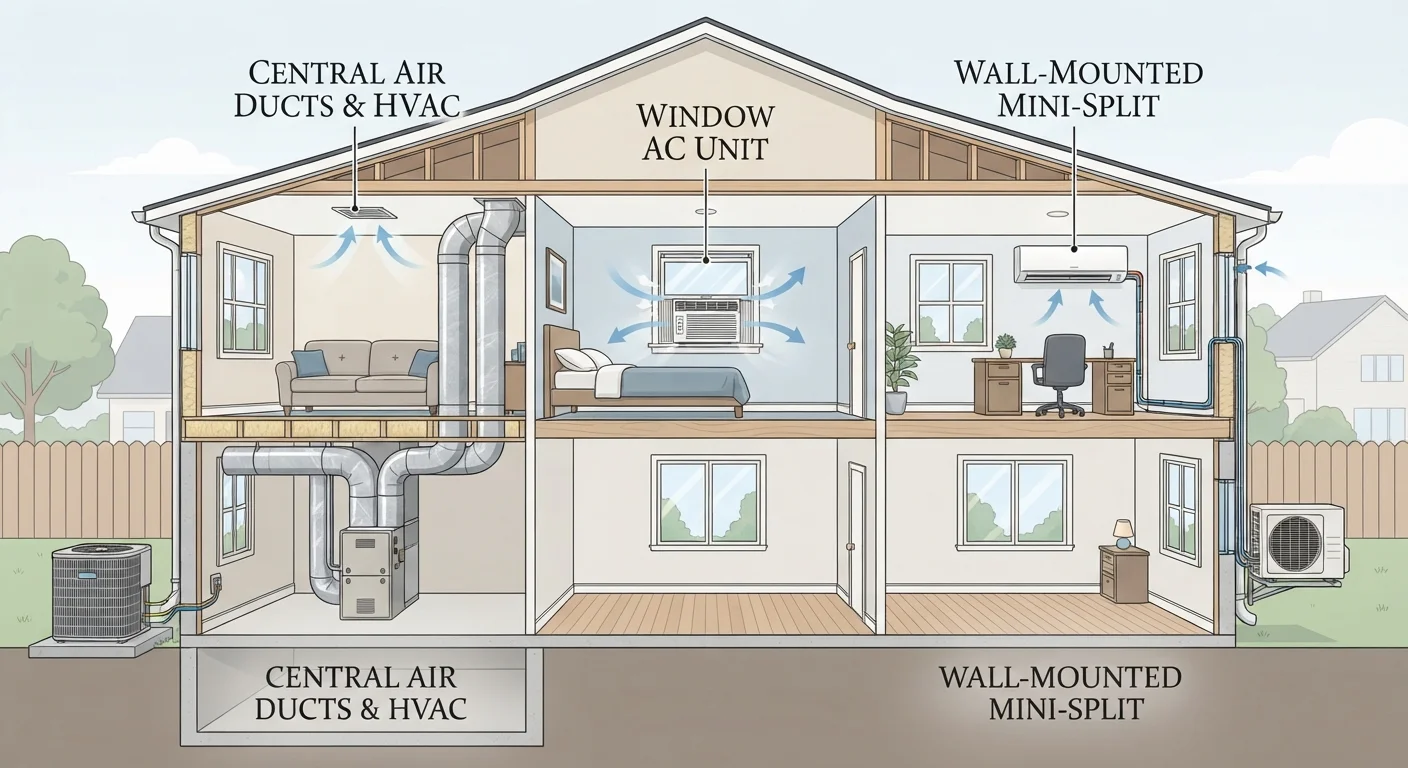
A central system uses a compressor (typically installed outdoors) connected to an air handler inside. Cooled air travels through a network of ducts and is distributed through vents in each room. A single thermostat typically controls the entire home. This approach requires existing ductwork - or the expense of installing it.
Window Units
A window air conditioner is a self-contained appliance that fits into a standard double-hung window opening. The unit exhausts heat outside while blowing cooled air into the room. Installation takes minutes and requires no professional help in most cases. Each unit cools only the room it's placed in.
Mini-Split Systems
A mini-split (also called a ductless split system) consists of an outdoor compressor unit linked by refrigerant lines to one or more wall-mounted indoor air handlers. Each indoor unit can be controlled independently, allowing room-by-room temperature management. Installation requires a small hole in the wall for the refrigerant lines but no ductwork. Most mini-splits also function as heat pumps, providing heating in cooler months.
Installation and Upfront Costs
Setup requirements vary considerably across the three options, and that difference shapes the true cost of each.
| Central Air | Window Unit | Mini-Split | |
|---|---|---|---|
| Typical upfront cost | High (system + installation) | Low (unit only) | Moderate to high (unit + install) |
| Professional installation required | Yes | No | Yes |
| Ductwork needed | Yes | No | No |
| Cooling coverage | Whole home | Single room | One room per indoor unit |
| Efficiency (general) | Moderate to high | Moderate | High |
| Heating capability | Separate system needed | No | Yes (heat pump models) |
| Noise level indoors | Low | Moderate to high | Very low |
| Renter-friendly | Rarely | Usually | Rarely |
Central air installation is the most involved. If your home already has ductwork in good condition, adding or replacing a central system is more straightforward. Without ducts, installation becomes a major construction project. Professionals handle all central air work.
Window units require no professional installation, but they do require an appropriately sized window opening and a dedicated electrical circuit for larger models. They're the only option here that a renter can typically deploy without landlord approval for modifications.
Mini-split installation sits in the middle: it requires a licensed HVAC technician to handle refrigerant and electrical work, but there's no duct construction involved. Costs vary by the number of zones (indoor units) being installed. For homes without ductwork, mini-splits often prove less expensive overall than adding full duct systems. See our guide to hidden appliance costs for a broader look at what installation and ongoing expenses can add up to.
Efficiency, Operating Costs, and Energy Labels
Efficiency ratings directly affect what you'll pay each month. For central systems and window units, look for the SEER2 (Seasonal Energy Efficiency Ratio) or EER2 ratings on the EnergyGuide label - higher numbers mean lower operating costs per unit of cooling. Mini-splits are frequently among the most efficient options available, particularly inverter-driven models that adjust compressor speed to match demand rather than cycling fully on and off.
Window units tend to consume more electricity per square foot cooled compared to modern mini-splits, though their lower purchase price may offset this over shorter ownership periods. Central air efficiency varies widely depending on the system's age and the condition of the ductwork - leaky ducts can waste a significant portion of cooled air before it reaches living spaces.
To make sense of the yellow EnergyGuide label that appears on most window units and central systems at the point of sale, see our room-by-room EnergyGuide reference.
Size the System to the Space
Oversized cooling equipment cools air quickly but doesn't run long enough to remove humidity effectively, leaving rooms feeling clammy. Undersized equipment runs constantly without reaching target temperatures. For any system type, look for published sizing guidelines (often expressed in BTUs per square foot) and factor in ceiling height, insulation quality, and sun exposure before settling on a capacity.
Practical Considerations Before You Choose
Beyond cost and efficiency, several practical factors should guide the decision:
- Home type and ownership: Renters are generally limited to window units unless a landlord permits mini-split installation. Homeowners have all three options.
- Existing infrastructure: Homes with functioning ductwork are natural candidates for central air. Older homes, room additions, and detached structures typically benefit from mini-splits.
- Number of rooms: Window units become cumbersome if you need to cool more than two or three rooms. Both central air and multi-zone mini-splits scale more cleanly.
- Noise tolerance: Central air moves air through vents quietly. Window units can be noticeably loud. Mini-splits operate near-silently indoors, with sound limited to the outdoor unit.
- Air quality: Central systems with proper filtration can improve whole-home air quality. For rooms where indoor air quality is a separate concern, see our comparison of air purifiers and dehumidifiers.
- Smart home compatibility: Many modern thermostats and mini-split controllers offer Wi-Fi control and scheduling. If integration with a broader smart home setup matters, review key questions to ask before adding any smart device first.