

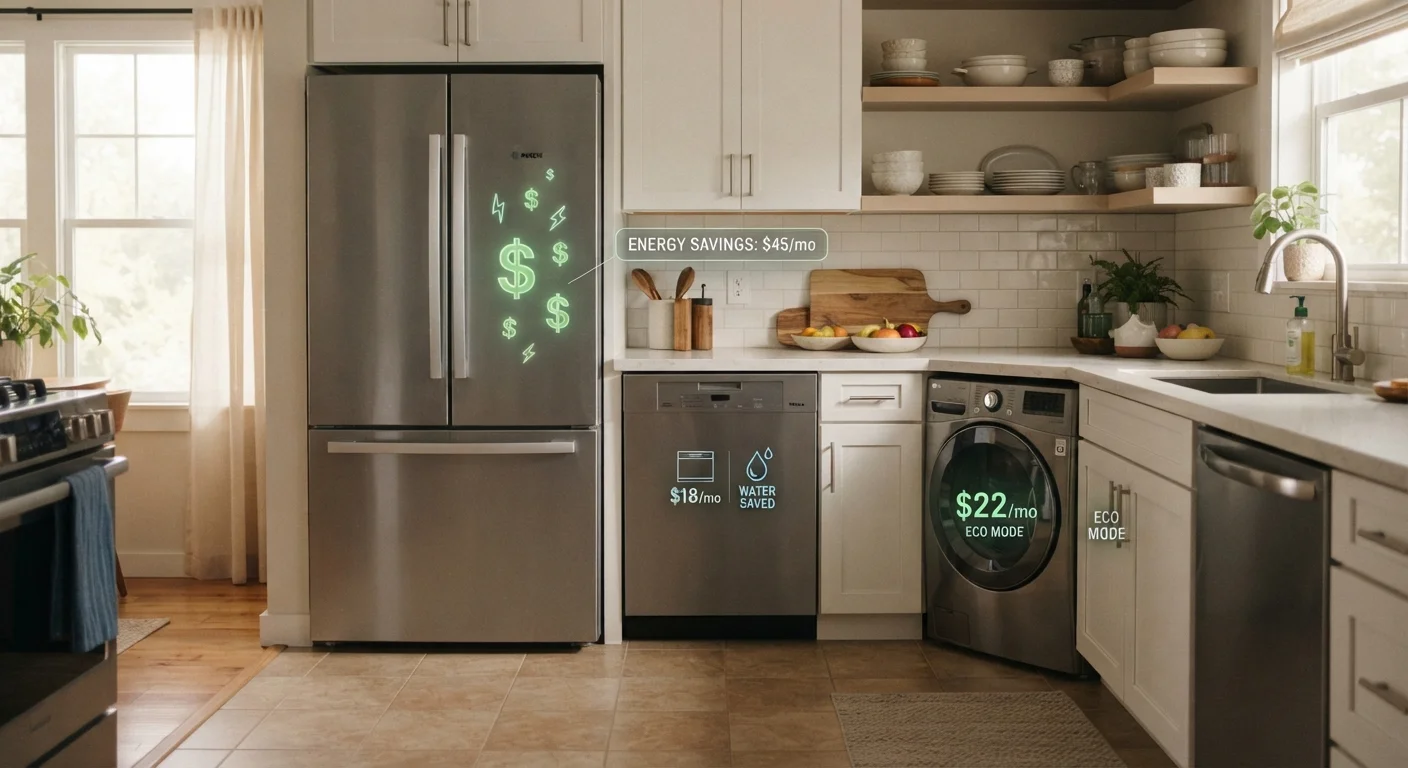
Key Takeaways
Total Cost of Ownership (Appliances)
The total cost of ownership is the full amount you spend on an appliance over its useful life - not just the purchase price. It includes electricity or gas to run it, water consumption, routine maintenance, repairs, and eventual replacement. For most major appliances, these ongoing costs frequently exceed what you paid at the register.
Energy economists often express running costs in terms of annual kilowatt-hour (kWh) consumption multiplied by the local utility rate. The federal EnergyGuide label provides estimated annual energy cost figures to support apples-to-apples comparisons between models.
Why the Sticker Price Is Misleading
Walk through any appliance showroom and you'll see prices front and center. What you won't see is the number that often matters more: how much the machine will cost you every month for the next decade. For most households, running costs accumulate to a figure that rivals or exceeds the original purchase price long before the appliance wears out.
This gap between upfront price and total cost of ownership is why two seemingly identical refrigerators at different price points can represent very different long-term values. The cheaper unit may draw significantly more power, adding $30-$60 or more to annual electricity bills - a difference that compounds over ten or fifteen years of continuous operation. Understanding this dynamic is the foundation of smarter appliance decisions.
For a practical framework on comparing running costs at the point of purchase, see how to read an EnergyGuide label - the yellow tag required on most major appliances provides standardized annual cost estimates that make comparisons straightforward.
The Four Cost Layers Every Owner Should Know
Appliance running costs fall into four distinct categories. Tracking each one separately gives a clearer picture of where money actually goes.
1. Energy Consumption
Electricity and gas costs are the dominant ongoing expense for most appliances. A standard electric water heater can account for 14-18% of a household's total electricity use. Refrigerators run 24 hours a day, every day. HVAC systems in climates with hot summers or cold winters can represent the single largest utility line item in the home. Local utility rates vary significantly across the U.S., so the same appliance costs more to run in some states than others.
2. Water Usage
Dishwashers, clothes washers, and refrigerators with ice makers all consume water - and in areas with higher water rates or tiered pricing, that usage adds up. Older washing machine designs can use three to four times more water per load than current high-efficiency models, a difference that affects both water and water-heating costs simultaneously.
3. Maintenance and Repairs
Filters, gaskets, belts, and cleaning treatments are recurring small expenses that protect against much larger repair bills. Neglecting them is a false economy. A $15 refrigerator door gasket that seals properly prevents the compressor from overworking; ignoring a failing gasket can shorten the compressor's life by years. See maintenance habits that extend appliance life for a practical breakdown by appliance type.
4. Lifespan and Replacement Timing
An appliance that fails five years early forces an unplanned purchase and loses the efficiency value of years of remaining service. Lifespan is shaped by build quality, usage intensity, and how consistently the unit is maintained - all factors within a homeowner's influence.
~$2,000
Average annual U.S. household energy bill
According to the U.S. Energy Information Administration, the average American household spends roughly this amount annually on electricity alone, with appliances and HVAC representing the largest shares.
14-18%
Share of electricity used by water heaters
The U.S. Department of Energy estimates that water heating accounts for this portion of a typical home's total electricity consumption, making it one of the most significant appliance costs.
10-15 years
Typical refrigerator lifespan
Industry estimates place average refrigerator useful life in this range, though maintenance practices and usage intensity can push that figure higher or lower.
Used and Refurbished Appliances: Cost Tradeoffs
Buying secondhand can reduce the upfront cost substantially, but it shifts risk. An older unit may already be operating inefficiently, and parts availability shrinks as models age. The key question isn't just "what does it cost today?" but "what will it cost to run and maintain, and how many years of use remain?"
Before purchasing a used appliance, review the key inspection points for condition, warranty coverage, and parts availability. A unit with a low asking price but a degraded compressor or no remaining warranty may deliver a poor total value compared to a newer, more efficient model.
How Appliance Costs Fit Into Your Household Budget
Appliance running costs are fixed and semi-fixed expenses - they recur whether or not you're tracking them. Adding them to your household budget as a line item, rather than absorbing them invisibly into utility bills, helps surface opportunities to reduce consumption or plan for replacement before a breakdown forces your hand.
Appliance costs are part of a broader pattern of household expenses that tend to be underestimated. If you're mapping out your full spending picture, budgeting fundamentals and practical everyday money habits can help you account for recurring home costs alongside other spending categories. Unlike small discretionary purchases, appliance costs aren't easily cut - but they can be managed through informed buying decisions and consistent upkeep.
Use the EnergyGuide Label Before You Commit
Every major appliance sold in the U.S. is required to carry a yellow EnergyGuide label showing an estimated annual energy cost based on average usage and national electricity rates. Use that figure as a baseline when comparing models - a unit that costs $30 less per year to run saves $300 over a decade. Adjust the estimate using your own utility rate for a more accurate projection.
This article is for general informational purposes only and does not constitute financial or purchasing advice. Cost estimates vary based on local utility rates, usage patterns, and individual appliance models. Consult your utility provider and qualified technicians for guidance specific to your situation.