

Key Takeaways
Power Bank / Portable Charger
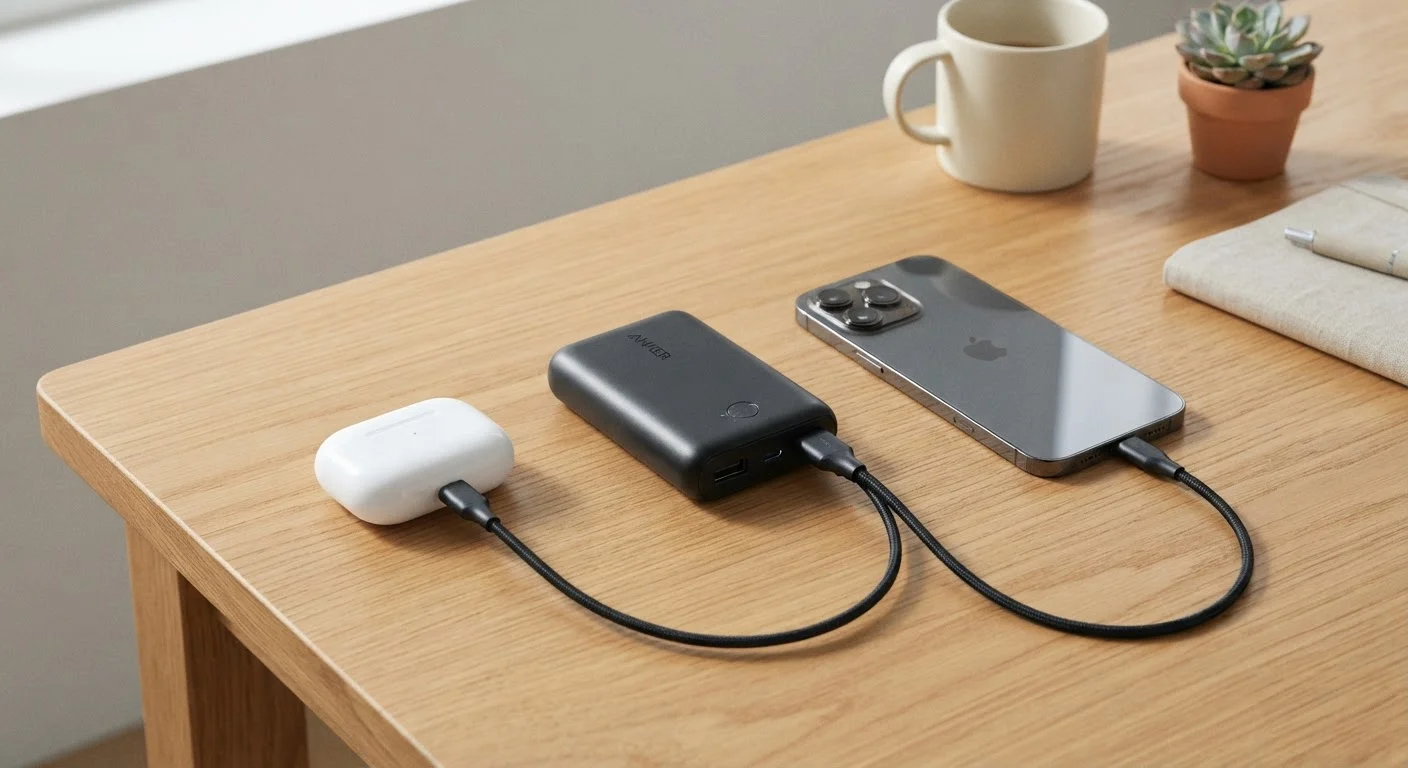
A power bank is a rechargeable battery pack you carry with you to charge phones, tablets, earbuds, and other devices when a wall outlet isn't available. You charge the power bank at home, then use it on the go to top up your gadgets via USB cables or, in some models, wireless charging. They range from palm-sized units that can give a phone one extra charge to larger packs that can charge multiple devices several times over.
Power banks convert stored DC energy through onboard circuitry that manages output voltage and current; the efficiency of this conversion — typically 80–90% — means usable capacity is always somewhat less than the rated milliamp-hour figure.
What Milliamp-Hours Actually Tell You
The most prominent number on any power bank is its milliamp-hour (mAh) rating. This measures how much electrical charge the internal battery can store. Think of it like the size of a water tank: a bigger tank holds more water, and a higher mAh rating stores more energy.
To estimate how many charges you'll get, divide the bank's mAh by your device's battery capacity. A 10,000 mAh power bank charging a phone with a 3,800 mAh battery looks like 2.6 charges on paper — but real-world efficiency losses (heat, voltage conversion, internal circuitry) typically reduce that to closer to two charges. Plan for roughly 80–85% of the theoretical maximum as a practical rule of thumb.
Larger capacity sounds appealing, but there's a trade-off: more mAh means a heavier, bulkier unit. A 5,000 mAh bank fits easily in a jacket pocket; a 20,000 mAh bank is closer to a paperback book in size and weight. Match the capacity to how you actually use it — a day trip calls for something different than a week of backpacking.
80–85%
Typical real-world power bank efficiency
Conversion losses from heat and internal circuitry mean usable capacity is consistently below the rated mAh figure, a well-established characteristic of lithium-ion power conversion.
100 Wh
FAA carry-on limit per power bank
The U.S. Federal Aviation Administration sets 100 watt-hours as the general limit for lithium-ion power banks in carry-on baggage without prior airline approval.
~27,000 mAh
Approximate mAh equivalent of 100 Wh
Calculated at the standard lithium-ion cell nominal voltage of 3.7V; this is the practical upper limit for most travelers without needing special airline permission.
Wattage and Charging Speed: Why It Matters
Wattage (W) tells you how fast a power bank can deliver energy to your device. It's calculated by multiplying voltage by current (amps). A standard USB-A port often delivers around 5–12W, while modern fast-charging standards — like USB Power Delivery (USB-PD) and proprietary protocols — can push 18W, 30W, 65W, or more through a USB-C port.
Here's the catch: charging speed is limited by whichever component has the lower ceiling — the power bank's output or your device's maximum input. If your phone accepts up to 25W, a 65W bank charges it no faster than 25W. The higher wattage only matters if you're also charging something that can use it, like a laptop or tablet.
Check both the output specs of the power bank (what it can deliver) and your device's input specs (what it can accept) before assuming you'll get fast charging. These details are typically listed in the product manual or your device manufacturer's support pages. For a broader look at charging technology, see our guide to wireless charging speed and compatibility.
Pass-Through Charging, Ports, and Features Worth Understanding
Pass-through charging is a feature that allows you to charge the power bank itself while it simultaneously charges a connected device. This is handy overnight — plug one cable into the wall, connect your phone to the bank, and both charge while you sleep. The limitation is that input and output often happen at reduced speeds when running simultaneously, so it's slower than charging each device separately.
Port selection matters more than it might seem. USB-A ports are the traditional rectangular connectors and are widely compatible. USB-C ports support higher wattage and are increasingly standard on phones, tablets, and laptops. If you own newer devices, look for a bank with at least one USB-C port that supports USB Power Delivery. Some banks include multiple ports so you can charge two or three devices at once — though total output is shared across all active ports.
Other features you may encounter:
- LED indicators: Show remaining charge, usually in 25% increments.
- LCD displays: Give a more precise percentage readout.
- Wireless charging pads: Let you set a Qi-compatible device on top to charge without cables.
- Solar panels: Trickle-charge the bank in sunlight — useful for extended outdoor trips, though slow in practice.
Travel Rules and Safe Storage
If you fly, power bank regulations are worth knowing before you pack. U.S. and international aviation guidelines generally allow lithium-ion power banks in carry-on bags only — not checked luggage — because of fire risk in the cargo hold. The standard limit is 100 watt-hours (Wh) per bank without airline approval, which corresponds to roughly 27,000 mAh at the standard lithium-ion cell voltage of 3.7V.
To convert mAh to Wh: multiply mAh by the voltage (usually 3.7V) and divide by 1,000. A 20,000 mAh bank is about 74Wh — within the limit. A 30,000 mAh bank is about 111Wh — over the limit and likely prohibited without prior approval. Airlines can and do enforce this at the gate, so check your bank's label before traveling.
For storage at home, keep power banks at partial charge (around 50%) if you won't use them for several weeks. Storing them fully charged or fully depleted for long periods can gradually reduce total capacity. Avoid leaving them in hot environments like a parked car — heat is hard on lithium-ion chemistry. For more context on how battery habits affect longevity, our piece on battery myths worth unlearning covers common misconceptions clearly.
Choosing the Right Size for Your Situation
There's no universal right answer — the best power bank is the one you'll actually carry. Here's a practical framework:
- Everyday commuters: A 5,000–10,000 mAh bank is light enough for a bag or large pocket and will handle one to two phone charges — more than enough for a day out.
- Frequent travelers: A 10,000–20,000 mAh bank balances capacity and portability for multi-day trips. Look for USB-C Power Delivery if you also carry a laptop or tablet.
- Outdoor or off-grid use: High-capacity banks (20,000+ mAh) or those with solar panels make sense when you're away from outlets for days at a time.
Consider what devices you're actually powering. Earbuds need far less capacity than a tablet. If you only need to top up your phone on a long commute, a compact 5,000 mAh unit is easier and lighter to carry than a high-capacity brick you'll never fill to need.
Understanding your devices' real power demands — and which gadgets quietly draw energy even when idle — can help you plan more effectively. See how standby power consumption adds up across common household gadgets for a useful reference point.