

Key Takeaways
Capsule Wardrobe
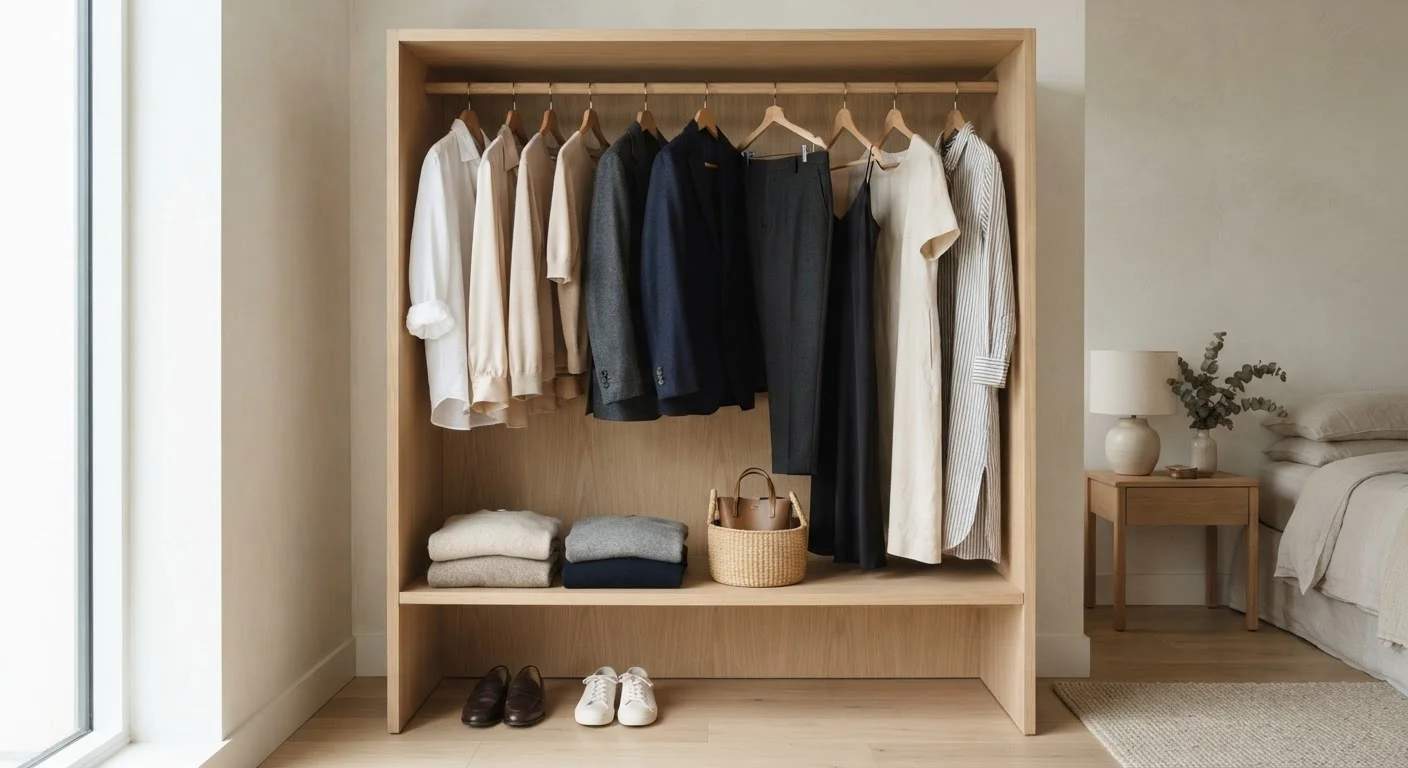
A capsule wardrobe is a small, intentionally selected collection of clothing where every piece works well with several others. The goal is to own fewer garments while being able to create more complete, wearable outfits. Items are chosen for versatility, quality, and compatibility rather than trend appeal or impulse.
The concept is often attributed to London boutique owner Susie Faux, who coined the term in the 1970s. Donna Karan's 1985 'Seven Easy Pieces' collection later popularized the idea in mainstream fashion.
The Core Idea Behind a Capsule Wardrobe
At its simplest, a capsule wardrobe is a deliberate editing-down of your clothing to pieces that do the most work. Instead of accumulating garments season by season, you identify a manageable set of items that fit your actual life and combine freely with each other.
The term doesn't describe a rigid formula. It's a philosophy: every item earns its place. A navy crewneck sweater works with jeans, trousers, and skirts. A well-fitted white shirt layers under blazers, goes to the office, and rolls up for weekends. When clothing functions this way, a closet with 35 items can feel more complete than one holding 150.
What distinguishes a true capsule from simply owning fewer things is intentionality. You're not just cutting back — you're selecting with purpose. That means understanding your own routine, color preferences, and the occasions you actually dress for, not an aspirational version of your life.
“A capsule wardrobe is not about owning less for its own sake — it's about owning exactly what serves you, so that getting dressed stops being a problem to solve.”
— Susie Faux, London boutique owner credited with coining the term 'capsule wardrobe' in the 1970s
Does the Concept Actually Work in Real Life?
The capsule wardrobe works well for some people and requires significant adjustment for others. The honest answer is that it depends heavily on lifestyle fit.
People with fairly consistent weekly routines — commuting to an office several days, weekends with family, occasional evenings out — often find it straightforward to identify their core needs. For them, a capsule reduces morning friction and stops the habit of buying items that never get worn.
Those with highly varied demands face more complexity. A nurse who also coaches youth soccer and attends formal dinners has genuinely different clothing requirements that a small, unified wardrobe may struggle to serve. In these cases, a modified approach — maintaining separate functional groups of clothing, each curated — can work better than a single unified collection.
The evidence for capsule wardrobes is mostly practical rather than scientific: people report spending less on clothing, feeling less overwhelmed getting dressed, and making more use of what they own. These outcomes are plausible, but individual results vary depending on how honestly the initial selection is made.
For a structured starting point, see building a wardrobe from scratch — it covers the foundational decisions in practical terms.
What Belongs in a Capsule Wardrobe
The backbone of any capsule is a set of reliable basics — pieces in neutral or versatile tones that pair without effort. Think straight-leg denim in a dark wash, a structured blazer, clean white or cream tops, and a few layering pieces that transition across seasons. These are the items that get worn repeatedly because they genuinely work.
Beyond basics, a capsule has room for a small number of pieces that reflect personal style or serve specific needs — a printed dress you actually reach for, a specific pair of boots suited to your climate, a sweater in a color you like wearing. These aren't indulgences; they're what makes the collection feel like yours rather than a uniform.
What doesn't belong: items kept out of guilt, pieces waiting for an occasion that never arrives, and anything that requires everything else to change around it. These are closet weight — they take up space without contributing outfit options.
Understanding what makes a garment genuinely foundational helps cut through the noise when deciding what actually earns a place.
~30%
Clothes worn regularly from the average wardrobe
Consumer research consistently finds that most people wear a small fraction of the clothing they own on a regular basis, suggesting significant unused capacity in typical closets.
65+
Outfits possible from 10 versatile pieces
Fashion analysts note that 10 fully interchangeable garments can theoretically generate over 60 distinct outfit combinations, demonstrating the math behind capsule wardrobe efficiency.
How to Build One Without Starting Over
Most people don't need to discard everything and begin again. A realistic approach starts with what you already own.
A wardrobe audit is the most practical first step: go through your closet methodically and remove anything that hasn't been worn in the past year, doesn't fit, or can't pair with at least two other items you own. What remains is the rough shape of your capsule.
From there, you can identify genuine gaps — not wants, but functional absences. If you have five jackets but no reliable layering piece for moderate weather, that's a real gap. If you have plenty of casual tops but nothing that works for an occasional professional setting, that's worth addressing.
Transitions between seasons also affect how a capsule operates. Rotating storage for heavier seasonal pieces, while keeping a core of year-round items accessible, is how most people make the concept practical across a full calendar year. For that piece of the process, seasonal wardrobe transitions offers a methodical approach.
The result doesn't have to be perfect or permanent. A capsule wardrobe is a living system — you refine it as your life, body, and circumstances change.
This article is for general informational and educational purposes only. Style recommendations are not substitutes for personalized professional advice.