

Key Takeaways
Why Enrichment Is Non-Negotiable for Indoor Cats
Cats are predatory animals with complex behavioral needs that don't disappear simply because they live indoors. Without adequate stimulation, indoor cats commonly develop signs of boredom and chronic stress — including over-grooming, excessive vocalization, destructive scratching, and litter box avoidance. Understanding these signals is the first step; see our article on recognizing feline stress and making environmental adjustments for a closer look at what those cues mean.
Enrichment isn't about keeping your cat busy for the sake of it. It's about providing an environment that lets cats express natural behaviors — hunting, climbing, hiding, exploring — in safe, appropriate ways. Research in veterinary behavioral medicine consistently links a stimulating environment to lower cortisol levels, reduced aggression, and stronger human-animal bonds. The strategies below are drawn from that evidence base and can be adapted to virtually any living situation.
Add Vertical Space with Cat Trees and Wall Shelves
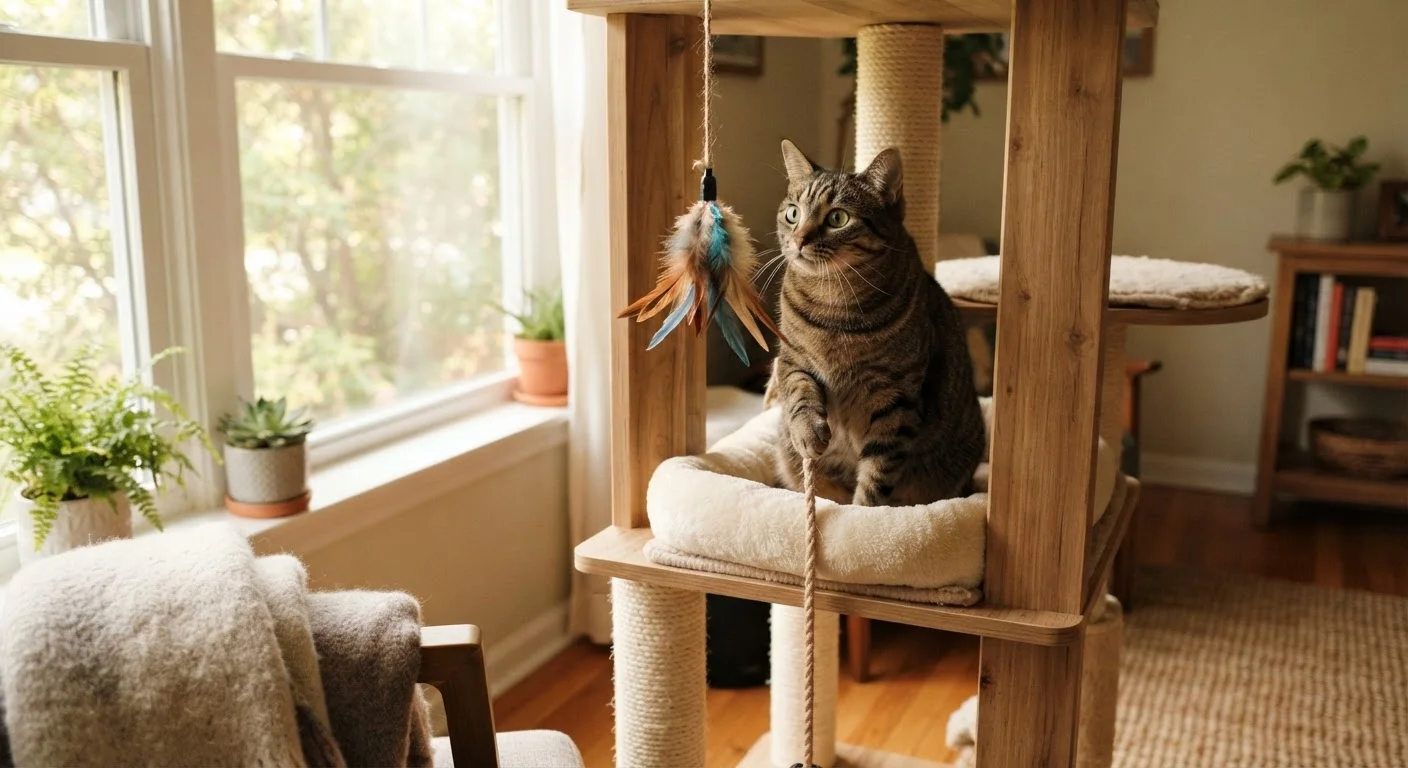
Cats are instinctively drawn to height. Elevation provides a sense of security, allows them to survey their territory, and serves as a refuge from perceived threats — including other pets or household commotion. A sturdy cat tree near a window or a series of wall-mounted shelves at varying heights can dramatically expand your cat's usable living space without requiring more floor area.
When planning vertical routes, think in terms of a continuous path rather than isolated platforms. Cats prefer to travel, so connecting shelves, ramps, and perches creates a more engaging environment than a single elevated spot. Ensure platforms are wide enough for your cat to lie down fully, and add soft bedding to make them genuinely inviting.
Elevation gives cats security, territory, and mental stimulation all at once.
Use Puzzle Feeders and Foraging Toys
In the wild, cats spend a significant portion of their day hunting for food — a behavior that engages problem-solving, fine motor skills, and patience. Replacing a static food bowl with a puzzle feeder or foraging toy taps directly into this instinct. Even a simple muffin-tin feeder or a kibble-filled paper bag gives a cat something to work through before eating.
Puzzle complexity should match your cat's experience level. Start with simpler designs — trays with raised edges or balls that dispense kibble when rolled — before introducing multi-step puzzles. Cats that rarely use puzzle feeders may need encouragement initially; placing a few treats on top of the feeder alongside their regular food can help them learn the game. This kind of feeding enrichment also pairs naturally with scheduled mealtimes rather than free-feeding, creating structured windows of mental activity.
Puzzle feeders replace passive eating with active problem-solving that satisfies predatory drive.
Incorporate Scent Enrichment
Cats' olfactory systems are far more sensitive than ours, and scent is one of the most underused tools in indoor enrichment. Novel, cat-safe scents — dried herbs like valerian or silver vine, a small amount of outdoor soil placed in a container, or items brought in from outside — can provide minutes to hours of investigation.
Catnip is the most well-known option, but responses vary: roughly 50–70% of cats are genetically predisposed to respond to it, and those that do typically show excitement followed by a refractory period. Silver vine and honeysuckle wood are alternatives that engage cats who don't respond to catnip. Introduce scent items on a cloth or in a sock so they can be refreshed or replaced easily. Always verify that any plant or herb you use is non-toxic to cats before introducing it.
Novel scents engage a cat's most powerful sense and can sustain interest for hours.
Provide Dedicated Scratching Surfaces
Scratching is a healthy, necessary behavior — it maintains claw condition, stretches muscles, and deposits scent markers that help cats feel secure in their space. Redirecting scratching to appropriate surfaces isn't about punishment; it's about giving cats options they actually prefer over your furniture.
Texture and orientation both matter. Some cats prefer sisal rope; others favor corrugated cardboard or carpet. Vertical scratching posts should be tall enough for your cat to fully extend — typically at least 28–32 inches — and stable enough not to wobble. Horizontal scratchers suit cats who prefer to scratch along the floor. Place them near sleeping areas and entry points, as cats commonly scratch after waking or when marking territory around doorways. For more context on misunderstood feline behaviors, see our piece on common cat behavior myths.
Scratching surfaces must match your cat's preferred texture and orientation to actually work.
Schedule Daily Interactive Play Sessions
No amount of environmental setup replaces active, owner-directed play. Interactive play — using a wand toy, feather teaser, or laser pointer paired with a physical reward — mimics a full hunt sequence: stalk, pounce, catch. This sequence is deeply satisfying for cats and is one of the most effective ways to reduce pent-up energy and redirected aggression.
Two 10–15 minute sessions per day are generally more effective than one long session. Vary the movement to mimic real prey: erratic, unpredictable motion holds attention better than steady back-and-forth. Always end interactive laser sessions with a physical toy the cat can actually catch, preventing frustration. Morning and evening sessions align well with cats' natural crepuscular activity peaks — the times when they are most instinctively alert and ready to hunt.
Two short daily play sessions satisfy the full hunt sequence and reduce problem behaviors.
Create Safe Outdoor Access with Window Perches or Catios
Visual and sensory access to the outdoors provides a rich, constantly changing enrichment experience — birds, insects, wind movement, and ambient sound all stimulate a cat's senses without exposing them to the hazards of free roaming. A padded window perch installed at a bird-feeder-facing window can become a cat's favorite daily activity with minimal investment.
For households with outdoor space, an enclosed "catio" — a screened enclosure attached to a window or door — offers the most complete outdoor enrichment while keeping cats safely contained. Even a small balcony enclosure provides fresh air, natural scents, and sunlight that indoor environments can't replicate. Whatever the setup, ensure there is shade available and that the enclosure is escape-proof before leaving a cat unsupervised.
Window access to bird activity can function as the feline equivalent of daily television.
Building an Enrichment Routine That Sticks
The most effective enrichment isn't a one-time cage upgrade — it's a thoughtful, evolving routine. Rotate toys weekly so familiar objects regain novelty. Introduce new scents, textures, or puzzle configurations gradually, especially for anxious cats. And remember that feeding itself is an enrichment opportunity: structured mealtimes and food puzzles can replace static bowl feeding with something mentally engaging. Our guide to free-feeding versus scheduled meals explores how feeding style shapes both behavior and weight.
For senior cats, lower-impact enrichment — scent work, gentle puzzle feeders, ground-level perches — matters just as much as it does for kittens, though the format should shift with mobility and energy levels. Our article on how health needs change as cats age offers relevant context. Enrichment is also part of the broader picture of responsible pet ownership — one of many commitments that compound into a genuinely well-adjusted animal.
Rotate Toys to Restore Novelty
Cats habituate quickly to familiar objects — the same toy left out daily loses its appeal within days. Store a portion of your cat's toys out of sight and swap them in weekly. This simple rotation keeps enrichment items feeling new without requiring ongoing purchases.
This article is for general informational purposes and does not constitute veterinary medical advice. If your cat shows sudden behavioral changes, consult a licensed veterinarian or veterinary behaviorist.