

Key Takeaways
Why Nail Length Matters More Than You Might Think
A dog's nails should just clear the floor when the dog is standing. When nails grow too long, they press back into the nail bed with every step — shifting weight distribution, stressing joints, and over time altering the way a dog walks. In senior dogs especially, chronically long nails can contribute to posture problems and discomfort. Regular trims are not cosmetic; they are a genuine component of your dog's physical wellbeing.
Most dogs need a trim every three to four weeks, though active dogs who walk frequently on hard pavement naturally wear their nails down and may need less frequent attention. Dogs who spend most of their time on soft surfaces — carpet, grass, indoor flooring — tend to grow nails faster than they wear them. The dew claw, a nail found higher on the leg that never contacts the ground, is often overlooked and should always be included in your trimming routine.
Nail care fits naturally alongside other home grooming habits. If you are building out a full grooming schedule, see our guide on building a grooming routine for your dog for a broader framework that integrates coat, dental, and nail care together.
Understanding the Quick — and Why It Matters
Inside every dog nail runs a blood vessel and nerve bundle called the quick. Cutting into it causes pain and bleeding, which is the primary reason dogs develop aversions to nail trimming. The good news: with proper lighting and technique, the quick is manageable to avoid.
On dogs with light or white nails, the quick appears as a pinkish region visible through the nail — stop cutting before you reach it. On dogs with dark or black nails, the quick is not visible from the outside. Instead, trim small increments and watch the cross-section of the nail as you cut. When you see a small dark dot appear in the center of the cut surface, you are approaching the quick and should stop.
Always Have Styptic Powder Ready
Even experienced groomers occasionally nick the quick. Styptic powder applied with gentle pressure stops bleeding within seconds. Keeping it on hand means an accidental nick stays a minor inconvenience rather than a traumatic event. Cornstarch is a usable backup if you run out.
It is worth knowing what to do if you nick the quick. Styptic powder (available at most pet supply stores) stops bleeding quickly when applied with gentle pressure. Cornstarch can serve as a backup in a pinch. Having one of these on hand before you start trimming removes the panic from an accidental nick and makes the experience less distressing for both of you.
Tools You Will Need
Choosing the right tool matters, particularly for dogs with thick or curved nails.
Guillotine-style nail clippers
Ideal for small to medium dogs; the nail slides through a hole and a blade slices cleanly.
Scissor-style (plier) nail clippers
Better suited to large breeds or thick nails; provides more leverage for a clean cut.
Styptic powder
Stops bleeding immediately if the quick is accidentally nicked during trimming.
Nail file or rotary grinder
Smooths sharp edges after cutting and can gradually shorten nails for dogs who resist clippers.
High-value treats
Used to reward calm behavior throughout the desensitization and trimming process.
Avoid human nail clippers — they are not designed for the shape or thickness of dog nails and can cause splitting or cracking.
Step-by-Step: The Trim Itself
Before you begin cutting nails on a dog that has never been trimmed at home, invest at least a few short sessions in desensitization — letting the dog sniff the clippers, touching the paw without trimming, and rewarding calm behavior. Dogs that have had a painful nail trim in the past may need more gradual work. Our article on building a training routine that actually sticks covers the consistency and timing principles that make this kind of conditioning effective.
Set up a calm environment
Choose a well-lit, quiet space where your dog is comfortable. Have your clippers, styptic powder, and high-value treats within reach before you bring the dog in. Avoid trimming after vigorous exercise when the dog may be too stimulated, but a brief walk beforehand to take the edge off excess energy can help.
Introduce the clippers before trimming
Let your dog sniff the clippers. Click them near the dog without touching the paw. Reward with a treat after each click so the dog begins to associate the sound with something positive. This step is especially important for first-timers or previously anxious dogs — do not skip it, even if it takes multiple short sessions across several days.
Handle the paws gently before you cut
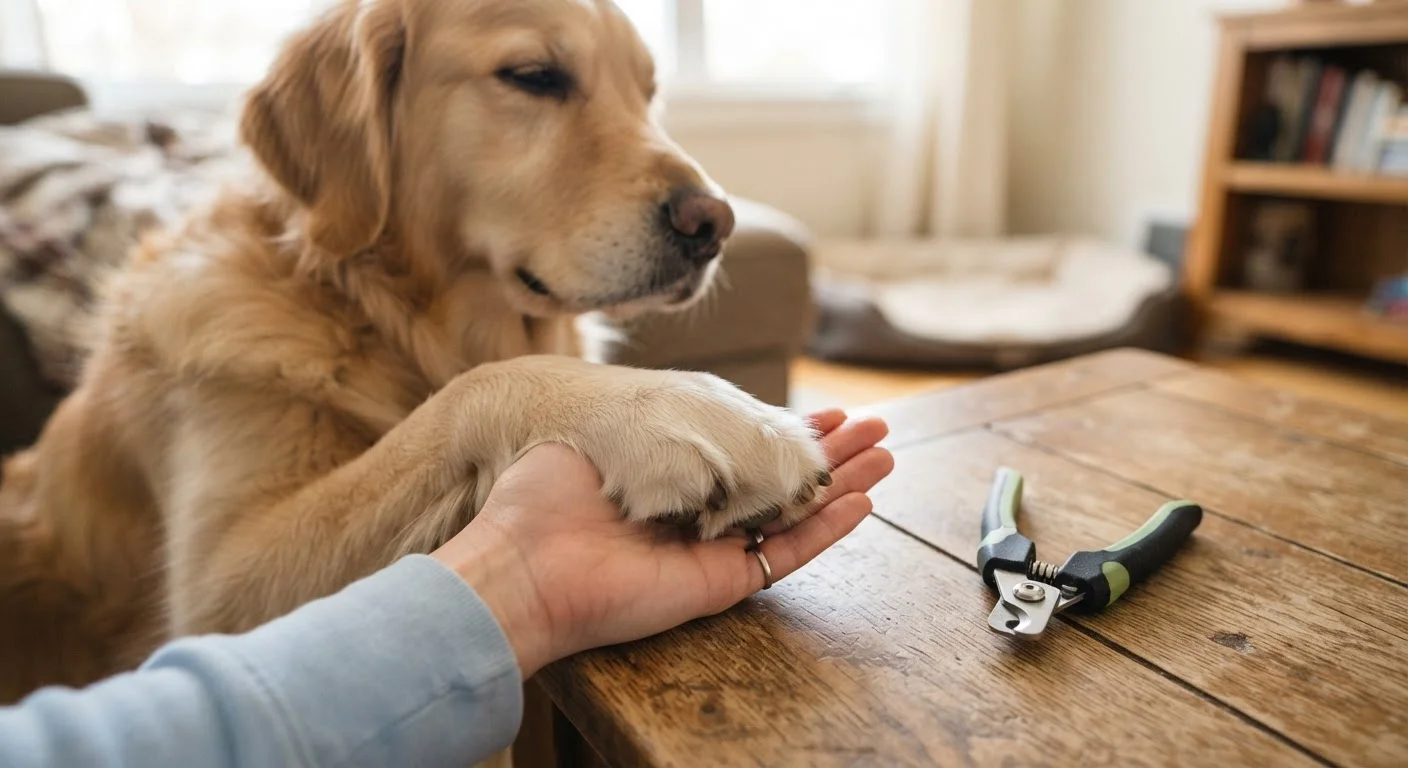
Hold one paw firmly but without squeezing, press the pad lightly to extend the nails, and reward the dog for allowing the touch. Repeat on each paw over one or more sessions until the dog tolerates paw handling without pulling back. This is the foundation of a cooperative trim.
Trim small amounts at a shallow angle
Position the clipper at roughly a 45-degree angle to the nail. Clip only the tip — about 1–2 mm at a time — especially on dark nails. Make a clean, single squeeze rather than rocking or twisting the clipper. After each nail, reward with a treat and brief praise. Work through all four paws, leaving the dew claws for last if present.
End on a positive note every time
Finish with a brief play session or a longer treat reward, regardless of how many nails you completed. The dog's emotional association with the entire event matters enormously. A session that ends positively — even if incomplete — does more for long-term cooperation than a stressful but fully finished trim.
This article is for general informational purposes and does not replace professional veterinary advice. If your dog shows signs of pain, anxiety that cannot be managed at home, or has a nail injury, consult your veterinarian.