

Key Takeaways
Why Small Spending Feels Invisible
Most people can recall their rent or mortgage payment without hesitation. Fewer can accurately estimate how much they spent on coffee, delivery fees, or app subscriptions last month. That gap isn't a personal failing — it's a predictable consequence of how small, frequent purchases are processed psychologically. Each transaction feels trivial in isolation, so it rarely triggers the same scrutiny as a large bill.
This is sometimes called the "latte factor" in popular financial discussion — the idea that habitual small purchases, compounded over time, carry real weight in a household budget. While no single purchase is the cause of financial stress, the cumulative pattern often is. Understanding how variable expenses behave is an essential first step in seeing the full picture.
The items below aren't framed as things you must eliminate. They're framed as expenses worth seeing clearly — so you can decide for yourself what's worth keeping.
Try a Two-Week Spending Log
Before making any changes, spend two weeks writing down every purchase — including the $2 ones. Use a notes app, a small notebook, or a simple spreadsheet. At the end of the period, total each category. Most people find at least one category where the real number is significantly higher than their mental estimate. That clarity is the foundation for any meaningful adjustment.
The Daily Purchases That Quietly Drain Budgets
Daily Coffee and Café Stops
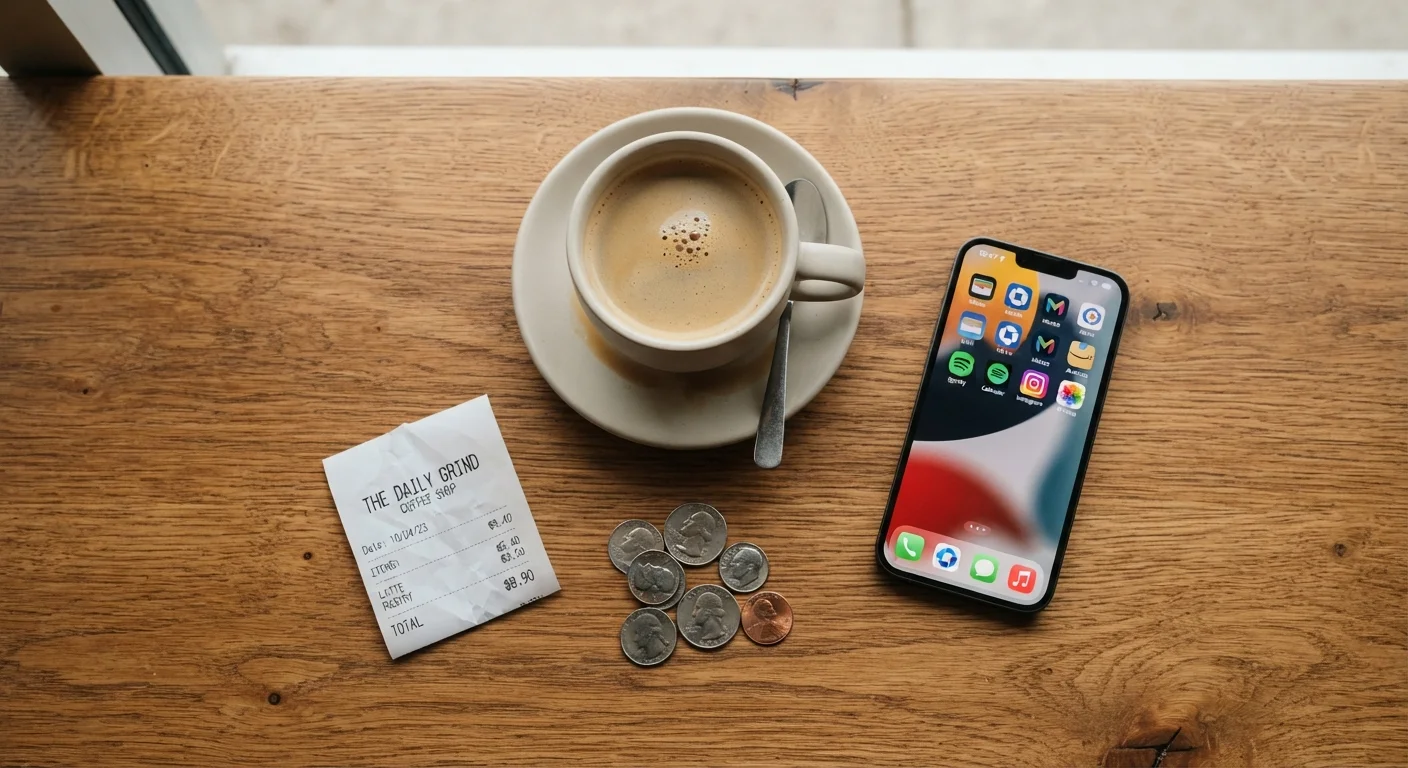
A single specialty coffee drink purchased five days a week at an average of $5–$6 per visit costs between $1,300 and $1,560 annually. Add occasional pastries or food items and the number climbs further. This doesn't mean café visits are a bad use of money — for many people, they serve a real social or productivity function. But the annual figure is worth knowing.
A practical middle ground: keep one or two café visits per week as a deliberate choice, and handle the rest at home. Even modest shifts in frequency produce noticeable annual savings without requiring full elimination of a habit you value.
Five café visits a week can cost over $1,500 a year — knowing the total changes the conversation.
Food Delivery Fees and Service Charges
Delivery apps have added multiple layers of cost beyond the menu price: delivery fees, service fees, small-order fees, and optional tips. A single order from a restaurant that would cost $15 in person can easily total $25–$30 with all charges included. Ordering twice a week at that difference adds up to over $1,000 in fees and markups across a year.
The convenience is real, and so is the cost. Picking up orders directly, cooking from a planned grocery list, or designating delivery as a once-a-week treat rather than a default can all reduce the annual figure significantly. For more on making grocery budgets work harder, see grocery shopping strategies that don't sacrifice nutrition.
Delivery fees and markups can add $1,000 or more annually for twice-weekly orders.
Unused or Forgotten Subscriptions
Streaming services, fitness apps, cloud storage tiers, news paywalls, and software tools each charge monthly — often between $5 and $20. Because billing is automatic and infrequent enough to feel invisible, many households carry subscriptions they no longer use. Industry survey data has consistently found that consumers underestimate their monthly subscription total by a meaningful margin.
A simple audit: review your bank or credit card statements for the past 60 days and flag every recurring charge. For each one, ask whether you used it in the past month. Canceling even two unused subscriptions at $12 each saves nearly $300 annually. A full subscription audit is worth doing at least once a year.
Most households carry subscriptions they've forgotten about — each one a quiet annual drain.
Convenience Store and Gas Station Purchases
Grabbing a bottle of water, a snack, or a drink at a convenience store while filling up or running errands is one of the most common forms of impulse spending. Individual transactions are small — $2 to $5 — but they happen frequently and without much deliberation. Three such stops per week at an average of $4 each totals over $600 in a year.
The underlying need is usually real: thirst, hunger, or a desire for a quick break. Meeting those needs in advance — carrying a reusable water bottle, keeping a snack in a bag — satisfies the same need at a fraction of the cost. It's a small logistical habit that compounds meaningfully over time.
Three convenience store stops a week at $4 each quietly adds up to over $600 a year.
ATM and Banking Convenience Fees
Using an out-of-network ATM typically triggers two fees: one from the ATM operator and one from your own bank. Combined, these often run $3 to $6 per transaction. Withdrawing cash twice a month from an out-of-network machine can cost $72 to $144 per year — not enormous, but entirely avoidable. Overdraft fees, when they occur, can run $25–$35 each, making even occasional overdrafts a significant annual line item.
Identifying your bank's in-network ATM locations, keeping a small buffer in your checking account, and setting up low-balance alerts through automated tools are straightforward ways to eliminate most of these fees. These are costs that provide no value — they're purely the price of inconvenience or inattention.
Out-of-network ATM fees are pure avoidable cost — they provide nothing in return.
Impulse Add-Ons at Checkout
Whether online or in person, checkout is engineered to prompt one more purchase — a warranty, an accessory, a suggested item, or a digital upgrade. These add-ons are often priced low enough to feel insignificant: $2 for faster shipping, $5 for an extended return window, $8 for a premium download. But they're triggered repeatedly across many purchases throughout the year.
A simple rule that helps: pause before approving any checkout add-on and ask whether you would have sought it out deliberately. Most of the time, the answer is no. Understanding the situations that reliably lead to overspending can help you build better defaults before you reach the checkout screen.
Checkout add-ons are designed to feel trivial — but they're triggered across dozens of purchases a year.
If you're looking for a broader view of how these habits fit your overall financial life, this complete guide to everyday money management covers the full landscape in practical terms.
Turning Awareness Into Action
Spotting these patterns is more useful than feeling guilty about them. A straightforward approach: track every purchase — however small — for two full weeks. Most people are genuinely surprised by the category totals. From there, the goal isn't to cut everything that isn't strictly necessary, but to make deliberate choices about what you're getting in return.
It also helps to understand the difference between needs and wants in your own spending context. Drawing those lines clearly is harder than it sounds and worth thinking through carefully. For purchases tied to subscriptions specifically, a regular audit — canceling services you haven't used in 60 days — is a low-effort, high-return habit. Subscription creep is one of the most common ways households overpay without noticing.
Finally, if you redirect any recovered spending toward savings, consider automating the transfer so it happens before you have a chance to spend it elsewhere. Automation can simplify this process, though it works best when set up carefully.
This article is for general informational and educational purposes only and does not constitute personalized financial advice. For guidance tailored to your individual circumstances, consider consulting a qualified financial professional.