

Key Takeaways
Option A
Fixed Expenses
The predictable anchor of your monthly budget.
Best for: Building a reliable spending baseline you can plan around every month.
Option B
Variable Expenses
The flexible costs that shift with your habits and circumstances.
Best for: Finding the adjustment room you need to save more or respond to unexpected changes.
If you want to establish a spending baseline and understand your financial floor
Fixed Expenses
Knowing your fixed costs tells you exactly how much income must come in each month before anything else. This is your non-negotiable starting point.
If you're looking for room to cut spending or redirect money toward savings
Variable Expenses
Variable costs are where most people find meaningful flexibility. Small consistent changes to variable spending can have a noticeable impact over time.
If you earn an irregular income and need to plan around uncertainty
Variable Expenses
On lean months, trimming variable costs is usually easier and faster than renegotiating fixed obligations like rent or insurance premiums.
What Makes an Expense Fixed or Variable
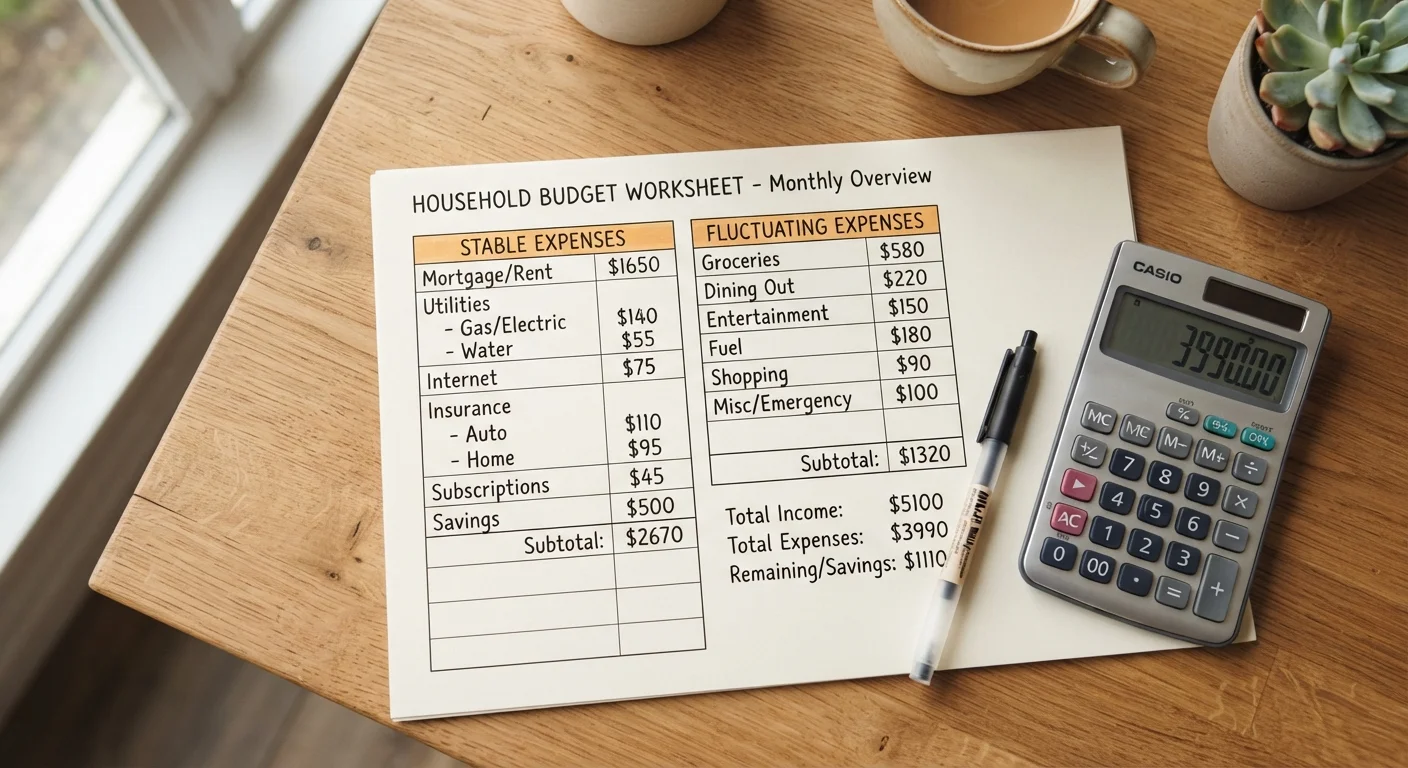
At its core, the distinction is about predictability. A fixed expense is one that costs the same amount every billing cycle - rent or mortgage payments, car loan installments, and monthly insurance premiums are classic examples. You know what's coming, and your budget can reflect that with confidence.
A variable expense, by contrast, changes from month to month depending on usage, behavior, or circumstance. Groceries, utilities, gas, dining out, clothing, and entertainment are all common examples. You might spend $180 on groceries in March and $240 in April - neither amount is wrong, but the difference matters for planning.
Some expenses look fixed but aren't - a gym membership with an annual price increase, or a subscription that adds tiers over time. These are worth auditing periodically so they don't drift unnoticed. Similarly, some variable expenses carry a roughly predictable floor: most households know their electric bill won't drop to zero, even in mild weather.
Understanding what qualifies as a need versus a want is closely related - fixed expenses tend to cover needs, while variable expenses span both needs and wants.
How Each Type Shapes Your Budget
Fixed expenses define your financial floor - the minimum income required to keep your household running before any discretionary spending. If your fixed obligations total $2,400 per month, that's the threshold you must meet. Budgeting below that isn't a strategy; it's a shortfall.
Variable expenses, on the other hand, are where a budget gets its flexibility - and its vulnerability. This is where strict category limits can build strong habits but also where lifestyle inflation tends to quietly take hold. A streaming subscription here, an upgraded grocery haul there - none of it feels significant in the moment, but the cumulative effect shows up fast.
| Criterion | Fixed Expenses | Variable Expenses |
|---|---|---|
| Monthly amount | Same every month | Changes each cycle |
| Examples | Rent, loan payments, insurance | Groceries, utilities, dining out |
| Budget predictability | High - easy to plan around | Lower - requires estimates |
| Flexibility to reduce | Low - usually contractual | High - adjustable by behavior |
| Risk of lifestyle inflation | Lower - changes require action | Higher - drift happens gradually |
| Best budget role | Sets your financial floor | Provides room for adjustment |
For people with steady paychecks, the typical approach is to lock in fixed expenses, estimate variable spending by category using past bank statements, and build a buffer for the unexpected. For those navigating income that changes month to month, the strategy shifts. Budgeting on an irregular income requires leaning harder on the variable side - identifying which costs can be dialed down in a lean month without derailing essential obligations.
Practical Steps for Managing Both in One Budget
Start by listing every fixed expense with its exact monthly amount. These go into your budget as firm line items. Then gather two to three months of bank and credit card statements to calculate average spending in each variable category. Use those averages - not your ideal - as your baseline estimates.
From there, mark each variable category as either essential (groceries, utilities, medication) or discretionary (dining out, hobbies, entertainment). Essential variable costs should be budgeted conservatively with a small buffer. Discretionary variable costs are your primary levers when you need to free up cash.
One practical tool worth building alongside this framework: a sinking fund for irregular but predictable expenses - car registration, annual subscriptions, holiday spending. Rather than treating these as budget surprises, sinking funds spread the cost evenly across the year, effectively converting a lumpy variable expense into a stable monthly savings habit.
Review your budget monthly. Variable expenses shift with seasons, life events, and habits - what worked in the summer may need recalibrating in December. A budget that gets revisited regularly is far more useful than a perfect one that's never looked at again. For broader money management guidance, the Everyday Money Tips hub covers practical habits to complement the budgeting work you're doing here.
This article is for general informational and educational purposes only and does not constitute personalized financial advice. For guidance specific to your situation, consider consulting a licensed financial professional.