

Key Takeaways
Our Verdict
High-deductible plans make the most financial sense for people who stay relatively healthy, can absorb a large unexpected bill, and want to build tax-advantaged savings through an HSA. Low-deductible plans tend to serve people better when they have predictable, recurring health needs or limited cash reserves to cover a large deductible. Neither choice is a mistake if it matches how you actually use - and pay for - care.
| Best for | Recommended |
|---|---|
| Generally healthy people with an emergency fund | High-Deductible Plan |
| Those with chronic conditions or frequent care needs | Low-Deductible Plan |
| People who want to build tax-advantaged medical savings | High-Deductible Plan (HDHP with HSA) |
| Those with limited savings who couldn't cover a large surprise bill | Low-Deductible Plan |
What These Two Terms Actually Mean
A deductible is the amount you pay out of your own pocket for covered medical services before your insurer starts sharing costs. If your deductible is $1,500, you pay the first $1,500 of covered bills each year - then cost-sharing (like copays or coinsurance) typically kicks in.
A high-deductible plan pairs a lower monthly premium with a higher deductible. A low-deductible plan does the opposite: higher monthly premium, lower threshold before insurance coverage begins. The IRS sets minimum thresholds that define a High-Deductible Health Plan (HDHP) for HSA-eligibility purposes, but the label "high" or "low" is relative across the broader market.
Understanding how these numbers connect is foundational. See how deductibles, premiums, and coverage limits relate to each other before comparing specific plans.
The Core Trade-Off: Premium Now vs. Bills Later
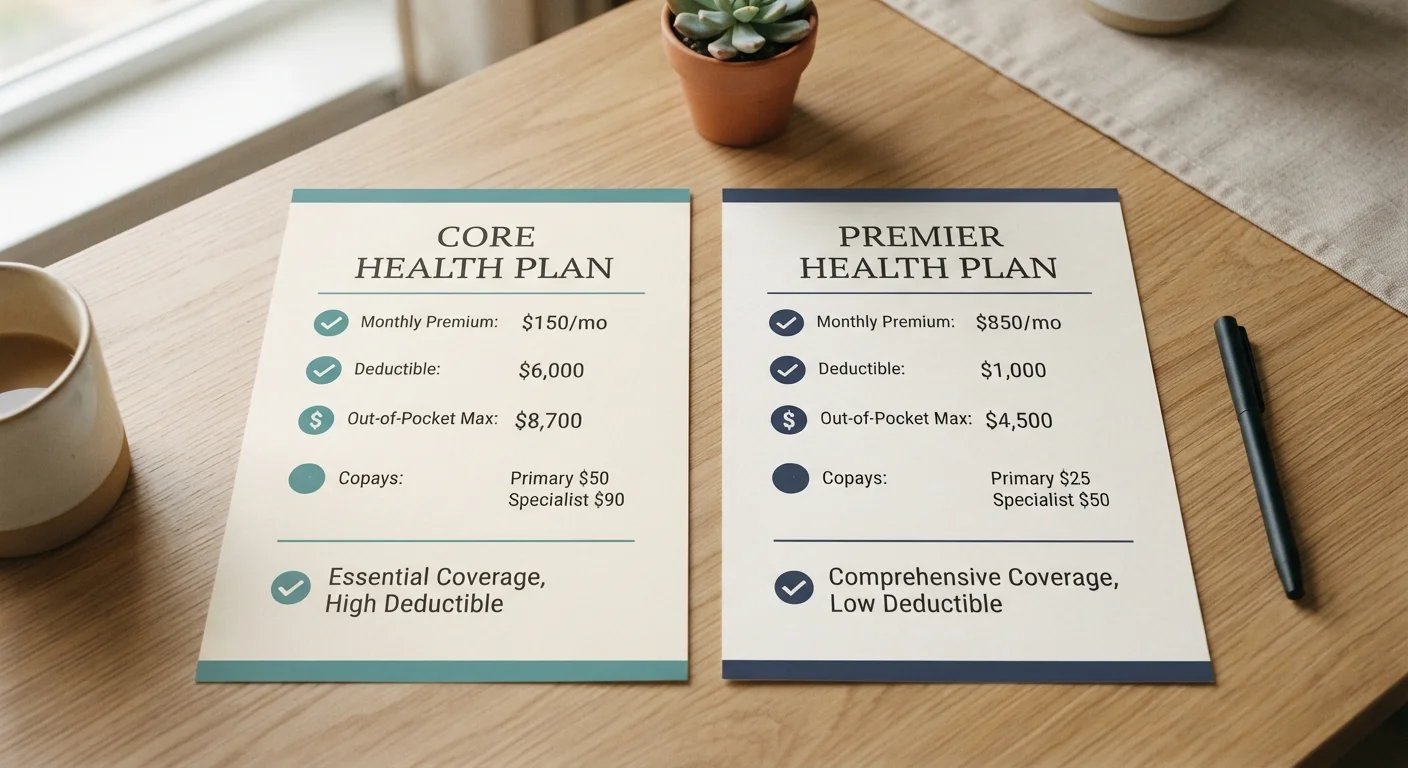
Every deductible decision is really a bet on how much care you'll use in a given year. If you stay healthy and use little care, a high-deductible plan often wins - you pay less per month and never hit your deductible. If you need surgery, manage a chronic condition, or have a surprise hospitalization, a low-deductible plan can mean significantly lower total costs despite the higher premium.
The math only works if you run both scenarios honestly. Add up 12 months of premiums for each plan, then estimate what you'd pay under each deductible given your likely care use. That total - not just the monthly number - is what you're actually comparing.
| High-Deductible Plan | Low-Deductible Plan | |
|---|---|---|
| Monthly Premium | Lower | Higher |
| Deductible Amount | Higher (often $1,600+) | Lower (often under $1,000) |
| Insurance Kicks In | After higher upfront cost | Sooner, after less out-of-pocket |
| HSA Eligibility | Yes, if plan qualifies as HDHP | No |
| Best When You Use Little Care | Strong advantage | Overpay on premiums |
| Best When You Use Frequent Care | Can get expensive quickly | More predictable total costs |
| Financial Risk if Hospitalized | Higher initial exposure | Lower initial exposure |
| Savings Buffer Needed | Ideally, enough to cover deductible | Less critical |
For a deeper look at where people go wrong with this calculation, see why getting the premium-deductible balance wrong costs you.
The HSA Factor: A Benefit Unique to High-Deductible Plans
One significant advantage of qualifying HDHPs is eligibility for a Health Savings Account (HSA). An HSA lets you set aside pre-tax dollars specifically for medical expenses. The money rolls over year to year - it doesn't expire - and can be invested. When used for qualified medical costs, withdrawals are also tax-free.
This triple tax benefit (pre-tax contributions, tax-free growth, tax-free withdrawals for qualified expenses) makes an HDHP-plus-HSA combination genuinely attractive for people who can afford to fund the account and absorb a higher deductible in a bad year. Think of the HSA as a way to self-insure the deductible gap over time.
Low-deductible plans do not qualify for HSAs, though some may come with a Flexible Spending Account (FSA) option, which works differently and has a use-it-or-lose-it annual limit.
Matching the Plan to How You Actually Use Care
Honest self-assessment matters more than any general rule. Ask yourself:
- How often do you see a doctor or specialist? One annual physical is very different from monthly specialist visits.
- Do you take regular prescription medications? Drug costs count toward your deductible on many plans, which changes the break-even point.
- Could you cover your full deductible today without financial hardship? A $4,000 deductible is only manageable if you have $4,000 available.
- Are you planning any procedures or expecting a significant health event? Pregnancy, elective surgery, or a known diagnosis shifts the calculus toward lower deductibles.
Also factor in your out-of-pocket maximum - the cap on what you'll pay in a year. Understanding how the out-of-pocket maximum and deductible work together helps you see your true worst-case exposure under each plan.
For a structured way to work through these questions, see questions to ask before choosing a coverage level.
This article is for general informational purposes only and does not constitute personalized insurance, financial, or medical advice. Coverage terms, costs, and eligibility vary by insurer, plan, and state. Read your actual policy documents and consult a licensed insurance agent or adviser before making coverage decisions.