

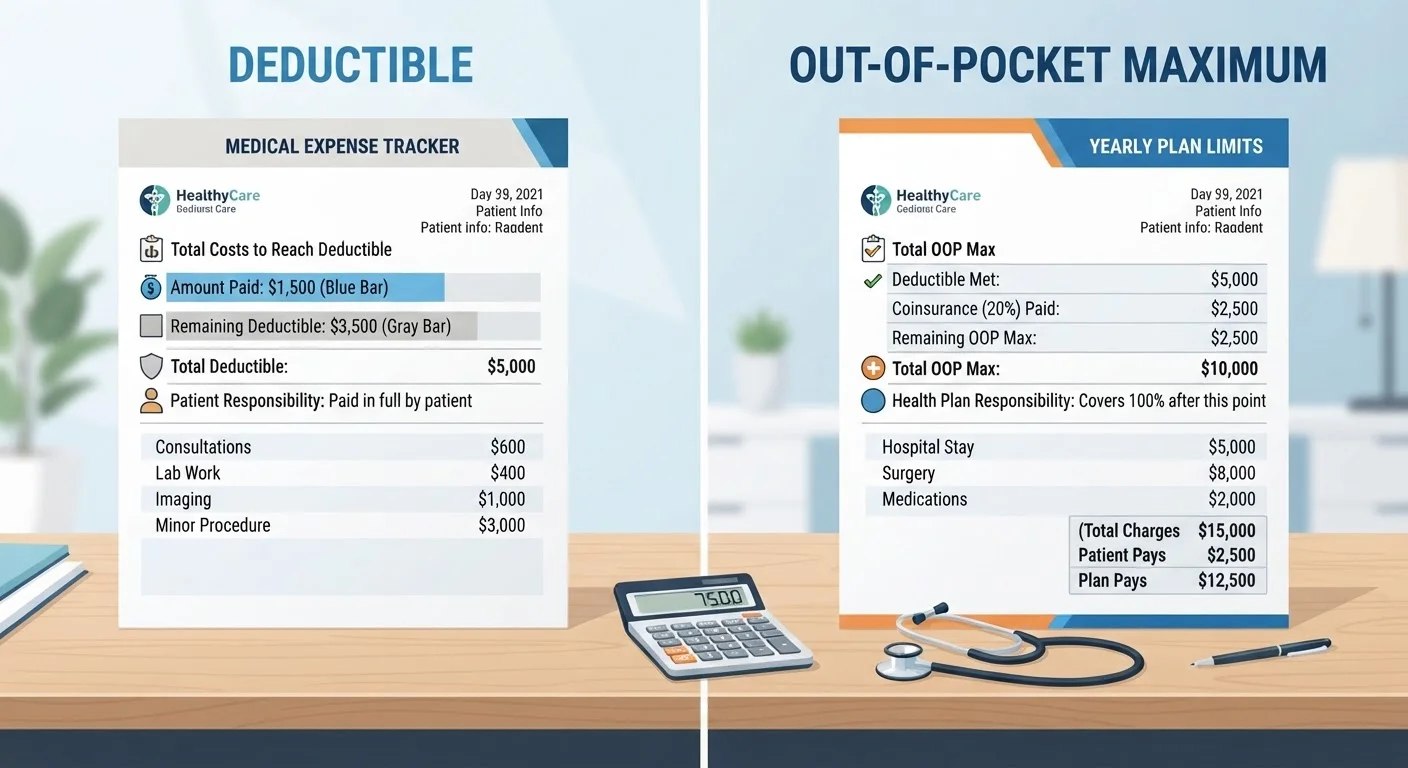
Key Takeaways
Option A
Deductible
The upfront threshold you clear before insurance starts sharing costs.
Best for: Understanding how much you pay entirely on your own before your insurer begins contributing to covered services.
Option B
Out-of-Pocket Maximum
The annual ceiling that caps your total cost exposure.
Best for: Knowing exactly when your insurer takes over 100% of covered costs, protecting you from catastrophic medical bills.
If you rarely use medical care and want to estimate your likely annual spending
Deductible
In low-use years, most people never reach their out-of-pocket maximum, so the deductible is the more relevant number for budgeting routine costs.
If you're facing a major surgery, chronic illness, or unpredictable health year
Out-of-Pocket Maximum
The out-of-pocket maximum defines your worst-case scenario. Knowing it tells you the absolute most you'll pay, which is critical for financial planning when costs run high.
If you're comparing two health plans side by side
Out-of-Pocket Maximum
Plans with similar deductibles can have very different out-of-pocket maximums, meaning dramatically different financial risk in a bad health year.
If you want to know when your insurer starts paying its share
Deductible
The deductible is the trigger point. Until you meet it, you generally pay full cost for most covered services.
How Each Number Actually Works
Your health plan comes with a stack of numbers - premiums, copays, coinsurance, deductibles, out-of-pocket maximums. Two of the most confused are the deductible and the out-of-pocket maximum. They sound similar, but they serve completely different functions.
The deductible is the amount you pay for covered medical services before your insurance company begins sharing the cost. If your deductible is $1,500, you pay the first $1,500 of covered expenses yourself. After that, cost-sharing kicks in - typically in the form of coinsurance (a percentage split) or copays (flat fees per visit). Your insurer starts contributing, but you're still on the hook for a portion.
The out-of-pocket maximum (sometimes called the out-of-pocket limit) is exactly what it sounds like: the most money you will pay for covered services in a single plan year. Once you hit that ceiling - through any combination of your deductible, coinsurance, and copays - your insurer pays 100% of covered in-network costs for the remainder of the year. Think of it as a financial stop-loss built into your policy.
For deeper context on how these numbers interact with your premium, see how deductibles, premiums, and coverage limits relate to each other.
What Counts Toward Each - and What Doesn't
Here's where many people get tripped up. These two figures are related but not the same pool of money.
| Criterion | Deductible | Out-of-Pocket Maximum |
|---|---|---|
| What it represents | Amount you pay before cost-sharing begins | Total cap on your annual spending |
| When it applies | At the start of your plan year | After deductible + coinsurance + copays accumulate |
| What happens after you meet it | Insurer begins sharing costs (coinsurance/copays) | Insurer pays 100% of covered in-network costs |
| Does the premium count toward it? | No | No |
| Does it include the deductible? | N/A - it is the starting point | Yes - deductible spending counts toward the max |
| Typical range (individual, ACA plans) | $500-$8,000+ | $2,000-$9,450 (federal limit for ACA plans) |
A few important clarifications:
- Your premium never counts toward either number. The monthly amount you pay to maintain coverage is separate from what you spend when you actually use care.
- Out-of-network costs may not count. Most plans only apply in-network spending toward your deductible and out-of-pocket maximum. Out-of-network care often has its own, higher deductible and out-of-pocket limit - or may not be covered at all.
- Copays vary by plan design. Some plans count copays toward the out-of-pocket maximum; others don't. Read your Summary of Benefits and Coverage (SBC) carefully.
- Family plans have two layers. Family policies typically have individual deductibles and out-of-pocket maximums nested within higher family-level limits. One family member can hit their individual limit before the family limit is reached.
To understand how copays and coinsurance feed into these totals, see how each cost-sharing structure works in practice.
A Real-World Scenario
Say you have a plan with a $1,500 deductible, 20% coinsurance after the deductible, and a $5,000 out-of-pocket maximum. You have an unexpected hospitalization that generates $20,000 in covered in-network bills.
- You pay the first $1,500 (your deductible). Running total: $1,500.
- After that, you pay 20% coinsurance. The remaining $18,500 in bills triggers $3,700 in coinsurance (20% of $18,500). But your out-of-pocket maximum is $5,000, and you've already paid $1,500 - so you only owe $3,500 more before hitting the ceiling.
- Once your total spending reaches $5,000, your insurer covers the rest of that bill and any subsequent covered costs at 100% for the rest of the plan year.
Without an out-of-pocket maximum, that same hospitalization could have cost you $3,700 in coinsurance alone - and any further health events that year would keep adding up. The maximum is the number that protects you when things go seriously wrong.
If you're wondering why your total costs still feel high even with insurance, this breakdown of how deductibles, copays, and out-of-pocket maximums add up.
This article provides general educational information about health insurance concepts. It is not personalized insurance, financial, or medical advice. Coverage terms, costs, and rules vary by plan and insurer. Always review your actual policy documents and consult a licensed insurance professional for guidance specific to your situation.