

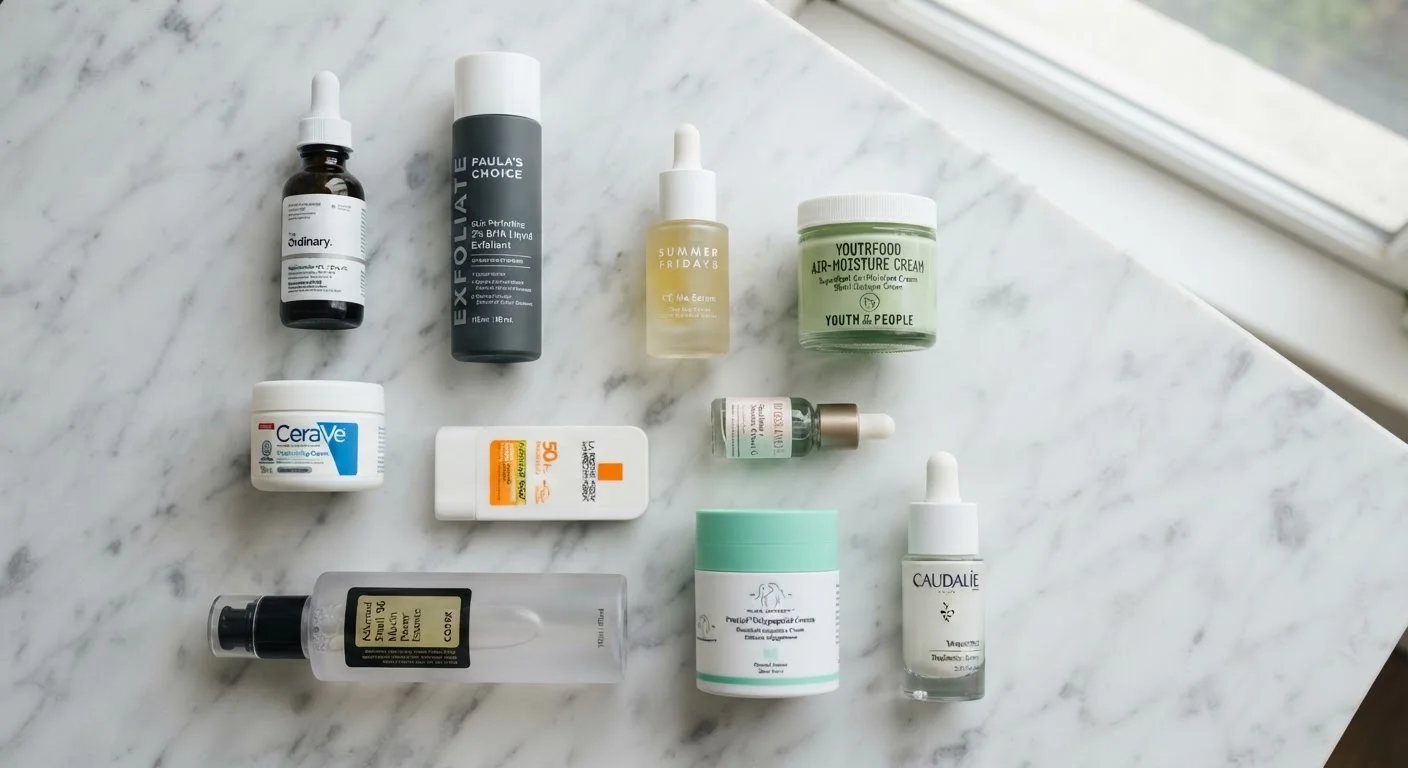
| Skin surface pH range | 4.5 – 5.5 (mildly acidic) (Widely cited in dermatology literature) |
| Stratum corneum thickness | Approximately 10–20 micrometers (General dermatological reference) |
| Common humectants | Glycerin, hyaluronic acid, urea |
| Retinoid types (strength order) | Retinyl esters → Retinol → Retinal → Tretinoin (Standard dermatological classification) |
Why Skincare Vocabulary Matters
Walk down any beauty aisle or scroll through a skincare retailer and you'll encounter terms like occlusive, humectant, comedogenic, and transepidermal water loss — language that sounds clinical but is rarely explained. Misreading these terms can lead to products that irritate, clog pores, or simply don't do what you need them to do.
This glossary draws on dermatological science to define the terms most commonly found on labels and in ingredient discussions. Whether you're building your first routine or auditing what's already on your shelf, these definitions give you a grounded starting point. For a broader framework, see our first-timer's complete skincare guide.
Ceramides
Lipid molecules naturally found in the skin's outer layer that help hold skin cells together and retain moisture. Ceramide-containing products are commonly used to reinforce a weakened skin barrier.
Humectant
An ingredient that draws moisture from the environment — or from deeper skin layers — into the outermost skin layer. Common humectants include hyaluronic acid, glycerin, and urea.
Emollient
An ingredient that softens and smooths the skin by filling gaps between skin cells. Emollients improve texture and flexibility; examples include squalane, shea butter, and fatty acids.
Occlusive
An ingredient that forms a physical seal on the skin surface to slow moisture evaporation. Petrolatum and dimethicone are classic occlusives often used as the final step in a layered routine.
Comedogenic
Describes an ingredient with a tendency to clog pores and potentially trigger breakouts. 'Non-comedogenic' on a label signals the formula was designed to avoid this effect, though individual responses vary.
Transepidermal Water Loss (TEWL)
The passive evaporation of water through the skin to the surrounding atmosphere. High TEWL is a sign of a compromised skin barrier; moisturizers — particularly occlusives — work to reduce it.
Exfoliant
An agent that removes dead skin cells from the surface. Chemical exfoliants (AHAs, BHAs) dissolve the bonds holding dead cells in place; physical exfoliants use abrasion. Both require careful use to avoid over-exfoliation.
Retinoid
A class of vitamin A derivatives — including retinol, retinal, and prescription tretinoin — used to support cell turnover and collagen production. They range in strength and can cause irritation, especially when first introduced.
Broad Spectrum
A sunscreen claim indicating the product protects against both UVA rays (linked to aging and deep tissue damage) and UVB rays (linked to sunburn). Our sunscreen label guide covers this and other SPF terms in full.
Active Ingredient
A component that performs a specific, clinically recognized function — such as a sunscreen filter, an exfoliating acid, or an anti-acne agent. Actives are regulated differently from cosmetic ingredients in the U.S.
pH (Potential of Hydrogen)
A scale from 0 to 14 measuring acidity or alkalinity. Skin's natural surface pH is mildly acidic (roughly 4.5–5.5), and many effective skincare actives must be formulated within a specific pH range to work properly.
Skin Barrier
The outermost layer of skin (stratum corneum) that regulates moisture and blocks external irritants. A healthy, intact barrier is the foundation of most skincare goals; harsh cleansers or over-exfoliation can compromise it.
Key Concepts That Shape Every Routine
Beyond individual ingredients, a few foundational concepts show up repeatedly across product categories and routine advice. Understanding them helps you evaluate claims rather than simply trust them.
The Skin Barrier
The outermost layer of skin — the stratum corneum — acts as a physical and chemical barrier against environmental stressors, bacteria, and moisture loss. When this barrier is compromised, skin becomes more reactive, dehydrated, and prone to sensitivity. Many modern skincare formulations are specifically designed to support or restore barrier function rather than strip it.
pH and Skin Compatibility
Healthy skin maintains a slightly acidic pH of roughly 4.5 to 5.5. Products that are significantly more alkaline — including some traditional bar soaps — can temporarily disrupt this balance, reducing the skin's ability to defend itself. Checking whether an active ingredient (like a chemical exfoliant) is formulated at an effective pH matters more than many shoppers realize. Our label-reading guide covers how to spot this information on packaging.
Skin Type vs. Skin Condition
These terms are frequently conflated. Skin type refers to your skin's baseline behavior — oily, dry, combination, or normal — largely determined by genetics and sebum production. A skin condition, such as dehydration, acne, or rosacea, can occur in any skin type and may change over time or with environment. Correctly identifying which you're addressing helps narrow product choices considerably. See our article on identifying your skin type accurately for a structured walkthrough.
For a closer look at specific ingredients referenced throughout this glossary, the grooming ingredients reference offers plain-language explanations of what actives do and for whom.
This article is for general informational and educational purposes only. It does not constitute medical or dermatological advice. If you have a skin condition, persistent irritation, or concerns about a specific ingredient, consult a licensed dermatologist or qualified healthcare professional.