

| Governing standard (U.S.) | ASTM D5489 / FTC Care Labeling Rule |
| Number of symbol categories | 5 (wash, bleach, dry, iron, dry clean) |
| Temperature unit in symbols | Celsius (°C) (Standard on U.S. labels per ASTM D5489) |
| X through any symbol | Do not perform that care action |
| Dots on iron/dryer symbols | 1 = low heat, 2 = medium, 3 = high |
Why Care Labels Exist and What They're Based On
The Federal Trade Commission (FTC) requires that most garments sold in the United States include a permanent care label with instructions for cleaning, drying, ironing, and — where relevant — bleaching. These labels appear as a combination of text and standardized symbols drawn from the ASTM D5489 care labeling standard, which aligns closely with the international ISO system used worldwide.
The manufacturer is responsible for testing the garment and providing instructions that won't damage it under normal use. That means when a label says dry clean only, it reflects how that specific construction and fabric combination responds to water and agitation — not a generic suggestion. Following care instructions correctly extends garment life significantly and reduces the chance of shrinkage, color loss, or structural damage.
ASTM D5489
The U.S. standard for care labeling symbols on textile products, published by ASTM International. It defines the symbols used on American garment tags and closely mirrors the international ISO 3758 standard.
Tumble dry
A drying method using a mechanical clothes dryer with rotating heat. The number of dots on the dryer symbol indicates the appropriate heat level — one dot for low, two for medium, three for high.
Non-chlorine bleach
An oxygen-based or color-safe bleach that does not contain sodium hypochlorite (chlorine). It is gentler on dyes and fibers and is the only bleach type permitted when the triangle symbol shows diagonal lines.
Dry cleaning
A professional cleaning process that uses chemical solvents rather than water to clean fabric. It is used for garments that would shrink, distort, or lose structure if washed with water.
Flat dry
A drying method in which a garment is laid horizontally on a clean surface to dry. Used for items — typically knits and wool — that would stretch or lose shape if hung while wet.
Permanent care label
A label sewn or printed into a garment that the FTC requires to remain legible for the life of the item. It must include all instructions needed to safely clean the garment.
The Five Core Symbol Categories
Every care symbol on a U.S. garment label belongs to one of five categories. Each category uses a distinct base shape, making it possible to identify the instruction type at a glance before reading the detail.
| Governing standard (U.S.) | ASTM D5489 / FTC Care Labeling Rule |
| Number of symbol categories | 5 (wash, bleach, dry, iron, dry clean) |
| Temperature unit in symbols | Celsius (°C) (Standard on U.S. labels per ASTM D5489) |
| X through any symbol | Do not perform that care action |
| Dots on iron/dryer symbols | 1 = low heat, 2 = medium, 3 = high |
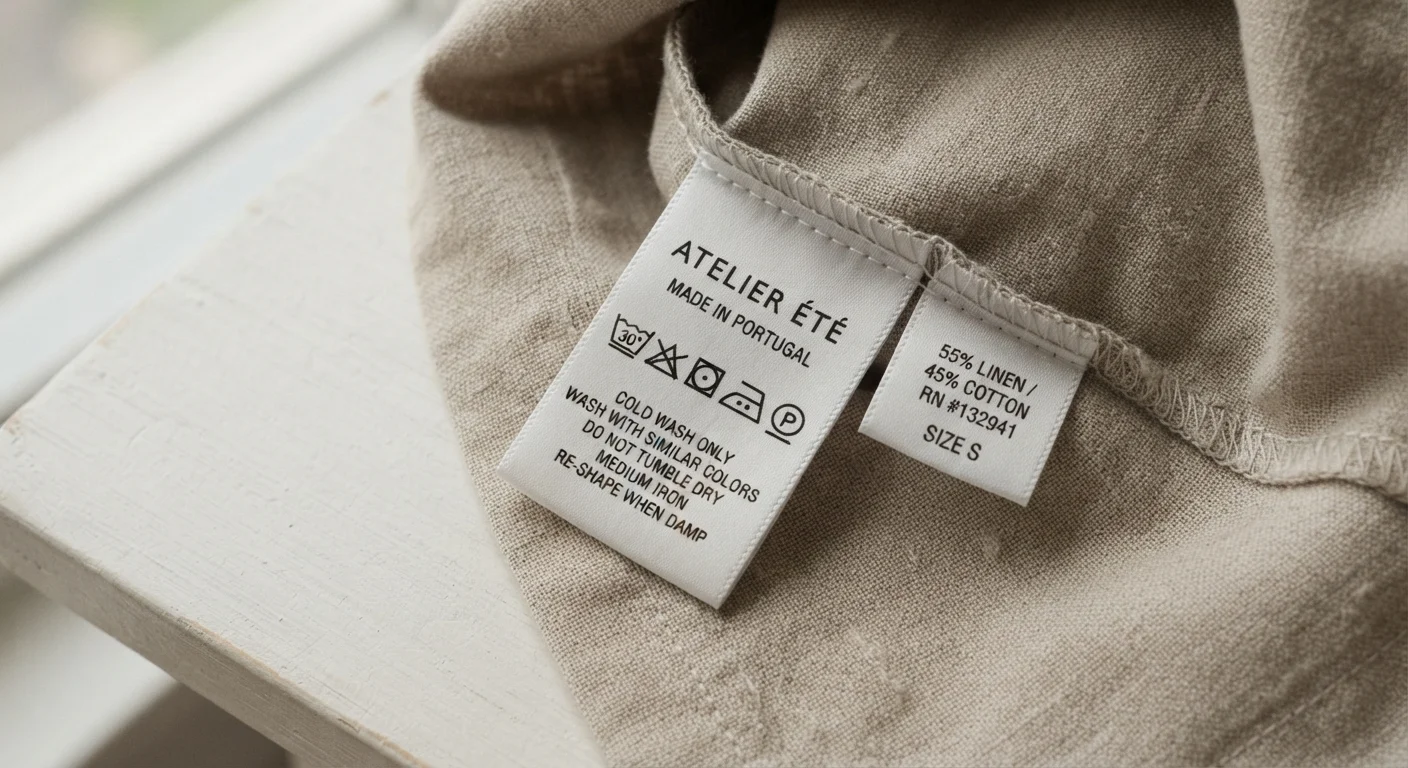
- Washtub (basin with water): Indicates machine or hand washing. The number inside the tub (e.g., 30, 40, 60) is the maximum water temperature in Celsius. A hand dipping into the tub means hand wash only. An X through the symbol means do not wash.
- Triangle: Relates to bleaching. An empty triangle means any bleach is safe. A triangle with diagonal lines means non-chlorine bleach only. An X through the triangle means do not bleach.
- Square (with inner shapes): Covers drying. A circle inside the square means tumble dry. Dots inside that circle indicate heat level: one dot for low, two for medium, three for high. A square with vertical lines means hang dry; horizontal lines mean flat dry.
- Iron shape: Governs ironing and pressing. Dots indicate temperature: one dot for low (synthetics), two for medium (wool/polyester blends), three for high (cotton/linen). An X through the iron means do not iron.
- Circle: Signals professional dry cleaning. Letters inside — A, F, P, W — specify which solvents are safe to use, relevant primarily to your dry cleaner. An X through the circle means do not dry clean.
Common Symbols That Cause Confusion
A few symbols consistently trip people up, particularly on delicate or structured garments.
The Dotless Iron
An iron symbol with no dots and no X is still valid — it means ironing is permitted at any temperature at the user's discretion. When in doubt with an unfamiliar fabric, start with the lowest setting.
"Dry Clean Only" vs. "Dry Clean"
A circle alone (without an X) technically recommends professional cleaning but doesn't prohibit careful hand washing for some fabrics. However, structured items like tailored jackets rely on dry cleaning for shape retention, not just fiber safety. Unless you're confident about the fabric, treat the circle as a firm instruction.
The Flat Dry Symbol
A square with one horizontal line across the middle means the garment should be dried flat — usually wool knits or items that stretch when hung wet. This isn't the same as hang drying and the distinction matters for fit.
If you enjoy decoding product labels in other categories, see how the same kind of careful reading applies to skincare label ingredients.
Putting It Into Practice
Before sorting laundry, do a quick check of the care labels in the load — mismatched temperatures or a single dry-clean item mixed into a hot wash can cause irreversible damage. A few practical habits help:
- Check the label when you buy, not when you wash. Knowing upfront that something is hand-wash only helps you decide if it fits your routine.
- When multiple care symbols appear, follow the most restrictive one. If the wash symbol says 30°C and the dry symbol says tumble dry low, both limits apply.
- Faded or cut labels are a common problem with older or secondhand garments. For unknown fabrics, treat them as delicate: cold water, gentle cycle, air dry.
- If a garment is labeled for professional cleaning but you want to attempt home care, test with a small, hidden area first — and understand that results aren't guaranteed.
Understanding how your wardrobe works is part of dressing well in practical terms. Once you're confident in garment upkeep, it's worth exploring how clothing fits into broader style decisions — decoding dress codes is a natural next step.
For a similar label-reading challenge in a different context, the approach used on bedding labels shares useful overlap with garment care literacy.