

Key Takeaways
Leash Pulling
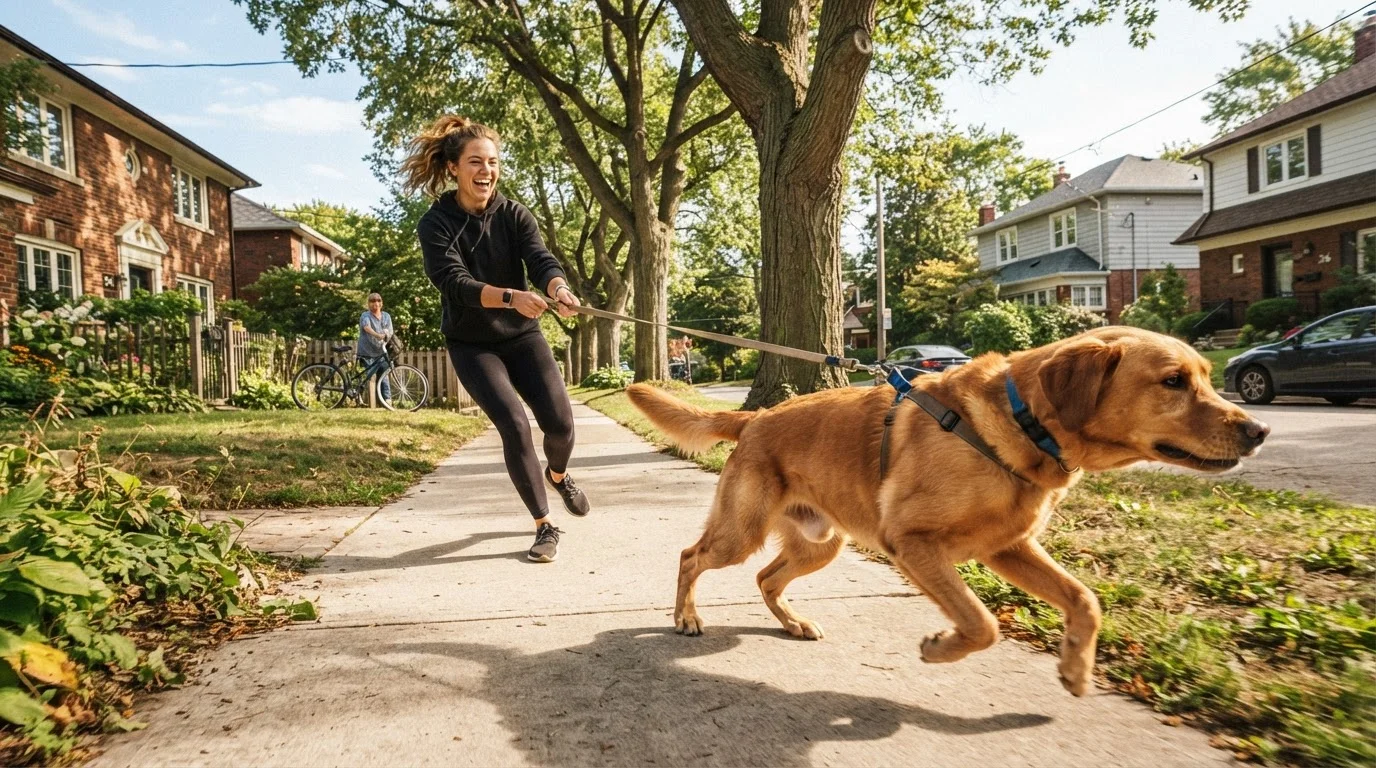
Leash pulling is when a dog consistently moves ahead of its handler and strains against the leash during a walk. It is a natural, instinct-driven behavior — not deliberate defiance or dominance. Dogs pull because their sensory world, movement speed, and motivational drives differ fundamentally from ours. Understanding the behavior's root cause is essential for addressing it effectively.
The behavior is often reinforced by the simple forward movement a dog gains each time it pulls — a mechanism known in behavioral science as positive reinforcement through environmental access.
The Instinct Behind the Pull
When your dog hits the end of the leash and lunges forward, it can feel like a power struggle. But from a behavioral standpoint, there is no contest happening — your dog is simply following a deeply wired drive to explore.
Dogs experience the world primarily through scent. A dog's nose contains roughly 300 million olfactory receptors compared to about 6 million in humans, and the part of their brain dedicated to analyzing smells is proportionally far larger than ours. Every patch of grass, fire hydrant, and passing stranger broadcasts an avalanche of information — identity, health status, recent activity — that your dog is urgently motivated to investigate.
Walking on a leash at human pace while that sensory flood is happening is genuinely difficult for a dog. The pull is not defiance; it is the gap between your speed and their curiosity.
Let Your Dog Sniff — Strategically
Allowing structured sniff breaks during a walk can reduce overall pulling by giving your dog an outlet for their primary motivation. Designating specific moments where the dog is cued to sniff freely — rather than being dragged forward constantly — makes the rest of the walk easier to manage and more mentally satisfying for the dog.
How the Brain Reinforces Pulling
Beyond instinct, there is a powerful learning mechanism at work. Each time a dog pulls and the owner follows — even slightly — the dog receives a direct reward: forward movement toward something interesting. This is positive reinforcement in its most automatic form.
Behavioral science describes this as the dog being reinforced by environmental access. The leash is not punishing the pull; it is temporarily delaying a reward that the dog consistently wins. Over hundreds of walks, this pattern becomes deeply embedded.
This is also why punishment-based corrections often fail to solve pulling long-term. Jerking the leash or using aversive collars may suppress the behavior momentarily, but they do not teach the dog what to do instead — and they can introduce stress or fear that creates new behavioral problems. For a deeper look at why training philosophy matters, see our overview of positive reinforcement vs. correction-based training.
What 'Loose-Leash Walking' Actually Requires
Loose-leash walking is not a natural dog behavior. It is a trained skill that asks the dog to move at a pace and in a direction that the environment is actively competing against. Understanding this reframes the challenge: you are not correcting bad behavior, you are teaching a genuinely difficult new one.
Effective loose-leash training works by making walking beside you more rewarding than reaching the end of the leash. This typically involves:
- Stopping forward movement the instant the leash tightens — removing the reward (forward progress) for pulling
- Rewarding the dog the moment it returns to a loose leash — marking and treating position, not just compliance
- Building duration gradually — starting in low-distraction environments before moving to busier settings
- Keeping sessions short and positive — cognitive fatigue affects training quality quickly
Consistency matters more than intensity. A dog that gets loose-leash practice on every walk, even briefly, progresses faster than one that has occasional long training sessions. Be aware that common training habits can quietly undermine your dog's progress — inconsistent cues and delayed rewards are frequent culprits.
Breed, Age, and Individual Differences
Not all dogs pull with the same intensity, and individual variation matters. Dogs bred for jobs that require sustained forward drive — sled dogs, terriers, hounds — may pull more persistently because those traits were selectively amplified. This does not make training impossible; it means expectations and timelines may need adjustment.
Age plays a role as well. Puppies that never learn to walk politely on leash develop reinforcement histories that make the habit harder to undo in adulthood. Young dogs are also more easily aroused by novel stimuli, which is why impulsive behaviors in young dogs often appear in clusters — pulling, jumping, and mouthing frequently share the same underlying excitability.
If a dog's pulling is accompanied by lunging, snapping, or extreme reactivity toward other dogs or people, that warrants closer evaluation. Our article on aggression types and triggers outlines when professional guidance is appropriate.
This article is for general informational purposes only and is not a substitute for personalized guidance from a certified professional dog trainer or veterinary behaviorist.