

Key Takeaways
Puppy Problem Behaviors
Counter surfing, jumping up on people, and mouthing (playful biting) are among the most common behaviors owners report in young dogs. Despite being frustrating, these behaviors are not signs of a defiant or badly raised dog — they are predictable expressions of normal canine development driven by exploration, social communication, and reinforcement history. Understanding why dogs do these things helps owners respond more effectively and set realistic expectations.
Each behavior is maintained by operant conditioning: the dog repeats actions that have previously produced rewarding outcomes, whether food, attention, or tactile stimulation.
Why Young Dogs Do What They Do
Young dogs arrive wired to explore, socialize, and interact with their environment using every tool available to them — their noses, paws, and mouths chief among them. When a six-month-old Lab surfs your kitchen counter or a Border Collie mix body-slams visitors at the door, it isn't staging a rebellion. It's behaving in ways that, from the dog's perspective, have worked before.
The behavioral logic behind these three common complaints — counter surfing, jumping up, and mouthing — shares a common thread: reinforcement history. Dogs repeat behaviors that produce outcomes they find rewarding, even when owners have no intention of providing a reward. Understanding that mechanism reframes the whole picture. The dog isn't the problem; the pattern of consequences is.
For a broader look at how early experiences shape behavior, see our guide to puppy socialization, which covers the developmental window during which habits are formed most easily.
Counter Surfing: Exploration Meets a Jackpot
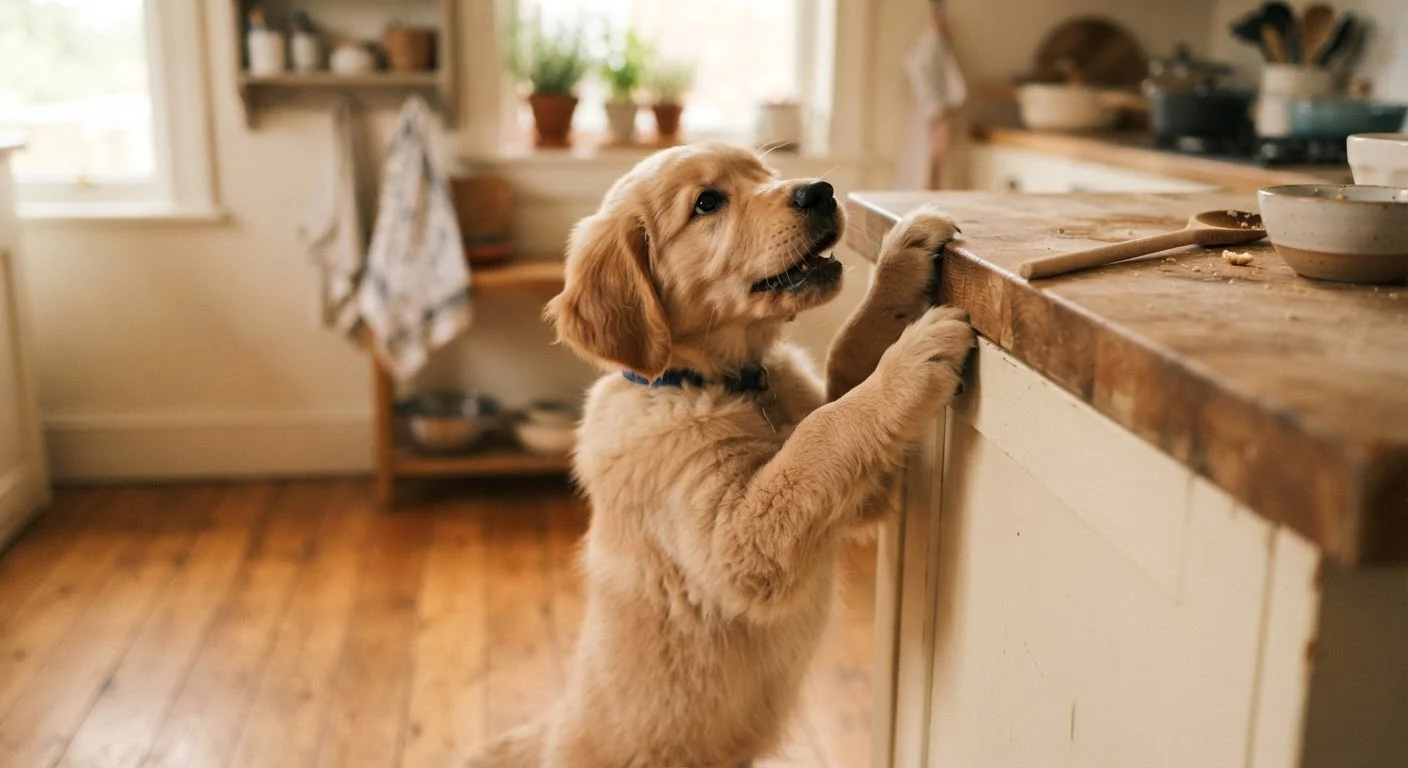
Counter surfing — when a dog places its front paws on a counter or table to investigate what's there — is essentially scavenging behavior shaped by an intermittent reward schedule. The dog doesn't find food every time it checks the counter, but the times it does are powerful enough to sustain the habit indefinitely. In behavioral terms, intermittent reinforcement produces some of the most persistent behaviors observed in any species.
Taller breeds are disproportionately likely to develop this habit simply because the counter is within reach. But even smaller dogs will attempt it if they've been rewarded — intentionally or not — by finding crumbs, wrappers, or an unattended snack.
Manage First, Then Train
Before any training intervention can succeed, it helps to remove opportunities for the unwanted behavior to be reinforced. Clear counters of food, use a leash or gate to prevent unsupervised access, and provide enrichment that occupies your dog's energy. Management buys time for training to take hold without allowing the behavior to strengthen in the meantime.
Management is the most immediately effective tool here. Keeping counters clear of food, using baby gates, and providing enrichment that satisfies the dog's foraging instincts (puzzle feeders, sniff mats) removes both the opportunity and the motivation for the behavior before training has a chance to work.
Jumping Up: A Greeting Behavior Gone Too Big
Dogs greet other dogs and their human companions by moving toward the face. For a puppy small enough to reach a person's face by jumping up, this instinct gets reinforced early — people naturally look down, laugh, or reach out to pet the small, exuberant animal. As the puppy grows into a 60-pound adolescent doing the same thing, the behavior is already well-established.
What makes jumping particularly sticky is that almost any human reaction reinforces it. Being pushed away, told 'down,' or even kneed in the chest all deliver what the dog is seeking: physical contact and social attention. The dog doesn't parse the quality of the interaction — it registers that jumping produced engagement.
Consistent extinction of the behavior (turning fully away, removing eye contact, walking out of the room) paired with enthusiastic reinforcement of four-paw greetings is the most reliable path forward. The challenge, almost always, is consistency across all people the dog encounters — a topic explored in our article on training habits that slow progress.
Mouthing: The Language Puppies Are Born Speaking
Puppies communicate and explore almost entirely through their mouths. In the litter, mouthing is how siblings play, how they test boundaries, and how they learn bite inhibition — the ability to modulate the pressure of a bite. A puppy that mouths too hard receives an immediate social signal: the other puppy yelps and withdraws. Play stops. The mouthy puppy learns to be gentler.
When puppies join human households, this feedback loop breaks down. People often respond to nipping with movement, noise, or continued interaction — all of which can read to the puppy as continued play. Some puppies also mouth more intensely when overstimulated or overtired, which is worth recognizing as a management cue rather than a discipline moment.
~50%
Of relinquished dogs cited for behavior problems
Research published in veterinary behavior literature consistently finds that behavior problems — including jumping and mouthing — are among the leading reasons dogs are surrendered to shelters, underscoring the importance of early behavioral guidance.
4–6 months
Typical age range for peak mouthing behavior
Veterinary and behavioral sources note that mouthing tends to peak during the teething phase and decreases as adult dentition completes, though reinforcement history can extend it well beyond this window.
Mouthing typically decreases as adult teeth come in fully and as the dog develops other ways to interact. But the timeline depends on whether the behavior has been inadvertently reinforced. Redirecting to a toy, withdrawing attention calmly when mouthing escalates, and building impulse control through structured play all accelerate the process. This behavior is quite different from the threat signals described in our overview of dog aggression types and triggers.
What These Behaviors Have in Common — and What That Means for Training
Counter surfing, jumping, and mouthing are all maintained by reinforcement, often unintentional. That's actually clarifying, because it means the path forward isn't about willpower or dominance — it's about restructuring the consequences the dog encounters. Three principles apply across all three behaviors:
- Prevent the reward. Every unsupervised success strengthens the behavior. Management — barriers, leashes, cleared surfaces — buys time while training catches up.
- Reinforce the alternative. Dogs need to know what to do, not just what not to do. Four paws on the floor, sitting at greetings, and engaging with a toy instead of a hand all deserve clear, consistent rewards.
- Maintain consistency. A behavior that gets reinforced by one household member or one visitor remains viable. The dog doesn't compartmentalize — it simply learns that the behavior sometimes works.
For more on how routine interactions can quietly set training back, see our piece on common training habits that undermine progress. And if you're noticing behaviors that feel more intense than typical developmental nipping or excitement — such as growling over objects — our resource on resource guarding in pets covers that distinct pattern separately.
This article is for general informational purposes only and is not a substitute for guidance from a certified professional dog trainer or veterinary behaviorist.