

Key Takeaways
Why 'Stay' Is More Than One Skill
Many owners treat stay as a single command to teach in a single session. In practice, it's a composite behavior built from three distinct challenges: how long your dog holds the position (duration), how far away you move (distance), and whether the dog can maintain the behavior when competing stimuli are present (distraction). Behavioral science consistently supports training these elements separately and sequentially — layering them too quickly is one of the most common reasons stay breaks down under real-world conditions.
Before beginning, make sure your dog understands a basic sit or down cue reliably. If you're new to reward-based training, the foundational concepts in our pet training primer are worth reviewing first. You'll also want to be aware of subtle habits covered in this guide to training habits that undermine progress, since inconsistent cues are especially damaging to stay.
What you will need
Step-by-Step: Building a Solid Stay
Work through each step in order. Move forward only when your dog succeeds roughly 80% of trials at the current level — that threshold indicates genuine learning rather than luck. Keep sessions to 5–10 minutes and end while your dog is still succeeding.
Establish the position and introduce the cue
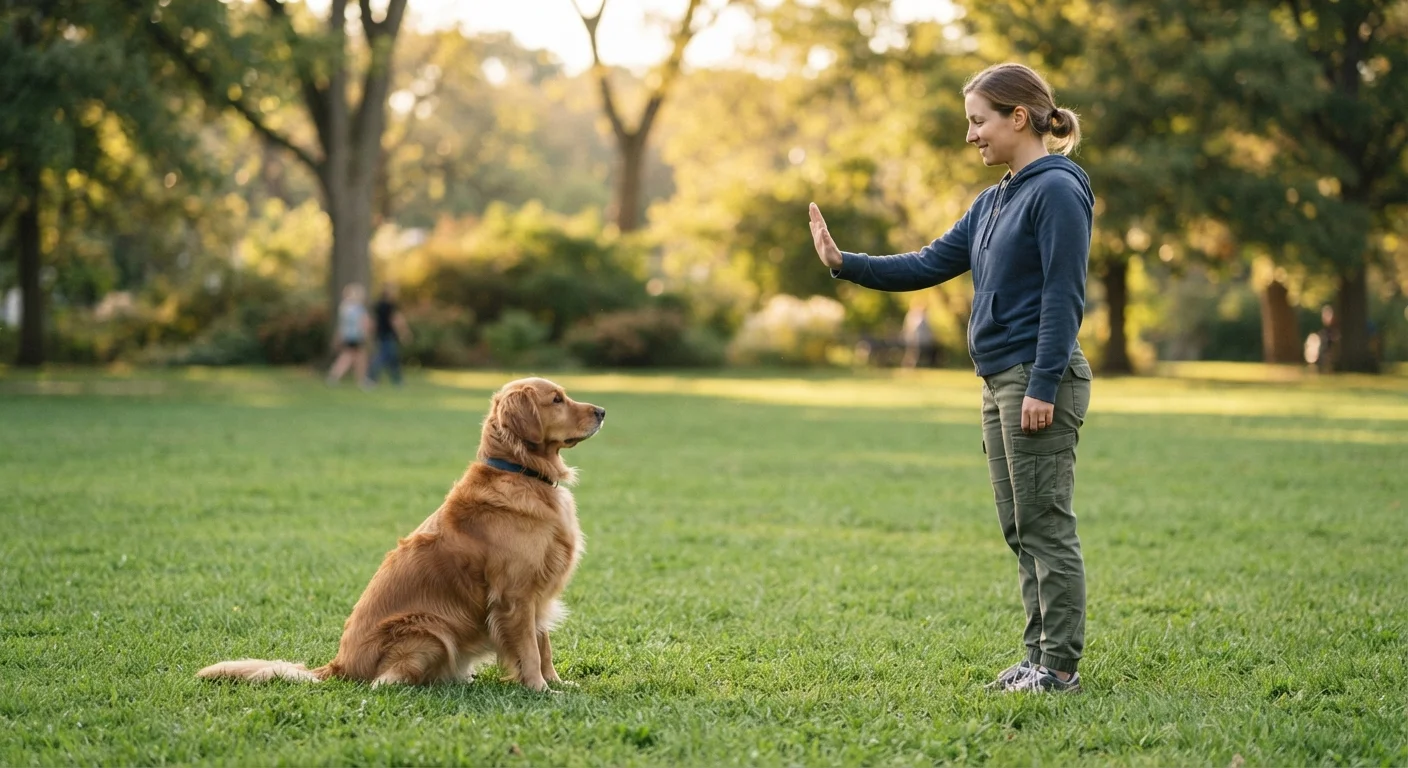
Ask your dog to sit or lie down. The moment they're settled, say 'stay' once in a calm, clear voice. Wait just one to two seconds, then deliver a treat directly to the dog's mouth — without calling them to you. Use your release word immediately after. The dog should not move to earn the reward; you're rewarding the stillness itself.
Build duration in small increments
Gradually extend the time between cue and reward: from 2 seconds to 5, then 10, then 20, and so on. Vary the intervals rather than always increasing — a pattern like 5, 10, 3, 15, 8 seconds keeps the dog engaged and prevents anticipation. Continue rewarding in position and releasing with your word. Do not add any distance yet.
Introduce distance once duration is solid
With duration at roughly 30 seconds in place, begin adding distance — one step at a time. Take a single step away, pause, return to the dog, reward in position, and release. Gradually increase to two steps, then three, always returning to the dog to reward rather than calling them to you. This keeps 'stay' and 'come' as separate behaviors.
Practice with mild distractions
Only after duration and distance are reliable in a quiet space should you introduce distractions. Start with mild ones: a toy placed nearby, another person walking through the room, or low background noise. Reward generously for any maintained stay. If the dog breaks, reduce the intensity of the distraction and rebuild from there.
Proof in real-world environments
Once your dog holds a 30-second stay with you 10 feet away and mild distractions present in a familiar space, begin practicing in new locations: the sidewalk, a friend's yard, a quiet park. New environments effectively reset difficulty — expect some regression and treat it as valuable repetition, not failure. Maintain your criteria gradually just as you did from the start.
Common Problems and How to Fix Them
Even with careful progression, you'll hit snags. Here's what to look for and how to respond:
- Dog breaks before release: You moved too fast on duration or distance. Drop back two steps and rebuild more gradually.
- Dog creeps forward as you move away: Reward earlier in your movement — before the dog shifts weight — rather than only when you reach the far point.
- Stay collapses around distractions: You likely introduced distractions before duration and distance were solid. Return to a quiet environment and proof each element again.
- Dog self-releases without cue: Be precise about your release word and deliver it every single time — movement alone should never signal the end of a stay.
Consistency across all household members matters enormously. Building a training routine that actually sticks helps everyone in the home use the same criteria, which prevents your dog from learning that stay is optional with certain people.
Short Sessions Beat Marathon Practice
Dogs learn best in short, frequent repetitions rather than long, exhausting sessions. Five minutes once or twice a day will produce faster, more durable results than a single 30-minute block. End each session while your dog is still succeeding — finishing on a positive note reinforces motivation for the next session. See how to structure consistent training routines for a practical framework.