

Key Takeaways
Resource Guarding
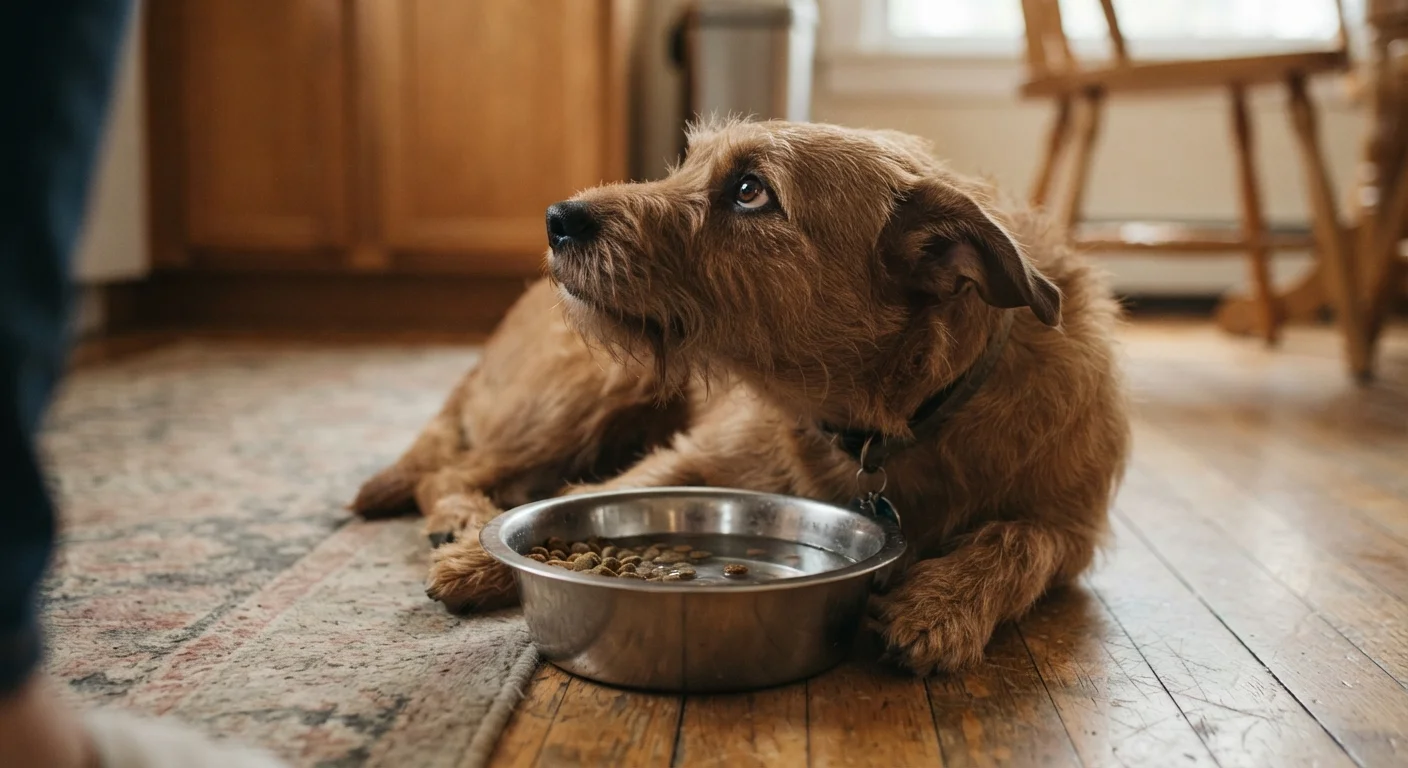
Resource guarding is a behavior in which a pet — most commonly a dog — uses body language, growling, snapping, or biting to prevent others from approaching or taking something it values. That "something" can be food, a toy, a resting spot, or even a person. It is a normal, hardwired survival behavior rooted in animal instinct, not a sign of bad character or spite.
Behaviorally, resource guarding is classified as a form of agonistic behavior — a broad category covering threat, aggression, and appeasement signals animals use to resolve competition. It exists on a spectrum from mild stiffening to overt aggression.
What Resource Guarding Actually Looks Like
Resource guarding rarely begins with biting. It typically unfolds as a sequence of escalating signals, and recognizing the early ones gives you time to respond safely before any situation worsens.
Common signs, roughly in order of intensity, include:
- Stiffening or freezing over the item while continuing to eat or hold it
- Side-eye or hard stare directed at whoever is approaching
- Hovering — the body curves around or over the resource
- Growling or lip curl — the clearest verbal warning
- Snapping or lunging without contact
- Biting — the behavior has fully escalated
Not every pet moves through every stage. Some skip straight to snapping. Understanding where your pet typically enters this sequence helps you identify its threshold — the point at which it starts to feel threatened — and manage accordingly.
Resource guarding isn't limited to dogs. Cats, rabbits, and birds can also display guarding behavior, though the signals differ. A cat may flatten its ears, swat, or block access to a food dish. A parrot might lunge from a favored perch. The common thread is any behavior designed to create distance between the pet and a perceived threat to its valued item.
Why Pets Guard Resources
Resource guarding is rooted in evolutionary biology, not personal grievance. For wild ancestors of domestic pets, losing food or shelter to a competitor could mean death. Animals that successfully defended resources were more likely to survive and reproduce. That wiring doesn't disappear simply because a pet now lives in a home where resources are reliably provided.
Several factors can amplify guarding behavior in domestic pets:
- Early-life scarcity: Animals from shelters, large litters, or environments where food was inconsistent may guard more intensely because their history taught them resources aren't guaranteed.
- Previous punishment for guarding: Ironically, pets that were punished for growling often escalate — they learn that warning signals don't work and go straight to snapping.
- High-value items: A regular kibble bowl may trigger no guarding at all, while a raw bone or chew triggers intense guarding in the same dog. Value is subjective and varies by animal.
- Pain or illness: A pet that is suddenly guarding more than usual may be experiencing discomfort. A veterinary check is appropriate when behavior changes without a clear environmental cause.
It is worth being direct about one common misconception: resource guarding is not about dominance or the pet trying to control the household. Framing it that way leads to confrontational responses — like forcing the pet to submit — that increase bite risk. This behavior is anxiety-driven, and effective management treats it as such.
A Note on the "Dominance" Framing
The idea that resource guarding is about a pet asserting dominance over its owner has been largely set aside by modern behavioral science. Major organizations including the American Veterinary Society of Animal Behavior have published position statements against dominance-based training approaches, noting that they can increase anxiety and aggression. Resource guarding responds far better to management strategies that reduce anxiety than to confrontational techniques.
How to Respond Safely in the Moment
When you notice guarding behavior beginning, the priority is de-escalation — not discipline. Here is what that looks like in practice:
- Stop approaching. If your pet stiffens, freezes, or begins to growl as you move toward a resource, pause and take a step back. You have moved inside its threshold distance — creating space immediately reduces pressure.
- Do not reach for the item. Grabbing at something a pet is actively guarding is how most bites happen. Wait for a calmer moment.
- Use a trade or a scatter. Toss a high-value treat away from the guarded item. When the pet moves to investigate, you can safely retrieve the item if needed. This does not reward guarding — it simply interrupts the sequence safely.
- Avoid punishment. Yelling, leash corrections, or physically removing the item forcibly suppresses the warning signal. The anxiety driving the behavior remains; the pet simply stops warning before it acts.
These are in-the-moment management strategies, not long-term solutions. They keep people safe while you work on the underlying issue. For broader guidance on responsible pet ownership, including how behavior fits into daily care, see everything that goes into responsible pet ownership.
Building Long-Term Tolerance Through Desensitization
The goal of behavior modification for resource guarding is to change what the pet predicts will happen when someone approaches its resource. Right now, it predicts loss — and guards accordingly. The training process shifts that prediction to something positive.
A basic desensitization approach works like this:
- Start at a distance where the pet shows no tension at all. This is your starting threshold.
- Approach slowly, stop well before tension appears, and drop a very high-value treat on the ground near the pet without reaching toward the resource.
- Step back. Repeat. Over many sessions, gradually decrease the distance as the pet remains relaxed.
- Progress to approaching, dropping a treat, briefly touching the bowl (without removing it), and stepping away.
- Eventually, the pet learns that a human approaching its food bowl predicts something good — not a threat.
This is a slow process. Sessions should be short (two to three minutes), and criteria should only increase when the pet is visibly relaxed at the current level. Rushing causes setbacks.
Resource guarding overlaps with other behavior challenges — including the normal but sometimes disruptive behaviors described in our guide to counter surfing, jumping, and mouthing. Understanding the behavioral logic behind each makes it easier to respond effectively across different situations.
For cases involving biting history, guarding directed at children, or multiple pets in conflict, a certified applied animal behaviorist or veterinary behaviorist is the appropriate next step. These professionals have the training to assess risk accurately and design a behavior modification plan suited to your specific animal.
This article is for general informational and educational purposes only and is not a substitute for professional veterinary or behavioral advice. Always consult a qualified veterinarian or certified animal behaviorist for guidance specific to your pet's needs.