

Key Takeaways
Option A
Zero-Based Budgeting (ZBB)
The meticulous, dollar-by-dollar planning system.
Best for: People who want full visibility into every spending decision and are comfortable with detailed monthly planning.
Option B
The Envelope Method
The tactile, cash-driven spending control system.
Best for: People who overspend in specific categories and benefit from the physical experience of handling actual cash.
If you have irregular income or want total control over every dollar
Zero-Based Budgeting (ZBB)
ZBB's monthly rebuild from scratch suits variable income and complex financial goals, giving you a fresh, intentional plan each pay period.
If you consistently overspend on groceries, dining, or entertainment
The Envelope Method
Physical cash limits are harder to override than digital ones, making envelopes especially effective for habitual category overspending.
If you prefer digital tools and want a modern workflow
Zero-Based Budgeting (ZBB)
ZBB integrates naturally with budgeting apps and spreadsheets, making it easier to track without handling physical cash.
If you are new to budgeting and want a simple, visual system
The Envelope Method
Labeled envelopes make spending limits concrete and immediately visible, lowering the learning curve for first-time budgeters.
If you want to aggressively pay down debt while funding savings simultaneously
Zero-Based Budgeting (ZBB)
ZBB explicitly assigns money to both debt payments and savings categories, ensuring neither gets overlooked during planning.
How Each Framework Actually Works
Understanding the mechanics of each system is the foundation for choosing between them. They share a common goal - intentional spending - but take entirely different paths to get there.
Zero-Based Budgeting
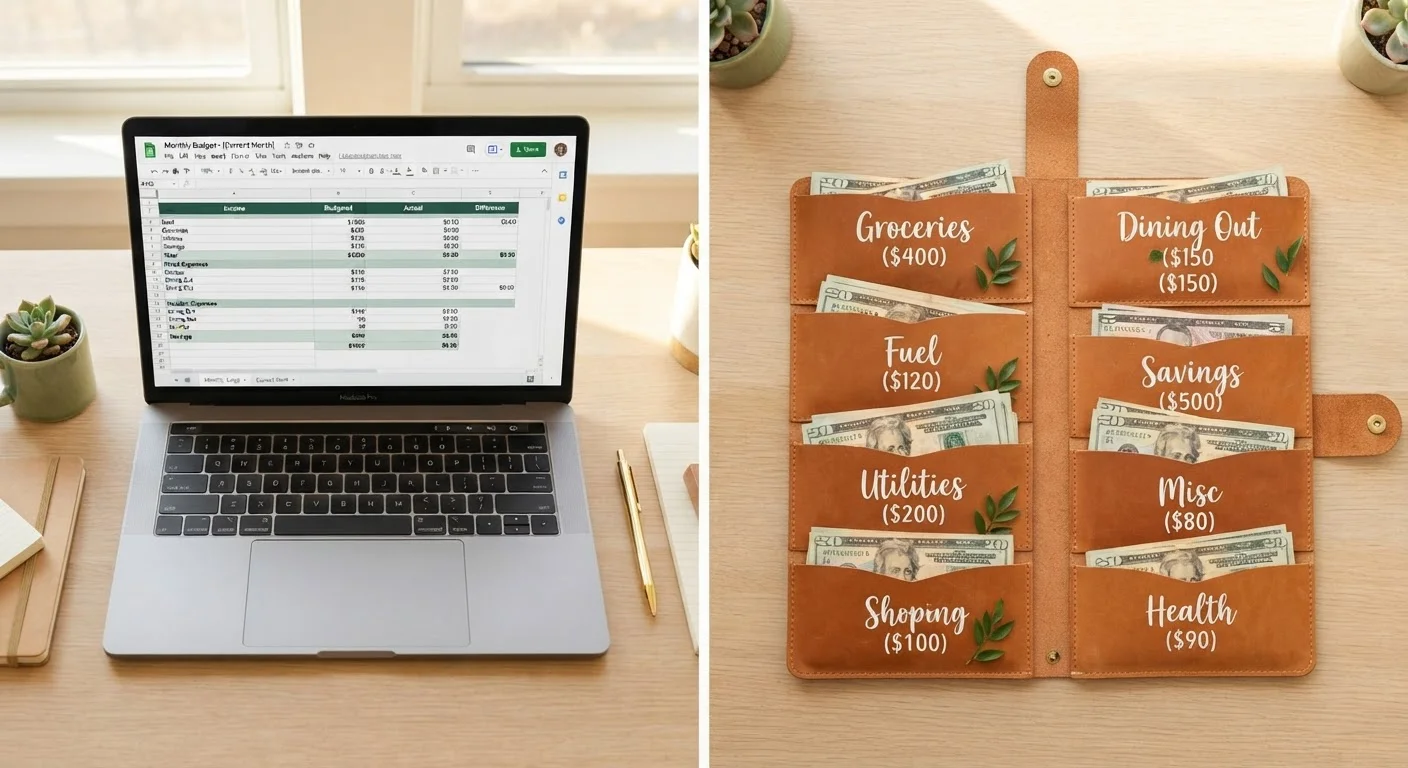
With zero-based budgeting, you start from zero each month and assign every dollar of your income to a specific category until the math reads income minus expenses equals zero. That doesn't mean spending everything - savings, investments, and debt payments each count as a category that receives a dollar assignment. The goal is that no income dollar is left undesignated. If your take-home pay is $3,800, your budget categories must collectively total $3,800.
This approach requires you to rebuild your plan each pay period rather than copying the previous month wholesale. That intentional reset is a feature, not a bug - it forces you to confront whether last month's allocations still match this month's priorities. Understanding which of your costs are fixed versus variable is especially important here, since variable expenses will change your plan each month.
The Envelope Method
The envelope method works by dividing your cash into labeled physical envelopes - one per spending category. When an envelope is empty, spending in that category stops for the month. Traditionally done with literal cash and paper envelopes, many people now apply the same logic digitally using budgeting apps that simulate envelope-style category limits.
The key mechanism is the hard stop. Unlike a credit or debit card where you can always spend more, an empty envelope creates a tangible boundary. That constraint is what makes the method effective for people who struggle to limit spending in specific categories.
| Criterion | Zero-Based Budgeting | Envelope Method |
|---|---|---|
| Core mechanism | Assign every income dollar to a category | Allocate cash into labeled spending envelopes |
| Monthly setup time | High - rebuilt from scratch each month | Low - refill envelopes each pay period |
| Works with digital payments | Yes - fully compatible | Partially - cash-first; digital adaptations exist |
| Savings & debt built in | Yes - explicit budget categories | Only if envelopes are created for them |
| Spending hard stop | Requires self-discipline to honor | Automatic - empty envelope = no spending |
| Best income type | Variable or stable income | Stable, predictable income |
| Learning curve | Moderate to high | Low - visually intuitive |
Where Each Method Struggles
Both frameworks have real limitations, and being clear-eyed about them helps you set realistic expectations before you commit.
Zero-Based Budgeting Limitations
The biggest friction point with ZBB is time. Rebuilding a detailed budget from scratch each month demands discipline and a willingness to sit with your numbers regularly. For people with unpredictable expenses or who find detailed planning stressful, ZBB can feel burdensome enough to abandon entirely. It also carries a risk of over-precision - spending hours on micro-categories at the expense of actually using the budget. If you want a balanced perspective on what strict systems offer and cost, the article on the upsides and downsides of strict budgeting is worth reading alongside this comparison.
Envelope Method Limitations
The envelope method becomes cumbersome in a cashless world. Most bills - rent, utilities, subscriptions - are paid digitally, which means you're often maintaining a hybrid system whether you plan to or not. The method also doesn't naturally push you to think holistically about your full financial picture the way ZBB does. It controls spending but doesn't necessarily prompt you to ask whether your overall income-to-expense ratio is healthy or whether savings goals are being funded adequately.
For a broader look at how budgeting tool choice interacts with both methods, see our comparison of spreadsheet, app, and pen-and-paper approaches.
~30%
Americans with a detailed monthly budget
Surveys by Gallup and similar research organizations consistently find that fewer than a third of U.S. adults maintain a detailed, written monthly budget.
1 in 3
Adults who run out of money before month's end
Consumer financial health research has found that roughly one in three American adults reports regularly reaching month's end with little to no money left over.
78%
Workers living paycheck to paycheck at some point
Multiple workforce surveys indicate that a large majority of U.S. employees have reported living paycheck to paycheck at some point, underscoring the need for active spending frameworks.
Making the Right Choice for Your Situation
The most effective budgeting method is whichever one you will actually stick with. That sounds simple, but it has real implications for how you choose.
If you have a stable monthly income and want to get serious about savings or debt payoff, ZBB's structured allocation process gives you a clear line of sight into where money is going and where it could be redirected. If you are newer to budgeting or struggling with specific spending categories like groceries or dining out, the envelope method's immediate, tactile feedback can be more effective than any spreadsheet formula.
Some people benefit from combining elements of both - using ZBB's whole-income planning logic while applying envelope-style caps to the two or three categories most prone to overspending. That hybrid approach isn't a compromise; it's pragmatism. If you're building a budget for the very first time, our ground-up walkthrough for complete beginners provides the foundational steps before you settle on any one system.
Whichever framework you choose, the starting point is the same: know your income, identify your expenses, and make a deliberate plan before the month begins rather than explaining the previous month after it ends.
This article is for general informational and educational purposes only and does not constitute personalized financial advice. Consult a qualified financial professional for guidance specific to your situation.