

Key Takeaways
The 50/30/20 Rule
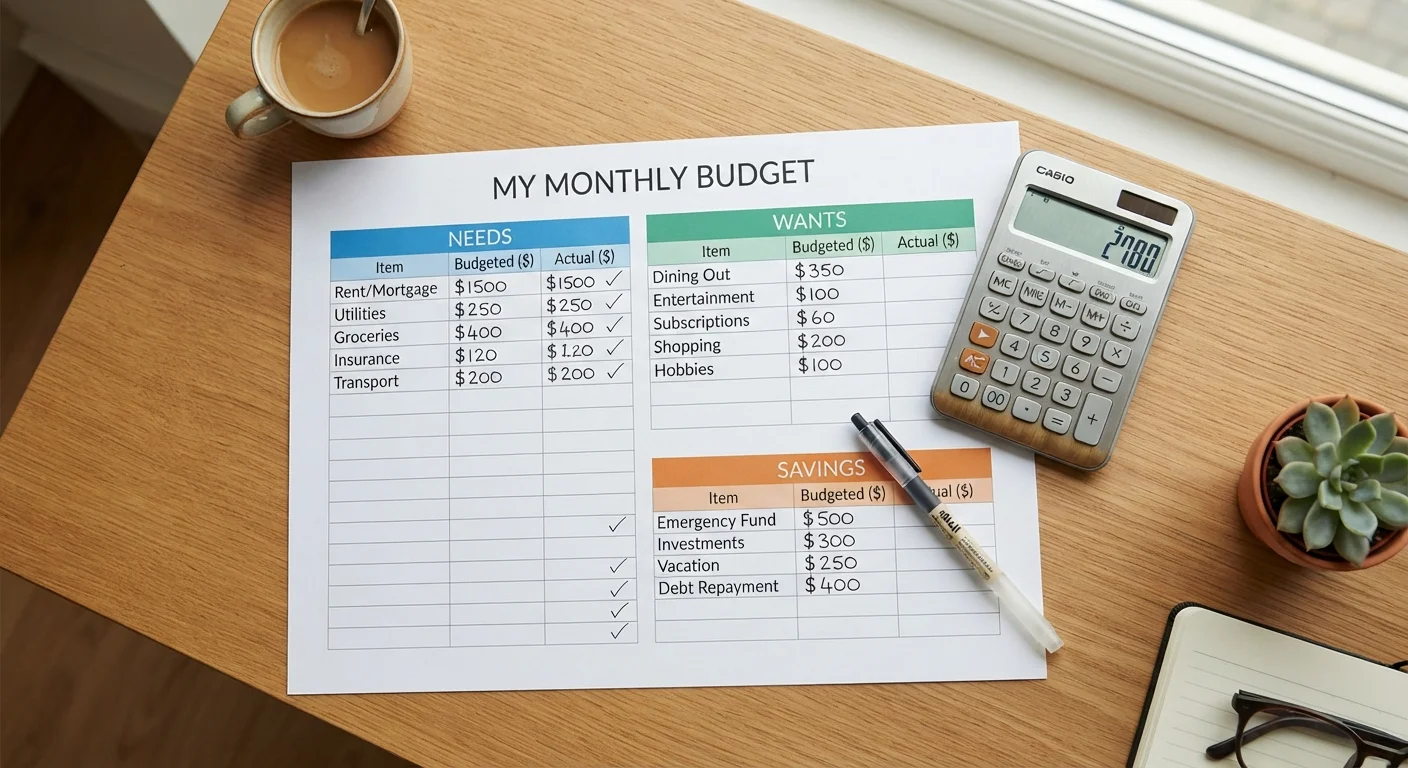
The 50/30/20 rule is a budgeting framework that divides your after-tax income into three categories: 50% for needs, 30% for wants, and 20% for savings and debt repayment. It gives you a simple percentage-based structure rather than tracking every individual dollar. The goal is a balanced financial life - covering essentials, allowing personal spending, and building long-term security at the same time.
The framework is often attributed to U.S. Senator Elizabeth Warren and her daughter Amelia Warren Tyagi, who described it in their 2005 book "All Your Worth: The Ultimate Lifetime Money Plan." It applies to net income - meaning after taxes and payroll deductions - not gross pay.
How the Math Works
Start with your monthly take-home pay - the amount actually deposited after all taxes and mandatory deductions. Multiply that figure by 0.50, 0.30, and 0.20 to find your target dollar amounts for each category.
For example, if your monthly net income is $4,000:
- Needs (50%): $2,000
- Wants (30%): $1,200
- Savings & debt payoff (20%): $800
Those three numbers become your monthly spending limits by category. You are not tracking every coffee or grocery receipt against a micro-budget - instead, you are monitoring whether each broad bucket stays within its ceiling over the month. This simplicity is the framework's main advantage over zero-based or envelope-style budgeting.
33%
Americans with no emergency savings
According to Bankrate's annual Emergency Savings Report, roughly one in three U.S. adults has no dedicated emergency fund - highlighting why the savings component of the 50/30/20 framework is critical.
$6,081
Average monthly consumer spending
The U.S. Bureau of Labor Statistics' Consumer Expenditure Survey reports average monthly household spending near this level, providing a baseline for understanding where most American spending actually goes.
~35%
Share of income spent on housing
The BLS Consumer Expenditure data shows housing consistently consumes around 33-35% of average after-tax income, leaving limited room for other needs within the 50% ceiling in many households.
Breaking Down Each Category
Needs (50%)
Needs are the expenses that keep you housed, fed, employed, and financially current. This includes rent or mortgage payments, renter's or homeowner's insurance, utilities, groceries, basic clothing, health insurance premiums, minimum required debt payments, and essential transportation costs such as a car payment, fuel, or transit pass. The test: if skipping it would create an immediate serious consequence - eviction, illness, default - it is a need.
What does not belong here: a streaming subscription, a gym membership, or restaurant meals. Those are wants, regardless of how habitual they feel. For a deeper look at drawing that line, see Needs, Wants, and Savings: Drawing the Lines Most People Blur.
Wants (30%)
Wants are discretionary lifestyle expenses - the things that make daily life enjoyable but are not strictly required. Dining out, entertainment subscriptions, travel, hobbies, clothing beyond basic necessity, and personal care upgrades all fall here. This is not a guilt category; a healthy budget includes room for personal spending. The 30% ceiling simply ensures wants don't crowd out savings.
Savings and Debt Repayment (20%)
This bucket serves your financial future. It covers contributions to an emergency fund, retirement accounts such as a 401(k) or IRA, other savings goals, and any debt payments above the minimum required amount. Directing at least 20% here consistently over time is what allows the framework to build genuine financial resilience, not just cash-flow management. You can find broader strategies in the Saving & Debt resource hub.
When the Standard Ratios Don't Fit
The 50/30/20 rule is a starting framework, not a universal prescription. Several real circumstances make the standard percentages difficult or impractical:
- High cost-of-living areas: In cities where average rent alone represents 40-45% of a median income, fitting all other essentials into the remaining 5-10% of the 50% bucket is nearly impossible. In these cases, the wants allocation is usually what absorbs the overflow - not savings.
- Very low incomes: When income is modest enough that fixed necessary expenses exceed half of take-home pay, the 50% target cannot be met through spending behavior alone. It reflects a structural income gap, not a budgeting failure.
- Large debt loads: Someone aggressively paying down high-interest debt may reasonably shift to a 50/20/30 structure - temporarily trimming wants to accelerate payoff - without abandoning the principle.
- Irregular income: Freelancers and gig workers should calculate the rule based on average monthly income rather than peak months to avoid overcommitting in lower-earning periods.
Adapting the ratios for your situation is not cheating the system - it is applying it intelligently. The Everyday Money Tips hub covers practical habits that work alongside frameworks like this one.
This article is for general informational and educational purposes only and does not constitute personalized financial, tax, or legal advice. Consult a qualified financial professional for guidance specific to your circumstances.