

Key Takeaways
Why Label Language Matters at the Point of Purchase
Product labels are written to sell, not always to inform. Terms like "handcrafted," "premium," and "heavy-duty" have no standardized regulatory definition in most product categories - meaning two items can carry identical language while differing dramatically in construction quality and expected lifespan. A few categories do have defined terminology (the FTC regulates wood and textile labeling, for example), but most product marketing operates in a largely self-described space.
Understanding the difference between regulated terms and marketing filler gives you a measurable advantage. Once you know what "full-grain leather" actually means versus "genuine leather," or why dovetail joints outperform staple assembly, you can compare products at a structural level rather than relying on price as a proxy for quality.
The list below covers the material and construction signals that most reliably predict durability across furniture, leather goods, metals, and textiles. For a hands-on inspection framework you can apply in-store or when unboxing, see our room-by-room build quality guide.
Solid Wood vs. Engineered Wood vs. Wood-Look
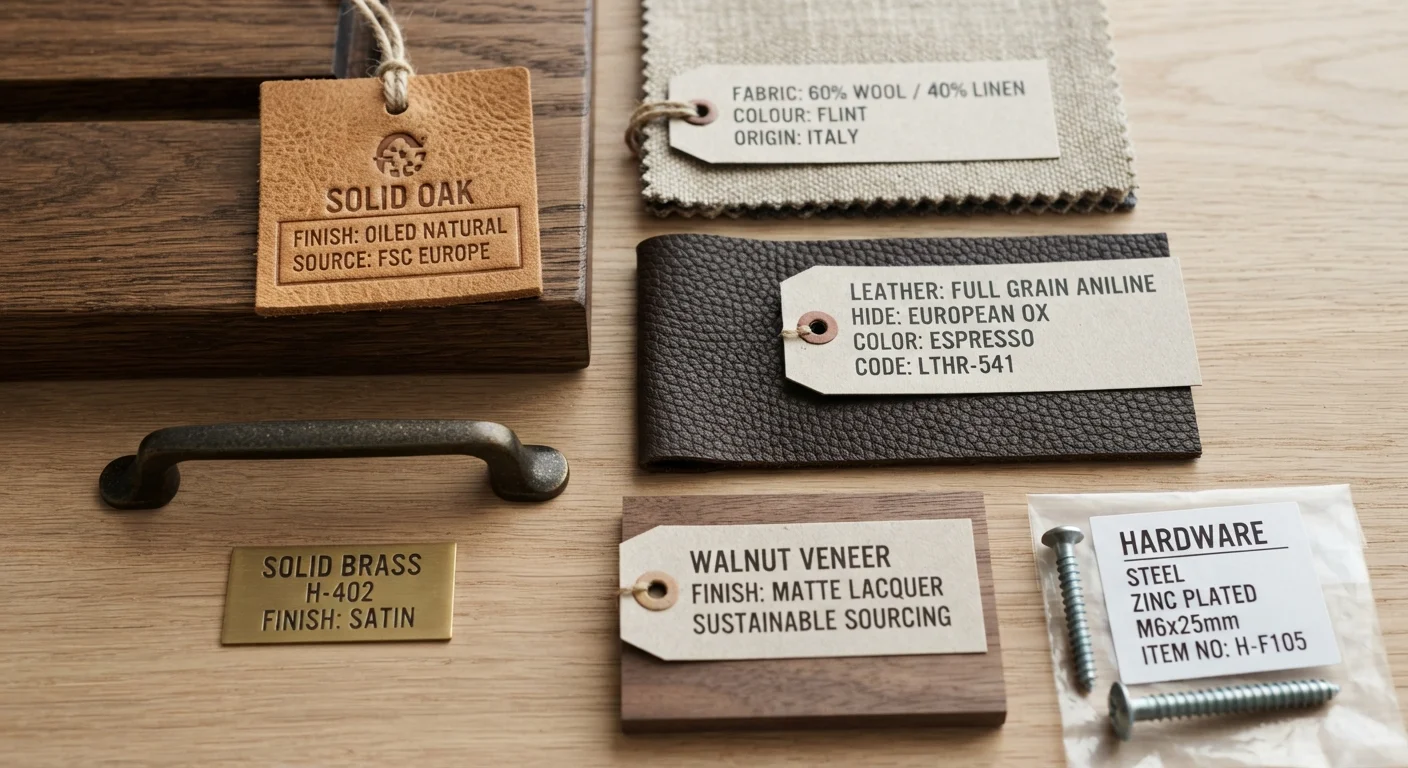
The FTC requires furniture labeled "solid wood" to be made entirely from lumber, with no particleboard or fiberboard core. "Solid [species] wood" (e.g., solid oak) is the strongest claim - it means the visible and structural components are the same species throughout. This material holds screws better over time, can be refinished, and typically lasts decades with reasonable care.
"Engineered wood" or "wood composite" covers a broad range: plywood, MDF (medium-density fiberboard), and particleboard are all engineered products. Plywood is structurally sound for many uses; particleboard is the weakest and most vulnerable to moisture. "Wood veneer" means a thin real-wood surface over an engineered core - the veneer itself can look identical to solid wood but won't withstand the same abuse or refinishing cycles.
"Wood-look" or "wood-tone" signals no real wood at all, typically laminate or vinyl over a composite substrate.
Solid wood holds screws better and can be refinished - particleboard cannot.
Leather Grades: Full-Grain, Top-Grain, Genuine, and Bonded
Leather labeling follows a rough hierarchy based on how much the hide is processed. Full-grain leather is the outermost layer of the hide, left largely intact with its natural grain pattern. It's the most durable grade - it develops a patina over time and resists moisture better than processed alternatives. Top-grain leather is sanded or buffed to remove imperfections, making it more uniform but slightly less durable than full-grain.
Genuine leather is a legally accurate but misleading term: it simply means the product contains real leather, but typically refers to lower layers of the hide - less dense, more prone to peeling and cracking over time. Bonded leather (sometimes called "reconstituted leather") is made from shredded leather scraps bonded with polyurethane. It looks like leather initially but tends to flake and delaminate within a few years of regular use.
For high-use items like sofas or everyday bags, the grade difference translates directly to years of usable life.
"Genuine leather" is legally accurate but often indicates a lower-quality hide layer.
Metal Descriptions: Stainless, Brushed, Plated, and Powder-Coated
Metal labels describe two different things that are easy to conflate: the underlying metal and the surface treatment. Stainless steel is an alloy (steel plus chromium, typically) that resists rust and corrosion - the grade number (304, 316, 430) indicates how corrosion-resistant it actually is, with 304 being the most common household grade. "Steel" alone could mean carbon steel, which rusts readily without a protective coating.
Brushed or satin finishes describe texture applied to a surface - they say nothing about the underlying metal quality. An item can be brushed aluminum, brushed steel, or brushed zinc alloy; durability depends on which. Chrome-plated means a thin chromium layer over a base metal (often steel or zinc); it can chip or peel with heavy use. Powder-coated means a dry paint finish baked onto the metal - it's more durable than liquid paint and resists chipping reasonably well, but the quality of the underlying metal still matters.
Brushed or satin finishes describe texture only - the underlying metal determines real durability.
Furniture Joinery: What Assembly Methods Signal
How furniture pieces connect matters more than most consumers realize, and it's rarely highlighted on a label. The most durable traditional method is mortise-and-tenon joinery, where a projecting piece (tenon) fits precisely into a slot (mortise) - common in quality chairs and tables. Dovetail joints, visible as interlocking trapezoidal cuts, are used in drawer construction and indicate strong mechanical resistance to pulling forces.
Staples and cam-lock hardware (the circular fittings common in flat-pack furniture) are faster and cheaper to assemble, but cam-locks loosen over repeated use. Corner blocks - triangular wood pieces glued inside frame corners - reinforce stress points; their presence or absence is a meaningful quality indicator in upholstered furniture frames.
When shopping in-store, you can often look underneath seat cushions or inside cabinet doors to check joinery directly. Product descriptions sometimes reference construction method; when they don't, it's worth asking or checking the manufacturer's detailed specs online.
Dovetail and mortise-and-tenon joints resist stress mechanically - staples and cam-locks do not.
Textile Construction: Seams, Stitch Density, and Thread Weight
In soft goods - bags, upholstery, apparel, outdoor gear - construction details predict durability more reliably than fabric composition alone. Stitch density (stitches per inch or centimeter) affects seam strength: higher counts generally mean a tighter, stronger seam. Industry references for quality stitching in bags and heavy-duty goods often cite 8-10 stitches per inch as a baseline for load-bearing seams, though specifics vary by application.
Thread weight and type matter too: bonded nylon or polyester thread is more abrasion-resistant than standard cotton thread for items that take daily stress. Bartacking - dense, reinforcing stitches at high-stress points like strap attachments and pocket corners - is a reliable indicator that a manufacturer anticipated where failure points would occur and addressed them. Its absence on a bag or backpack under load is a durability risk.
Seam finish also matters for longevity: bound seams and flat-felled seams (where the seam allowance is enclosed) hold up better in washable items than raw or overlocked edges alone. For more on how fabric composition interacts with these construction signals, the comparison of natural and synthetic rug materials provides useful context on how materials behave under repeated use.
Bartacking at strap attachments signals a manufacturer that anticipated and reinforced real-world stress points.
Coating and Finish Claims: Protective or Decorative?
Finishes on wood, metal, and ceramics serve two distinct purposes - protecting the substrate or enhancing appearance - and labels don't always distinguish between them. For wood furniture, lacquer provides a hard surface barrier but can crack under impact; oil finishes penetrate the wood and are easier to spot-repair but require more maintenance. Polyurethane coatings are durable and water-resistant, making them practical for tabletops and high-contact surfaces.
On ceramics and cookware, vitrified describes stoneware fired at high temperatures to reduce porosity - a genuine durability indicator. Glazed simply means a glass-like surface coating was applied; durability depends on firing temperature and glaze composition, not the term itself.
For outdoor furniture and equipment, look for finish claims paired with test standards when available - references to ASTM or ANSI testing for UV resistance or salt-spray corrosion testing are meaningful indicators. Generic phrases like "weather-resistant" or "outdoor-ready" carry no standardized threshold.
"Weather-resistant" has no standardized threshold - look for references to specific test standards instead.
Putting It All Together at the Register
No single label tells the full story. A solid-wood frame with poor joinery will fail early. Full-grain leather on a poorly stitched seam won't hold. The goal is to read labels as a system: material grade, construction method, and finish treatment together predict how a product will perform over years of real use.
When a label uses vague language - "wood-look," "metal-tone," "leather-style" - treat it as a signal that the underlying material is being obscured, not highlighted. Genuine quality materials are typically named explicitly because they're a selling point, not a liability. If the label hedges, ask a sales associate or check the manufacturer's spec sheet for precise material composition.
When a Label Doesn't Name the Material Directly
If a product description uses terms like "faux," "vegan," "synthetic," or adds "-look" or "-style" as a suffix, it's signaling an imitation material. These aren't negatives by default - synthetic leather, for instance, can be more moisture-resistant than genuine leather in some use cases - but the trade-off in durability and repairability should be factored into your decision. Ask for the actual material composition (e.g., polyurethane, PVC, microfiber) so you can evaluate it accurately rather than accepting the marketing descriptor at face value.
Labels also only cover part of the durability equation. Even well-made products can leave you under-protected if the warranty doesn't match the expected lifespan. Our guide to warranties and service contracts explains what manufacturer and extended coverage actually includes - and where gaps commonly appear.
For textile-specific purchases, the same decoding logic applies to clothing and bedding. See what clothing tags reveal about fabric durability and how bedding labels break down for category-specific detail.