

Key Takeaways
Impulse Purchase
An impulse purchase is an unplanned buying decision made in the moment, without prior intention or deliberate evaluation. Retailers deliberately design store layouts, signage, and product placement to increase the likelihood of these spontaneous decisions. Understanding the mechanics behind impulse buying is not about willpower - it's about recognizing an engineered environment.
Consumer behavior research distinguishes between 'pure' impulse purchases (entirely unplanned) and 'reminder' purchases (triggered by seeing a product you intended to buy). Retailers design for both, but the tactics differ.
How Retail Environments Are Designed, Not Discovered
Walking into a store feels natural - but almost nothing about the experience is accidental. The temperature, the width of the main aisle, the height of featured displays, the music tempo playing overhead: these are decisions made by merchandising teams, store planners, and, in larger chains, dedicated behavioral consultants. The goal is to maximize the dollar value of each visit by increasing the number of items in your cart that weren't on your original list.
This isn't a conspiracy - it's standard retail practice, and most of it is legal and disclosed nowhere in particular. The more useful response isn't suspicion; it's literacy. When you know what a specific store feature is designed to do, it becomes easier to make a deliberate choice rather than a reactive one.
For a broader look at how spending beyond your budget tends to happen, specific contexts and habits make overspending predictable - and the retail environment is one of the most reliably engineered of those contexts.
The Key Placement Tactics and What They're Doing
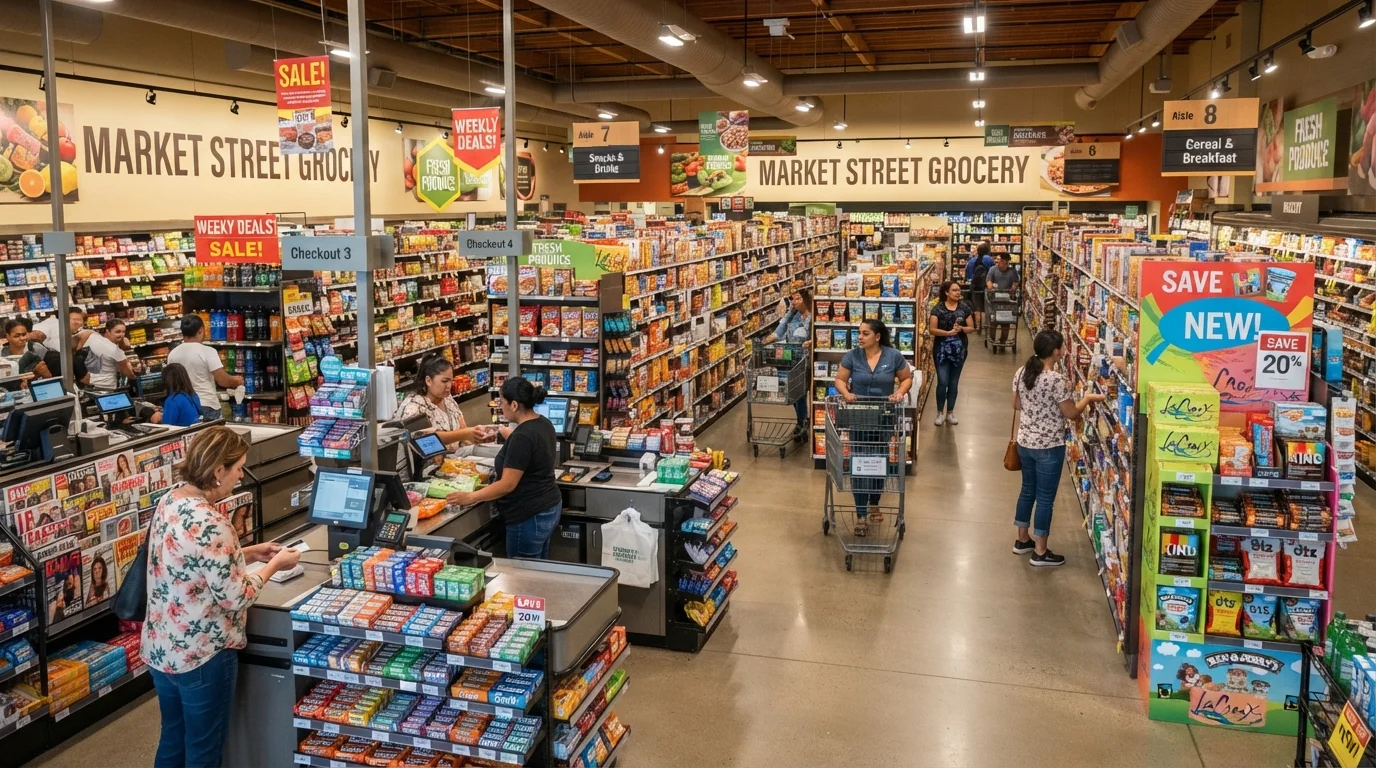
End caps are the shelving units at the end of each aisle. They receive far more shopper attention than mid-aisle positions because they're visible from the main traffic path. Products placed here are typically paying a premium for that visibility - either through a manufacturer's trade agreement with the retailer or an internal merchandising priority. They are not necessarily discounted, featured because they're new, or recommended by any independent standard.
Store entry zones - sometimes called the "decompression zone" - are the first several feet inside the entrance. Shoppers are still transitioning from outside, moving faster, and less likely to stop and evaluate. Retailers typically place visually striking seasonal displays or high-margin items just past this zone, where foot traffic slows and attention increases.
Checkout lanes are the most deliberate of all. The wait creates a window of idle attention, and the items stocked there - typically small, low-cost, and individually packaged - are priced to feel inconsequential. Retailers know that the psychological barrier to adding a $2 or $3 item to a $60 cart is minimal.
Check the Top and Bottom Shelves
When evaluating a product category, scan the full shelf range - not just what's at eye level. Lower-margin or store-brand alternatives are frequently stocked above or below the most visible zone. A few extra seconds of scanning can surface options that wouldn't appear in a quick grab.
Shelf height also matters: eye-level shelving commands the highest attention, which is why it's typically occupied by higher-margin products or those with active promotional agreements. Items at floor level or above eye level are often lower-margin alternatives.
Sensory and Urgency Cues That Accelerate Decisions
~40-80%
Share of supermarket purchases that are unplanned
Various consumer research studies have estimated that a substantial share of grocery purchases - often cited in the 40-80% range - were not on the shopper's original list, though exact figures vary by study methodology and store type.
Eye level
Shelf position with highest shopper attention
Retail planograms consistently prioritize eye-level shelf space for higher-margin or promoted items, a practice documented across grocery, pharmacy, and general merchandise categories.
1-3 seconds
Average time spent evaluating an unplanned purchase
Consumer behavior researchers have observed that impulse purchase decisions often occur in a matter of seconds, well before deliberate product evaluation can take place.
Beyond physical placement, retailers use environmental cues to keep you in a buying mindset. Lighting in produce and bakery sections is often warmer and more flattering to food appearance. Scent diffusion - particularly near bakeries, candle sections, or home goods - creates positive associations and extends the time shoppers spend in an area. Music tempo has been studied in retail contexts: slower tempos are associated with longer browsing times and higher average spend in some store categories.
Urgency language - "Today Only," "Limited Quantities," "While Supplies Last" - is designed to compress the time you spend evaluating a purchase. When you feel a deadline, deliberation feels like a risk rather than a prudent step. This is worth pausing on: genuine scarcity is rare in most retail categories, and urgency signals are a merchandising tool. Our related article on how sale pricing actually works covers this mechanism in detail.
Online retail mirrors these tactics. Countdown timers, low-stock warnings, "frequently bought together" modules, and one-click or saved-payment checkout all reduce friction and compress decision time - producing the same effect as a well-placed checkout lane display.
Practical Ways to Shop More Deliberately
Awareness of these tactics is genuinely useful, but it's most effective when paired with a few structural habits. A written list - on paper or in a notes app - functions as a pre-committed plan that makes additions visible rather than invisible. Every item not on the list requires a conscious decision to add it, which is a different cognitive state than simply placing something in the cart while moving through a display.
Using a basket instead of a cart for small trips matters more than it sounds: physical capacity limits the volume of unplanned items you can acquire, and the weight of a basket makes additions physically noticeable. Shopping when you're not hungry or pressed for time reduces the conditions under which urgency cues are most effective.
For larger purchases, a simple waiting practice - writing down the item and returning the next day - filters out a large proportion of impulse decisions without requiring any in-the-moment restraint. Most items that feel essential in the moment feel optional 24 hours later.
Payment method also plays a role in spending awareness. The trade-offs between cash, debit, and credit at the register are worth understanding - cash in particular creates a more concrete sense of outflow that digital payments tend to abstract.
This article is for general informational and educational purposes only and does not constitute financial or consumer advice tailored to your individual situation.