

Key Takeaways
Start here
Why Kitchen Ventilation Matters
Next
Range Hoods: The Most Common Solution
Then
Downdraft Ventilation: A Hidden Alternative
Also consider
Recirculating Fans: When Ducting Isn't Possible
When you're ready
Choosing the Right System for Your Kitchen
Why Kitchen Ventilation Matters
Every time you cook, your kitchen generates steam, grease particles, smoke, odors, and - with gas burners - combustion gases. Without a system designed to remove or filter that air, these byproducts accumulate indoors. Over time, that means grease buildup on surfaces, persistent odors, elevated humidity that can encourage mold, and degraded indoor air quality.
Good kitchen ventilation addresses all of these at the source. Understanding how the main system types work helps you evaluate what your space actually needs - and what trade-offs each option involves.
CFM
Cubic feet per minute - a measurement of how much air a ventilation system moves. Higher CFM means more airflow capacity.
Ducted system
A ventilation setup that uses physical ductwork to carry cooking air outside the home, removing smoke, moisture, and odors.
Ductless / Recirculating system
A fan unit that draws air through filters and returns the cleaned air back into the kitchen rather than exhausting it outdoors.
Downdraft ventilation
A system mounted at cooktop level, often behind or beside burners, that pulls cooking vapors downward rather than capturing them overhead.
Baffle filter
A type of metal filter used in range hoods that separates grease from airflow using a series of angled channels. It is washable and durable.
Sone
A unit used to measure perceived loudness of fans. Lower sone values indicate quieter operation; 1 sone is roughly equivalent to a quiet refrigerator hum.
Range Hoods: The Most Common Solution
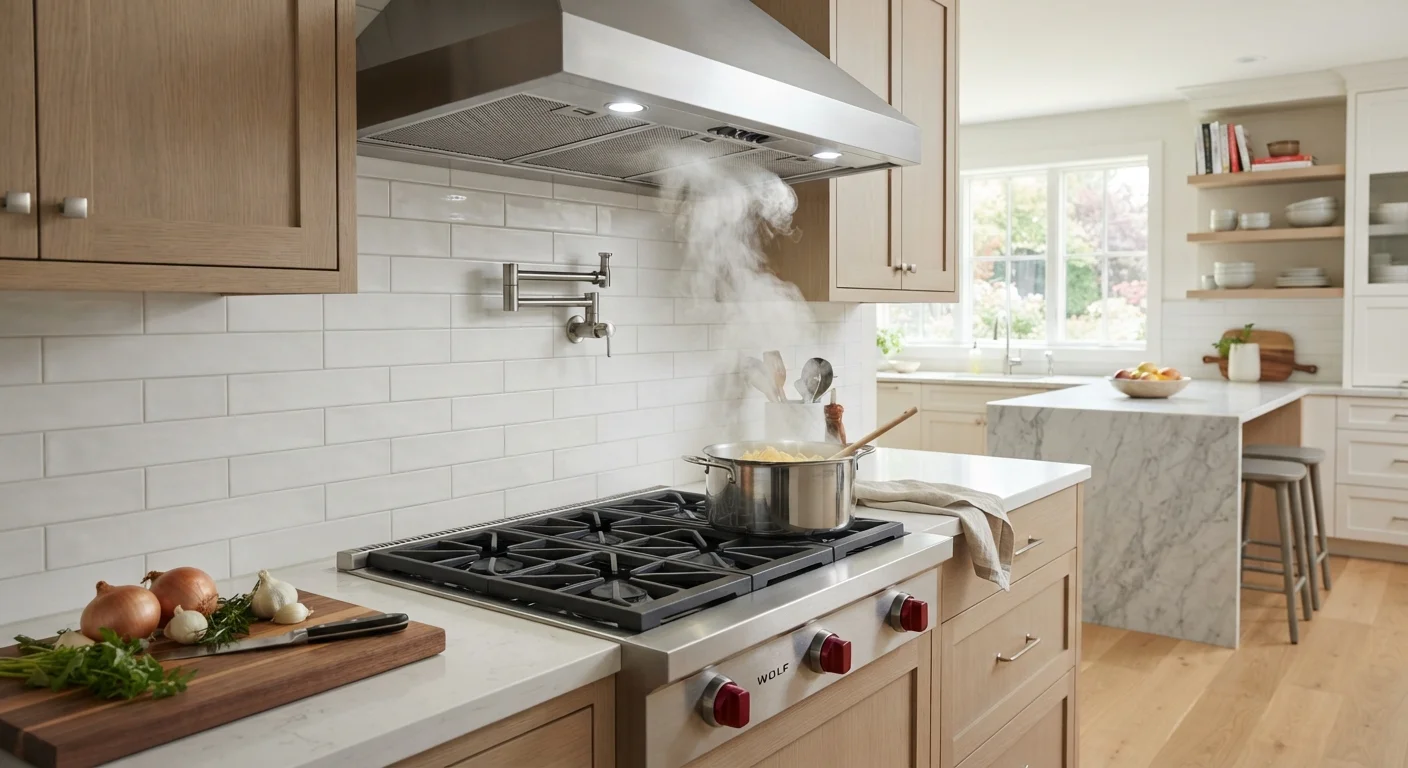
A range hood is a canopy-style unit mounted above the cooktop, typically 24 to 36 inches overhead. It draws rising vapors up into a capture zone before they spread into the room. Ducted range hoods then exhaust that air outside through a duct that runs through cabinetry, walls, or ceilings.
Ducted hoods are considered the most effective kitchen ventilation option because they physically remove air rather than filtering and returning it. Key specifications to compare include:
- CFM rating: Match this to your cooktop's heat output. Underpowered hoods struggle during high-heat cooking.
- Noise (sones): A hood rated at 1-3 sones is generally considered acceptable for everyday use; above 6 sones can be disruptive.
- Filter type: Baffle filters handle grease more efficiently than mesh filters and are easier to clean.
- Hood width: Ideally matches or slightly exceeds the cooktop width for better capture.
Wall-mount, under-cabinet, and island hoods are the most common configurations. Island hoods attach to the ceiling above a freestanding cooktop and require more powerful fans to compensate for their open surroundings.
Check Your Kitchen Layout Before Deciding
The best ventilation system depends heavily on whether your cooktop is on a wall, an island, or against a cabinet run. Confirm whether exterior duct routing is feasible before ruling out a ducted system - sometimes a shorter duct run than expected makes full extraction achievable. A local HVAC contractor can assess your space affordably.
Downdraft Ventilation: A Hidden Alternative
Downdraft systems are installed at cooktop level - either built into the cooktop itself or as a separate unit that rises from the countertop when in use. Instead of capturing rising vapors overhead, they pull air downward and exhaust it through ducting routed beneath the floor or through a low wall exit.
These systems are most practical for island cooktops where running overhead ductwork to the ceiling would be structurally difficult or visually intrusive. They preserve sightlines and keep the kitchen more open.
The trade-off is physics: heat and steam naturally rise, so a downdraft system works against that tendency. Even at higher CFM ratings, downdraft systems tend to capture less effectively than overhead hoods, particularly during very high-heat cooking. They are a reasonable compromise when overhead installation is genuinely impractical - not a preferred first choice on performance grounds alone.
Gas Cooktops Need Adequate Exhaust
Gas burners produce combustion byproducts including carbon monoxide and nitrogen dioxide in addition to cooking vapors. A recirculating fan does not remove these gases - only a ducted system exhausting air to the outside provides that protection. If you cook on gas, a ducted solution is strongly worth considering for indoor air quality reasons.
Recirculating Fans: When Ducting Isn't Possible
Recirculating (ductless) fans are mounted under cabinets or within a hood shell but require no exterior duct connection. Air is drawn through filters - typically a metal grease filter followed by an activated charcoal filter - and returned to the kitchen.
This makes them practical for apartments, condos, or kitchens where routing ductwork to the outside is not feasible. Installation is straightforward and does not require structural work.
The limitations are significant, however. Recirculating fans do not remove moisture, so humidity from boiling or steaming stays in the room. They also cannot remove combustion gases from gas burners. Charcoal filters reduce odors but must be replaced regularly - they are not washable. For light cooking in a well-ventilated space, recirculating fans may be adequate. For frequent or high-heat cooking, they are a functional compromise rather than an ideal solution.
For a broader look at how home systems manage air quality and comfort, see our guide to home cooling options, which covers how different systems handle airflow throughout the home.
Building Codes May Apply
Some local building codes require ventilation for gas cooktops or specify minimum CFM ratings for kitchen exhausts. If you are renovating or installing a new cooktop, check with your local building department or a licensed contractor before finalizing your ventilation choice. Requirements vary by municipality.
Choosing the Right System for Your Kitchen
The decision comes down to three practical factors: your cooktop type, your kitchen layout, and whether exterior ducting is achievable.
- Gas cooktops
- Prioritize a ducted system - either an overhead hood or a ducted downdraft - to exhaust combustion byproducts outside.
- Electric or induction cooktops
- Recirculating fans are a more viable option since there are no combustion gases, though ducted systems still handle moisture and odors better.
- Island cooktops
- Consider a ceiling-mounted island hood for best performance, or a high-CFM downdraft if overhead ducting is not workable.
- Apartments or no-duct situations
- A recirculating under-cabinet fan is usually the realistic choice; look for one with a charcoal filter and a higher CFM rating to compensate for its limitations.
Once you narrow down the system type, compare CFM ratings to your cooking habits, check sone ratings if noise matters to you, and confirm filter accessibility before purchasing - filters you can easily reach and clean are filters you will actually maintain.