

Key Takeaways
Why Mattress Construction Matters
A mattress is one of the few household purchases that directly affects your health every single night. Poor support can contribute to back pain and disrupted sleep; the wrong surface can worsen pressure points or cause overheating. Yet most shoppers focus almost entirely on price or brand rather than the structural choices that actually determine whether a mattress works for them.
Understanding what goes into a mattress - from its support core to its comfort layers - gives you a framework for evaluating any option you encounter, regardless of how it's marketed. For context on how the mattress fits into your broader sleep environment, see creating a sleep-friendly bedroom.
Core Support Systems: Coils, Foam, and Hybrids
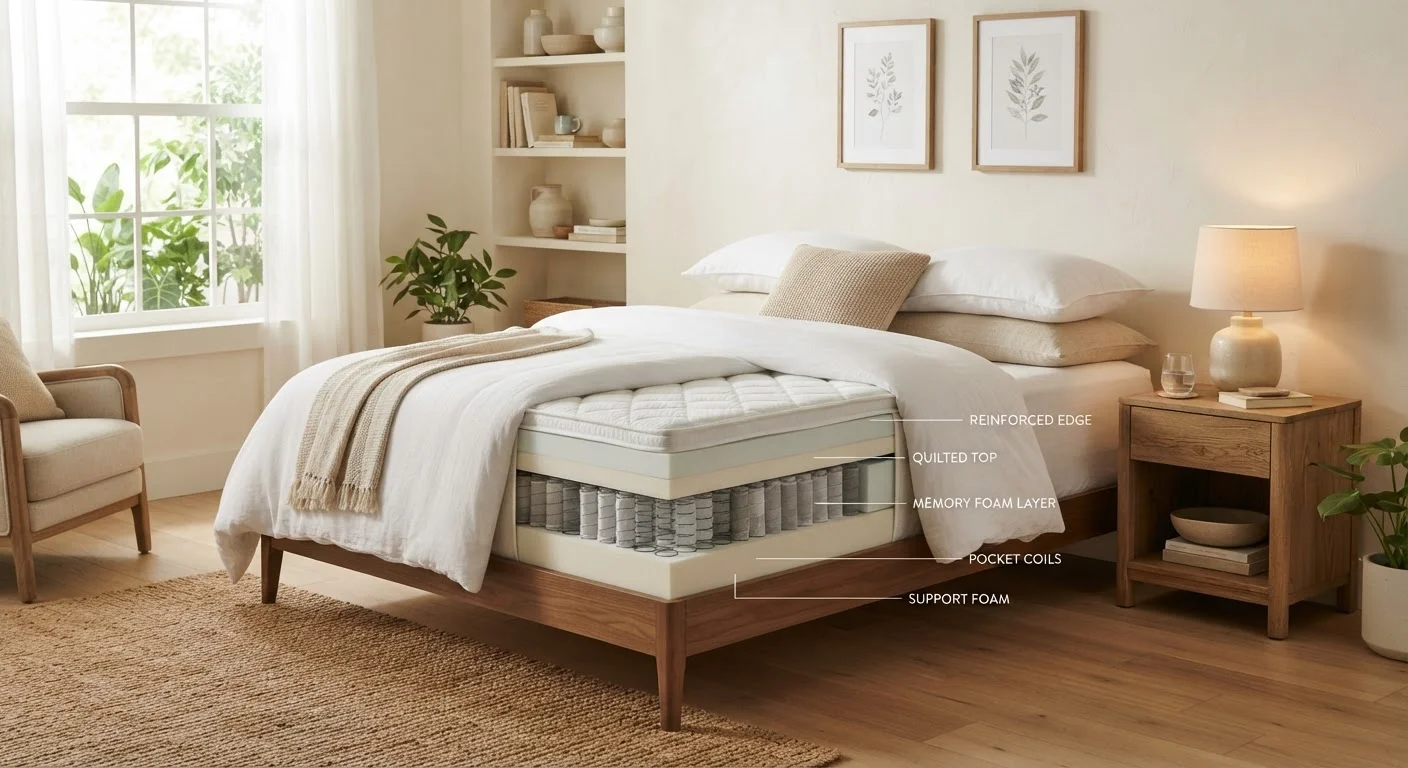
The support core is the structural foundation of any mattress. There are four main types:
- Innerspring (open coil): Traditional interconnected coils that offer bounce and airflow. Generally less effective at isolating motion between sleep partners.
- Pocketed coil: Individual fabric-wrapped coils that move independently, reducing motion transfer and providing more targeted support.
- All-foam: Layers of polyfoam or memory foam with no coil system. Conforms closely to the body; tends to retain heat unless specially engineered.
- Latex: Natural or synthetic rubber foam that responds quickly, sleeps cooler than memory foam, and is generally more durable. Natural latex carries a higher price point.
- Hybrid: Combines a pocketed coil base with foam or latex comfort layers, aiming to balance support, airflow, and contouring.
Coil count and gauge (wire thickness) matter in coil-based mattresses. Higher gauge numbers mean thinner, softer wire; lower gauge means firmer, more durable coils. A queen-size pocketed coil mattress with fewer than 800 coils is worth scrutinizing for long-term support.
When comparing pocketed coil mattresses, ask for the coil gauge and count in writing - not just the layer count. These numbers are far more useful than general comfort descriptors.
Manufacturers often emphasize layer count as a selling point, but gauge and coil count directly determine support longevity and load distribution across the sleep surface.
If you can only test a mattress briefly in a store, lie in your primary sleep position for at least five to ten minutes rather than sitting or shifting around - your body needs time to register pressure points.
Short tests in non-sleeping positions don't replicate the sustained pressure your body exerts during hours of sleep, leading many shoppers to misjudge comfort at the point of sale.
Firmness, Feel, and Sleep Position
Firmness is rated on a general 1-10 scale across the industry, but this scale is not standardized. A "medium" from one manufacturer may feel noticeably different from another's. When possible, test in person or rely on trial periods to form your own assessment.
Sleep position is the most reliable guide to firmness needs:
- Side sleepers typically need a softer to medium surface (roughly 3-5 on the scale) to cushion the shoulder and hip and prevent pressure buildup.
- Back sleepers generally benefit from medium to medium-firm (5-7) support that maintains spinal alignment without excessive sinkage.
- Stomach sleepers usually require a firmer surface (6-8) to prevent the hips from sinking and the lumbar spine from arching uncomfortably.
- Combination sleepers often do well with a medium option that adapts across positions.
Body weight also plays a role: heavier sleepers tend to sink further into the same surface, effectively experiencing it as softer, while lighter sleepers may find a medium mattress feels firmer than rated. This is general guidance - individual comfort and any existing physical conditions can shift what works best. Consult a healthcare professional if you have chronic back, hip, or joint pain before making a decision.
Temperature Regulation and Materials
Heat retention is a significant complaint among mattress owners. Dense memory foam traps body heat more readily than other materials, though many manufacturers add gel beads, copper infusions, or open-cell foam structures to mitigate this. Results vary by product.
Natural latex and pocketed coil constructions generally sleep cooler because they allow more airflow. Hybrid mattresses inherit this benefit from their coil base. If you sleep warm, look specifically for materials designed for airflow rather than relying solely on marketing language like "cooling."
Cover fabric also matters. Covers made from phase-change materials (PCMs) are engineered to absorb heat at a specific threshold, though the effect diminishes over time. Organic cotton covers breathe reasonably well and are a durable alternative. For complementary guidance on how bedding materials interact with sleep temperature, see what bedding labels actually mean.
Motion Isolation, Edge Support, and Other Practical Factors
Two features matter most for couples or those who share a bed:
- Motion isolation: All-foam and pocketed coil mattresses both perform well here. Open coil innersprings transfer movement readily across the surface.
- Edge support: A reinforced perimeter allows you to use the full mattress surface without feeling like you'll roll off, and it makes sitting on the edge of the bed more stable. This matters for people who need firm support when getting in and out of bed.
Also consider mattress height (profile). Thicker profiles (12-14 inches) typically allow for more distinct comfort layers but require deeper-pocket sheets. A mattress's overall weight affects how easily it can be rotated, which most manufacturers recommend doing every three to six months to slow wear patterns. For physical quality cues to check before buying, see evaluating build quality before you buy.
Warranties, Trial Periods, and What to Look for in Documentation
A standard mattress warranty runs 10 years, though some manufacturers offer longer coverage. Read the terms carefully: most warranties are limited, meaning they cover specific defects like visible sagging beyond a defined depth (commonly 1-1.5 inches) or broken coils, but not general comfort changes or normal wear.
Sleep trial periods - typically 90 to 365 nights - allow you to test the mattress at home. Key questions to ask before buying: Is return shipping free, or is there a fee? Is the mattress donated, recycled, or restocked? Some trials require a break-in period before a return is eligible.
A mattress purchase fits into a broader set of household decisions. For framing large home purchases in the context of your financial priorities, the saving and debt hub covers approaches to managing major expenses. And for the daily habits that interact with whatever sleep surface you choose, see sleep hygiene habits that shape rest.
This article is for general informational purposes only. If you have a medical condition that affects your sleep or musculoskeletal health, consult a qualified healthcare professional before making purchasing decisions based on those needs.