

Key Takeaways
Option A
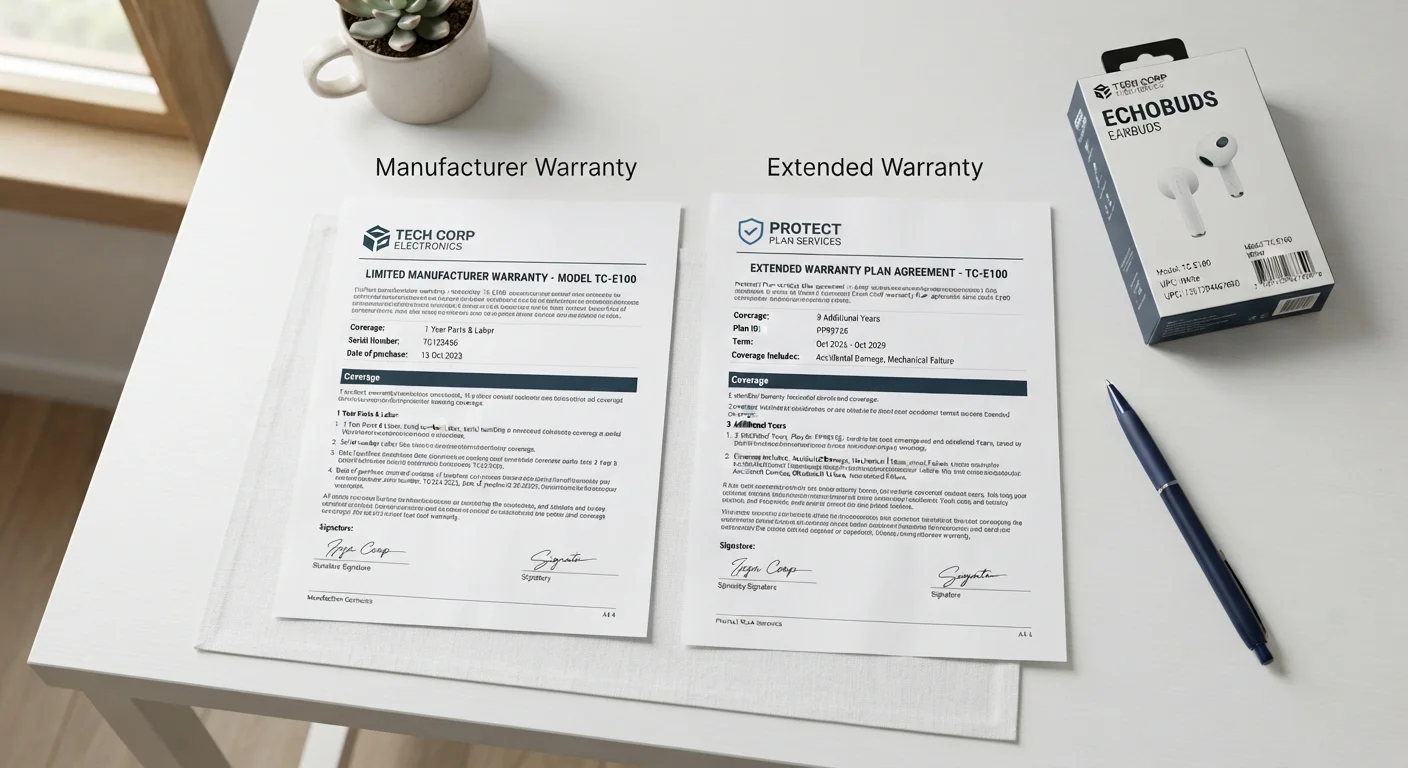
Manufacturer Warranty
The built-in promise that comes with every new product.
Best for: Consumers who want baseline defect protection at no additional cost during the initial ownership period.
Option B
Extended Warranty
A paid plan that picks up where the manufacturer leaves off.
Best for: Consumers who want coverage beyond the standard term, often including accidental damage or wear-and-tear scenarios.
If you want no-cost baseline protection for defects
Manufacturer Warranty
It's already included in what you paid and covers factory defects without any additional investment or paperwork.
If you own a high-cost appliance or device you plan to keep long-term
Extended Warranty
Repair costs on major appliances or electronics can rival replacement costs; an extended plan may offset that risk over several years.
If you're buying a lower-cost item with a short expected lifespan
Manufacturer Warranty
The economics of extended coverage rarely make sense when the item itself is inexpensive or likely to be replaced anyway.
If accidental damage or drops are a realistic concern
Extended Warranty
Manufacturer warranties almost never cover accidental damage; some extended plans do, making them worth evaluating for portable devices.
What a Manufacturer Warranty Actually Is
A manufacturer warranty - sometimes called a limited warranty - is a written guarantee issued directly by the company that made the product. It comes bundled with the purchase at no separate charge and promises that the product is free from defects in materials and workmanship for a specified period.
Coverage periods vary widely by product category. Small electronics may carry a 90-day warranty; major home appliances often come with one-year coverage, and some components (like compressors in refrigerators) may be warrantied for five to ten years separately from the main unit.
Crucially, manufacturer warranties are governed in the US by the Magnuson-Moss Warranty Act, a federal law requiring that written warranties on consumer products costing more than $15 be clearly disclosed before purchase. Under this law, a "full" warranty must repair or replace defective products at no charge within a reasonable time; a "limited" warranty can impose conditions - and most manufacturer warranties are limited.
What manufacturer warranties generally do not cover includes accidental damage, normal wear and tear, cosmetic damage, misuse, or damage caused by unauthorized repairs. For a plain-language breakdown of typical exclusions, see what a warranty actually covers and what it doesn't.
What an Extended Warranty Actually Is
Despite the name, an extended warranty is legally a service contract, not a warranty in the traditional sense. It is sold separately - typically at the point of sale by the retailer, or afterward by a third-party administrator - and is backed by whoever issues it, not by the original manufacturer.
This distinction matters practically. If the retailer or third-party company goes out of business, the contract may be unenforceable or require a lengthy claims process through a state insurance guarantee fund, depending on how the plan is structured in your state.
Extended plans vary significantly in what they add beyond the manufacturer warranty. Some simply extend the same defect coverage for additional years. Others add protections the manufacturer warranty lacks - such as coverage for accidental drops, liquid damage, or power surges. A few overlap entirely with the manufacturer period rather than starting after it expires.
| Criterion | Manufacturer Warranty | Extended Warranty |
|---|---|---|
| Cost to consumer | Included in purchase price | Purchased separately |
| Who backs it | The product manufacturer | Retailer or third-party administrator |
| Legal classification | Written warranty (Magnuson-Moss) | Service contract |
| Typical coverage | Defects in materials and workmanship | Varies; may add accidental damage, wear |
| Coverage period | Fixed; often 90 days to 1 year | Extends or supplements manufacturer term |
| Accidental damage | Almost never covered | Sometimes covered (plan-dependent) |
| Transferability | Often non-transferable | Varies by contract terms |
For a deeper look at how extended plans, retailer protection plans, and service contracts differ from one another, see warranties, extended plans, and service contracts.
How to Evaluate Whether an Extended Warranty Is Worth It
The financial logic of an extended warranty depends on three factors: the cost of the plan, the realistic probability of a claim, and the cost of repair or replacement without coverage.
Consumer research has generally found that most products do not fail within the window that extended warranties cover, and when they do, the repair cost often doesn't exceed the plan price by a meaningful margin on lower-cost items. That calculus shifts for complex, high-cost products - particularly those where labor costs for repair are high regardless of parts.
~$40B
US extended warranty market annual revenue
The US extended warranty and service contract market generates tens of billions annually, reflecting how widely these plans are sold across retail channels.
~80%
Products that never need a warranty claim
Industry analyses and consumer advocacy research have broadly estimated that the large majority of products are never used to make a warranty or service contract claim.
Before purchasing, ask these practical questions:
- Who backs the contract? Is it the manufacturer, the retailer, or a third party? Each carries different financial risk if the backer closes.
- What exactly is excluded? Read the exclusions list, not just the coverage highlights.
- Does it overlap with the manufacturer warranty? Paying for coverage you already have for year one is rarely good value.
- Is there a deductible? Some plans charge a fee per claim that reduces the effective benefit.
It's also worth knowing that your rights don't end with written warranties. Even without a paper guarantee, legal protections may still apply - see how implied warranties work even when no written warranty exists. And if you purchased online, your warranty claim process may differ from an in-store purchase - shopping online vs. in-store consumer rights covers those nuances.
This article provides general consumer education about warranty types and is not legal or financial advice. Terms, coverage, and applicable laws vary by state, product, and issuing party. Read all warranty and service contract documents carefully before purchasing.