

| Average sleep cycle duration | ~90 minutes (National Sleep Foundation) |
| Cycles per night (typical adult) | 4-6 cycles (NIH Sleep Research) |
| Proportion of sleep in Stage 2 | ~45-55% (American Academy of Sleep Medicine) |
| First REM episode onset | ~90 minutes after sleep onset (NIH) |
| Deep sleep (Stage 3) concentration | First half of the night (Sleep Medicine Reviews) |
| REM sleep concentration | Final hours of a full night (NIH Sleep Research) |
How Sleep Is Structured: The 90-Minute Cycle
Sleep is not a single uniform state. Each night, your brain moves through a repeating sequence of stages, typically completing four to six full cycles of roughly 90 minutes each. Understanding this architecture helps explain why how long you sleep is only part of the picture - the quality and continuity of those cycles matter just as much.
Sleep is broadly divided into two categories: non-REM (NREM) sleep and REM (rapid eye movement) sleep. NREM sleep itself has three distinct stages, each characterized by different patterns of brain electrical activity, muscle tone, and physiological processes. As the night progresses, the proportion of time spent in each stage shifts - early cycles contain more deep NREM sleep, while later cycles are richer in REM. For a deeper look at why this architecture matters so much to your overall wellbeing, see why sleep is the foundation of physical and mental recovery.
NREM Sleep
Non-rapid eye movement sleep, comprising Stages 1, 2, and 3. It accounts for the majority of total sleep time and is essential for physical restoration, immune function, and memory processing.
REM Sleep
Rapid eye movement sleep, characterized by high brain activity, vivid dreaming, and temporary muscle paralysis. It plays a central role in emotional regulation and cognitive memory consolidation.
Sleep Spindles
Brief bursts of rhythmic brain wave activity occurring during Stage 2 NREM sleep. They are thought to protect sleep continuity and support the transfer of information to long-term memory.
Slow-Wave Sleep (SWS)
Stage 3 of NREM sleep, dominated by large, slow delta brain waves. It is the deepest and most physically restorative sleep stage, supporting tissue repair and immune activity.
Hypnic Jerk
An involuntary muscle twitch that often occurs during the transition from wakefulness to Stage 1 sleep. It is a normal and harmless phenomenon.
Sleep Architecture
The overall structure and pattern of sleep cycles throughout a night, including the sequence, duration, and proportion of each sleep stage.
The Four Sleep Stages: What Happens in Each
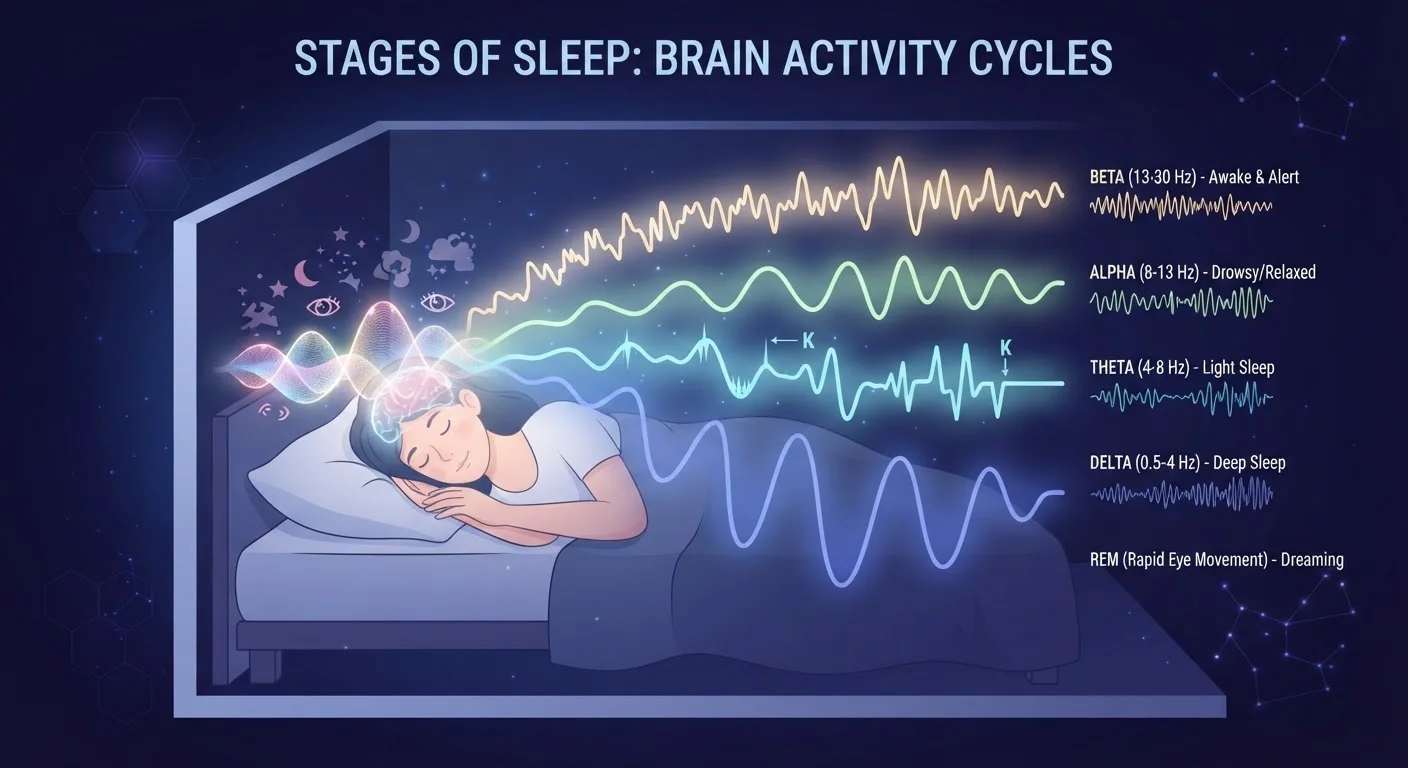
Stage 1 (NREM 1) - Light Sleep: This transitional stage lasts just one to seven minutes. Brain activity slows from waking patterns, muscle activity decreases, and you may experience brief, involuntary muscle twitches called hypnic jerks. You are easily awakened and may not feel you were truly asleep.
Stage 2 (NREM 2) - Baseline Sleep: Stage 2 accounts for roughly 45-55% of total sleep time in healthy adults, making it the most prevalent stage. Brain waves slow further but produce two distinctive features: sleep spindles (short bursts of rhythmic activity) and K-complexes (large, slow waves). Research suggests sleep spindles play a role in memory consolidation and protecting sleep from disruption. Core body temperature drops and heart rate slows during this stage.
Stage 3 (NREM 3) - Deep Sleep (Slow-Wave Sleep): Also called slow-wave sleep or SWS, this is the most physically restorative stage. Delta waves - large, slow brain waves - dominate. Growth hormone is released, immune function is supported, and tissue repair occurs. Deep sleep is concentrated in the first half of the night, which is why cutting sleep short disproportionately reduces this stage.
REM Sleep - Cognitive Restoration: REM sleep first appears roughly 90 minutes after sleep onset. The brain becomes highly active - nearly resembling waking activity - while the body's voluntary muscles are temporarily paralyzed, likely to prevent acting out dreams. REM sleep is closely associated with emotional processing, creative thinking, and memory integration. REM periods lengthen with each successive cycle, meaning the final hours of a full night's sleep are especially REM-rich.
| Average sleep cycle duration | ~90 minutes (National Sleep Foundation) |
| Cycles per night (typical adult) | 4-6 cycles (NIH Sleep Research) |
| Proportion of sleep in Stage 2 | ~45-55% (American Academy of Sleep Medicine) |
| First REM episode onset | ~90 minutes after sleep onset (NIH) |
| Deep sleep (Stage 3) concentration | First half of the night (Sleep Medicine Reviews) |
| REM sleep concentration | Final hours of a full night (NIH Sleep Research) |
Why Disrupted Cycles Have Real Consequences
Missing sleep stages - whether from sleep disorders, shift work, alcohol use, or simply cutting nights short - has measurable downstream effects. Alcohol, for example, suppresses REM sleep in the early part of the night; the body then experiences a REM rebound in the second half, leading to fragmented, less restful sleep overall. Stress and elevated cortisol can delay sleep onset and reduce slow-wave sleep; learn how the stress-cortisol loop disrupts sleep for more on this feedback cycle.
Age also reshapes sleep architecture significantly. Older adults tend to spend less time in slow-wave sleep and experience more frequent nighttime awakenings. For a full overview of how sleep needs and patterns shift across life stages, see sleep across the lifespan.
Understanding your sleep cycles is a first step - but translating that knowledge into better nightly habits matters most. Sleep hygiene habits and avoiding evening routines that undermine rest can meaningfully protect your cycle continuity night after night.
This article is for general informational and educational purposes only and does not constitute medical advice. If you have concerns about your sleep health, please consult a qualified healthcare professional.