

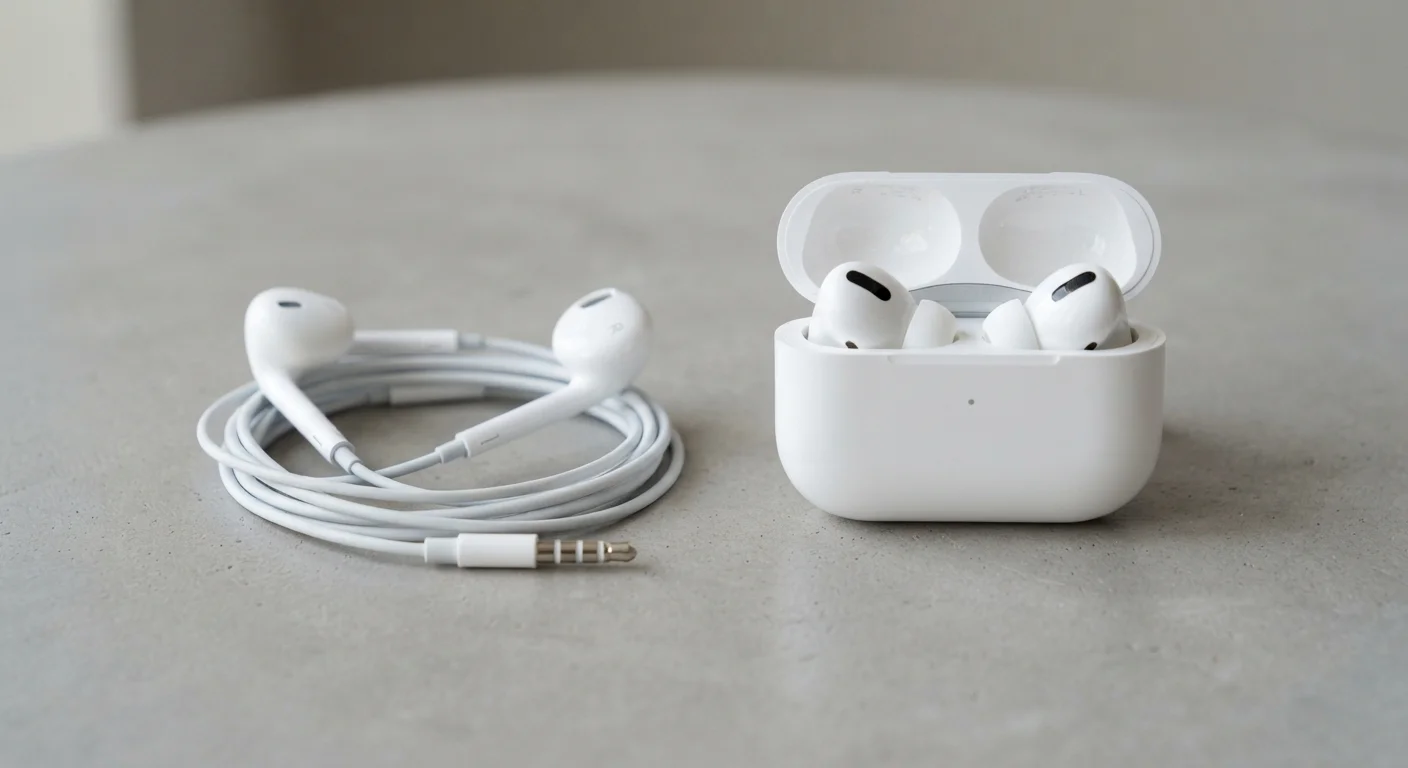
Key Takeaways
Option A
Wired Earbuds
The reliable, no-compromise audio standard.
Best for: Anyone who prioritizes consistent sound quality, zero latency, and never worrying about battery life.
Option B
Wireless Earbuds
The cable-free, lifestyle-first listening option.
Best for: Active users and commuters who value freedom of movement and everyday convenience over absolute audio purity.
If you edit video, game, or need zero audio delay
Wired Earbuds
Even the best Bluetooth connections introduce some latency. Wired earbuds eliminate this entirely, keeping audio perfectly synced to on-screen action.
If you work out, commute, or move around frequently
Wireless Earbuds
No cable means no snagging, tangling, or restricted movement. Wireless earbuds are purpose-built for active, on-the-go listening.
If you care deeply about consistent, uncompressed sound quality
Wired Earbuds
Wired connections transmit audio without Bluetooth compression artifacts, which can matter to critical listeners even though the gap has narrowed.
If convenience and simplicity are your top priorities
Wireless Earbuds
Auto-pairing, ear-detection features, and no cable management make wireless earbuds significantly easier to use day to day.
If you frequently misplace small items or have a tight budget
Wired Earbuds
Wired earbuds are harder to lose since they stay connected to your device, and comparable sound quality often costs less than wireless alternatives.
The Core Trade-Off: Convenience vs. Control
Switching from wired to wireless earbuds is not simply about removing a cable — it changes the fundamental relationship between your ears and your device. Wired earbuds use a direct analog or digital connection, meaning audio travels as a continuous signal with no processing delay and no power source required beyond your device. Wireless earbuds use Bluetooth, a short-range radio protocol, which requires encoding audio into a digital signal, transmitting it, and decoding it on arrival.
That chain of steps introduces two meaningful consequences: a small transmission delay called latency, and a dependency on battery power. For casual music listening, neither matters much. For video playback, voice calls, or gaming, even 50–200 milliseconds of lag can make audio feel noticeably out of sync with what you see on screen. Many modern wireless earbuds use low-latency Bluetooth codecs — such as aptX Low Latency or Bluetooth LE Audio — to shrink this gap, but wired connections remain the gold standard for time-sensitive audio.
| Criterion | Wired Earbuds | Wireless Earbuds |
|---|---|---|
| Audio Latency | Effectively zero | 50–200ms (codec-dependent) |
| Battery Required | No | Yes, 5–10 hrs typical |
| Audio Quality Ceiling | Uncompressed analog signal | Compressed; codec quality varies |
| Freedom of Movement | Restricted by cable | Full range of motion |
| Durability | Generally longer lifespan | Battery degrades over time |
| Setup | Plug in and play | One-time Bluetooth pairing |
| Risk of Loss | Low (tethered to device) | Higher (small, untethered) |
| Typical Price Range | Generally lower | Generally higher |
Battery Life: The Hidden Maintenance Cost
Every pair of wireless earbuds comes with a battery clock ticking. Most deliver somewhere between 5 and 10 hours of playback per charge, with their charging cases extending total battery to 20–30 hours before you need a wall outlet. That is sufficient for most daily routines, but it introduces a new habit: remembering to charge.
5–10 hrs
Typical wireless earbud battery life per charge
Most mainstream wireless earbuds on the market offer 5 to 10 hours of continuous playback before needing to return to their charging case.
~80%
Battery capacity retained after 300–500 charge cycles
Lithium-ion batteries, which power all wireless earbuds, typically degrade to around 80% of original capacity after several hundred full charge cycles.
200ms
Maximum common Bluetooth audio latency
Standard Bluetooth connections can introduce up to 200 milliseconds of audio delay, though low-latency codecs can reduce this to under 40ms in optimal conditions.
A dead battery mid-commute or mid-workout is a real-world failure mode that wired earbuds simply do not have. Lithium-ion batteries also degrade over time — typically retaining around 80% of their original capacity after 300–500 charge cycles — meaning wireless earbuds have a built-in lifespan tied to battery health. Wired earbuds, by contrast, can last many years with basic cable care. If you already think about battery management for devices like wireless chargers — see our guide on wireless charging and battery health for helpful context — adding earbuds to that rotation is manageable, but it is a genuine commitment.
Sound Quality and the Codec Question
A common concern when going wireless is audio quality loss. Bluetooth does compress audio, but the degree depends heavily on which audio codec is in use. Older codecs like SBC (Subband Coding) are more lossy and can introduce audible artifacts. Newer codecs like AAC, aptX, and LDAC transmit significantly more audio data, narrowing the gap with wired fidelity to the point where most listeners cannot reliably distinguish the difference in everyday settings.
Wired earbuds, particularly those using a 3.5mm analog jack, bypass digital-to-analog conversion in the earbuds themselves — your device handles it. This can be an advantage when paired with a quality source, but the practical difference is minor for the majority of listeners using streaming services with compressed audio files. The honest answer is that both formats can sound excellent, and the quality ceiling for each is largely determined by the earbuds themselves, not the connection type.
Fit, Durability, and Everyday Practicality
Wireless earbuds must fit securely on their own — there is no cable to help stabilize them in your ear canal. Many include multiple ear tip sizes and wing tips for this reason. If you have difficulty finding earbuds that stay put, the wired format may actually be more practical since the cable adds light tension that keeps them seated.
Durability is another practical dimension. Wireless earbuds contain more internal components — Bluetooth chips, antennas, batteries, and often microphones and touch sensors — giving more potential failure points. They are also easier to drop, lose, or accidentally put through a laundry cycle. Wired earbuds fail most commonly at the cable joint near the plug or the earpieces, a single stress point that is often visible and sometimes repairable. For long-term ownership, wired designs tend to outlast wireless ones, all else being equal.
For commuters, gym users, and people who spend time away from a desk, wireless earbuds offer a genuine quality-of-life improvement that is hard to overstate. For home listeners, studio users, or anyone who finds cable management a non-issue, wired remains a perfectly rational choice.