

Key Takeaways
Debt Consolidation
Debt consolidation is the process of combining multiple debts — such as credit card balances, medical bills, or personal loans — into a single new loan or payment. The goal is typically to simplify repayment and, ideally, reduce the interest rate you're paying overall. It does not eliminate what you owe; it reorganizes it.
Consolidation is distinct from debt settlement, which involves negotiating to pay less than the full amount owed. Consolidation generally requires repaying the full principal balance.
What Debt Consolidation Actually Does
When people talk about debt consolidation, they often mean two different things: the mechanics of combining debts and the hoped-for outcome of paying less. Understanding what consolidation actually does — and does not do — is the starting point.
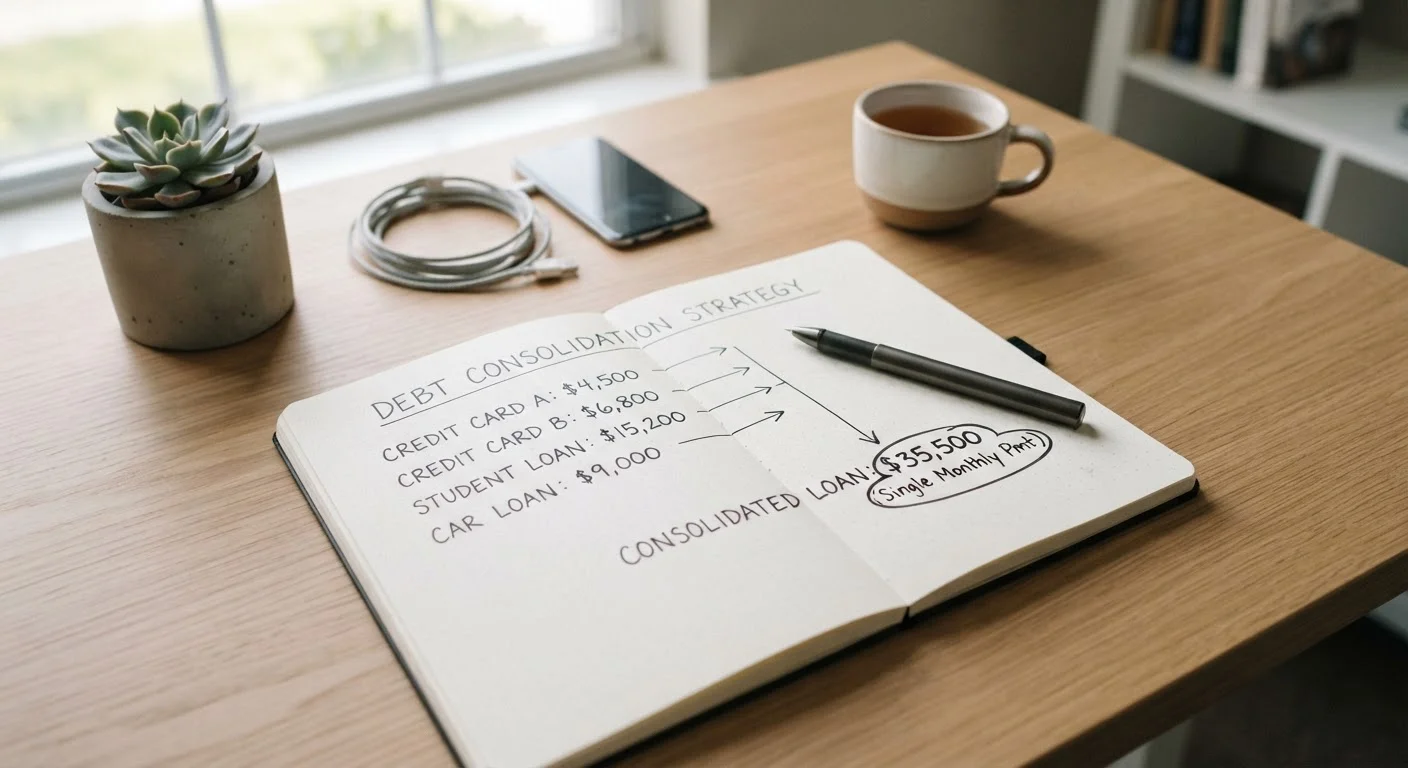
Consolidation takes multiple outstanding balances and rolls them into one new financial product. You make a single monthly payment instead of several. If the new product carries a lower interest rate than your existing debts, less of your payment goes toward interest and more reduces the principal. That's the core financial logic behind it.
What it does not do is reduce the principal you owe. If you have $15,000 in credit card debt, consolidating it means you still owe $15,000 — just to a different lender or on a different account. This distinction matters because some people consolidate debt and then continue using the paid-off credit cards, ending up with more total debt than before.
Consolidation vs. Bankruptcy: Not the Same
Debt consolidation is a voluntary repayment strategy — you remain obligated to repay the full amount you owe. Bankruptcy is a legal process with court oversight that may discharge certain debts but carries long-term consequences for your credit and financial options. If you're uncertain which path applies to your situation, consult a licensed financial counselor or attorney.
Common Ways People Consolidate Debt
There are two widely used tools for debt consolidation, and they suit different situations.
- Personal loans: You borrow a lump sum from a bank, credit union, or online lender and use it to pay off existing debts. You then repay the personal loan at a fixed interest rate over a set term. This approach works well when you can qualify for a meaningfully lower rate than your current debt carries. For a deeper look at how this compares to other options, see our comparison of personal loans and balance transfer cards.
- Balance transfer credit cards: Some credit cards offer a promotional 0% or low interest rate for a set period — often 12 to 21 months — on balances transferred from other cards. If you can pay off the balance before the promotional period ends, this can be an effective strategy. If you cannot, the rate typically resets to a standard rate that may be just as high as what you started with.
A less common option is a debt management plan (DMP) through a nonprofit credit counseling agency. In this arrangement, the agency negotiates with creditors on your behalf and you make a single monthly payment to the agency, which distributes it. This is not a loan — it's a structured repayment arrangement, and it may appear on your credit report.
When Consolidation May Help — and When It Won't
Consolidation is most likely to benefit you when all of the following are true: you can qualify for a lower interest rate than you currently pay, you can manage the new monthly payment without strain, and you're committed to not adding new debt on the accounts you just paid off.
It's less likely to help — and may make things worse — if you extend your repayment term so significantly that total interest paid over the life of the loan exceeds what you would have paid staying the course. Always calculate the total cost of repayment, not just the monthly payment amount.
If your debt is already feeling overwhelming, consolidation alone may not be enough. Review the warning signs that debt may be outpacing your ability to manage it before deciding on a path forward.
“Debt consolidation is a tool, not a solution. If the behaviors that created the debt don't change, consolidation just rearranges the furniture.”
— National Foundation for Credit Counseling, Nonprofit credit counseling organization
Building an Emergency Fund Alongside Debt Repayment
One underappreciated aspect of debt consolidation is what happens next. Many people consolidate, lower their monthly payment, and then have no plan for what to do with the freed-up cash flow. Without a budget, that money often gets absorbed by spending rather than savings or accelerated repayment.
Financial educators frequently recommend building at least a starter emergency fund — even $500 to $1,000 — while repaying consolidated debt. The reason is practical: without any savings buffer, an unexpected expense like a car repair or medical bill can push you back toward high-interest credit cards, undoing progress. For guidance on balancing these two priorities, see our article on saving and paying off debt at the same time.
Pairing consolidation with consistent habits — automated payments, a realistic monthly budget, and a small savings cushion — gives you the best chance of making lasting progress. Our strategies for staying consistent with debt repayment covers the behavioral side of this challenge in detail.
This article is for general informational and educational purposes only and does not constitute personalized financial advice. For guidance specific to your situation, consider speaking with a licensed financial professional.