

Key Takeaways
Removes willpower from the savings equation
When transfers happen automatically, you never face the temptation to spend first and save what remains. This "pay yourself first" structure is one of the most consistently supported saving strategies in personal finance research.
Builds consistency without ongoing effort
A scheduled transfer runs whether or not you remember, feel motivated, or have a busy month. That reliability is especially valuable during periods of financial stress, when manual saving is easiest to skip.
Accelerates emergency fund growth
Even modest recurring transfers accumulate meaningfully over time. Saving $100 per biweekly paycheck, for example, adds up to $2,600 over a year without a single active decision.
Reduces cognitive load around money
Automating routine saving frees mental bandwidth for more complex financial decisions, such as managing debt repayment or evaluating larger spending choices.
Adapts to any income level
Because the transfer amount is set by you, automation scales to any budget. There is no minimum threshold — the habit matters more than the amount, especially when starting out.
Overdraft risk if checking balance runs low
If your checking account doesn't hold enough to cover the scheduled transfer, your bank may charge an overdraft fee — wiping out the savings benefit entirely, or worse. This risk is highest for people with variable income or tight monthly cash flow.
Can mask an underlying budget problem
Automating savings does not fix overspending elsewhere. If your monthly expenses already exceed your income, a recurring savings transfer will accelerate the imbalance rather than resolve it.
Set-and-forget mindset leads to misalignment
Life circumstances change — income rises or falls, bills are added or removed — but automated transfers often stay unchanged for months or years. A transfer calibrated to last year's budget may be too small or dangerously large today.
Less effective for irregular income earners
Freelancers, gig workers, and those with commission-based pay may find fixed recurring transfers difficult to manage when income fluctuates significantly month to month. A percentage-based or manual-trigger approach often suits them better.
Doesn't address high-interest debt prioritization
Automatically diverting money to savings while carrying high-interest debt may not be the most mathematically optimal strategy. The right balance depends on interest rates, income stability, and personal risk tolerance — not automation alone.
Our Verdict
Automated savings is a genuinely effective habit-forming tool, particularly for people who struggle with consistency or find manual transfers easy to skip. That said, it is not a set-and-forget solution — it requires an accurate budget, a reliable cash cushion in your checking account, and periodic review. Used thoughtfully, automation can accelerate emergency fund growth and make saving feel effortless.
Best for people with stable, predictable income who want a low-effort system for building an emergency fund or long-term savings goal without renegotiating the decision every month.
How Automated Savings Transfers Work
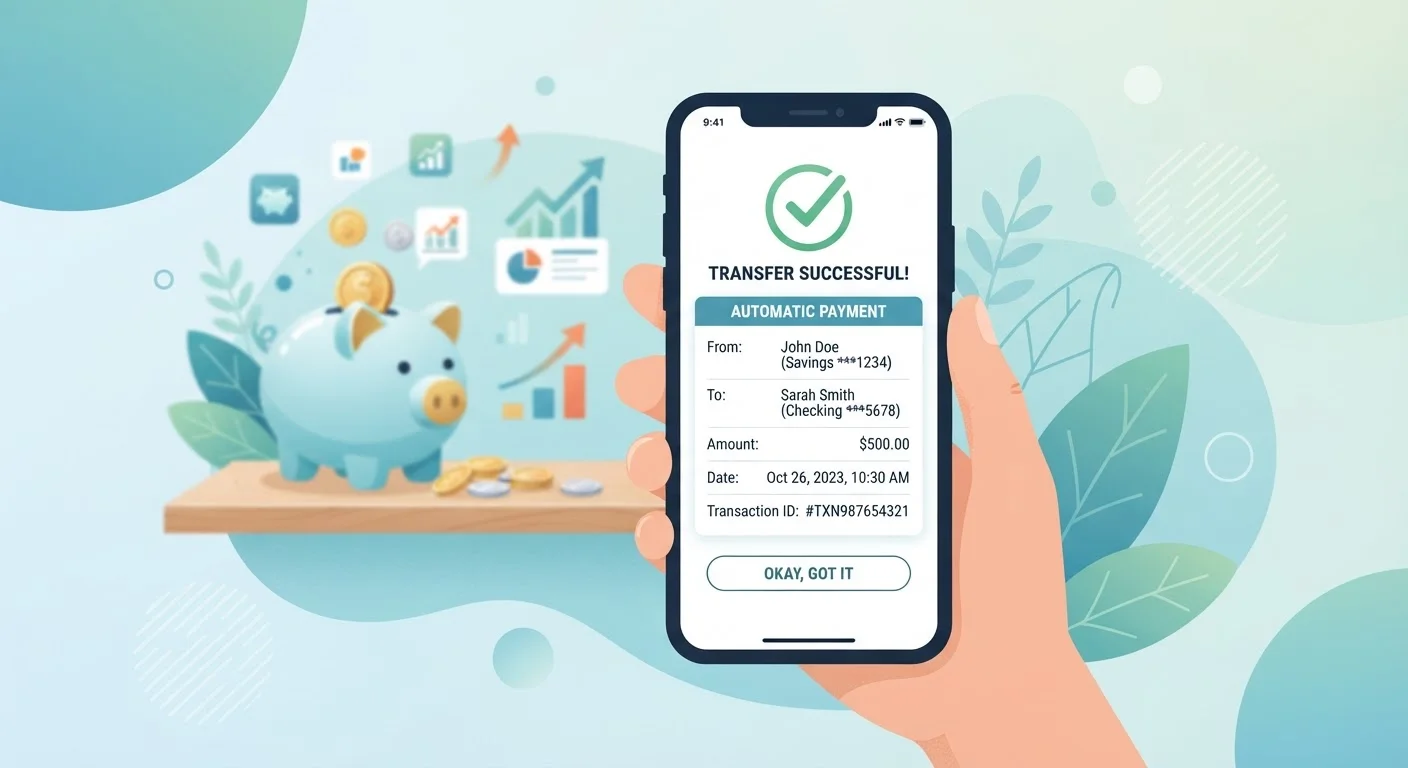
Automated savings is straightforward in practice: you instruct your bank or credit union to move a fixed dollar amount — or a percentage of each deposit — from your checking account to a designated savings account on a schedule you choose. Transfers typically run weekly, biweekly, or monthly, and most institutions let you set this up in minutes through online banking or a mobile app.
Some employers also allow a direct-deposit split, sending a portion of each paycheck straight to savings before it ever lands in checking. This approach mirrors how workplace retirement contributions work and is widely regarded as one of the most frictionless entry points into automated saving.
The destination account matters, too. Routing transfers to a high-yield savings account rather than a standard one means your balance earns a meaningfully higher interest rate over time, compounding the benefit of consistency. For a broader look at how automation fits into your overall financial picture, see our guide on automating your finances.
The Advantages of Automating Your Savings
The strongest case for automation is behavioral, not mathematical. Research in behavioral economics consistently shows that people save more when saving requires no active decision — removing the moment of choice eliminates the temptation to spend first and save whatever is left.
Removes willpower from the savings equation
When transfers happen automatically, you never face the temptation to spend first and save what remains. This "pay yourself first" structure is one of the most consistently supported saving strategies in personal finance research.
Builds consistency without ongoing effort
A scheduled transfer runs whether or not you remember, feel motivated, or have a busy month. That reliability is especially valuable during periods of financial stress, when manual saving is easiest to skip.
Accelerates emergency fund growth
Even modest recurring transfers accumulate meaningfully over time. Saving $100 per biweekly paycheck, for example, adds up to $2,600 over a year without a single active decision.
Reduces cognitive load around money
Automating routine saving frees mental bandwidth for more complex financial decisions, such as managing debt repayment or evaluating larger spending choices.
Adapts to any income level
Because the transfer amount is set by you, automation scales to any budget. There is no minimum threshold — the habit matters more than the amount, especially when starting out.
69%
Americans living paycheck to paycheck
According to a 2023 LendingClub and PYMNTS report, roughly 69% of U.S. consumers reported living paycheck to paycheck, underscoring the difficulty of saving without a structured system.
$1,000
Minimum emergency fund target cited by many advisers
Many personal finance educators suggest a starter emergency fund of at least $1,000 before focusing on other goals, a threshold that regular automated transfers can reach within a year at modest contribution levels.
Automation also supports emergency fund building, which is a foundational step for anyone managing debt alongside savings goals. If that balance is a challenge you're working through, our article on saving and paying off debt at the same time walks through how to prioritize when funds are limited.
The Limitations and Risks to Understand
Automation is not a financial cure-all. Several practical limitations deserve attention before you set up a transfer and walk away.
Overdraft risk if checking balance runs low
If your checking account doesn't hold enough to cover the scheduled transfer, your bank may charge an overdraft fee — wiping out the savings benefit entirely, or worse. This risk is highest for people with variable income or tight monthly cash flow.
Can mask an underlying budget problem
Automating savings does not fix overspending elsewhere. If your monthly expenses already exceed your income, a recurring savings transfer will accelerate the imbalance rather than resolve it.
Set-and-forget mindset leads to misalignment
Life circumstances change — income rises or falls, bills are added or removed — but automated transfers often stay unchanged for months or years. A transfer calibrated to last year's budget may be too small or dangerously large today.
Less effective for irregular income earners
Freelancers, gig workers, and those with commission-based pay may find fixed recurring transfers difficult to manage when income fluctuates significantly month to month. A percentage-based or manual-trigger approach often suits them better.
Doesn't address high-interest debt prioritization
Automatically diverting money to savings while carrying high-interest debt may not be the most mathematically optimal strategy. The right balance depends on interest rates, income stability, and personal risk tolerance — not automation alone.
A recurring theme across these risks is that automation works best when grounded in an accurate, current budget. If you haven't mapped your monthly income and expenses recently, consider spending time in budgeting basics before configuring recurring transfers. You might also compare how automation stacks up against strict budgeting approaches, which offer a different kind of control.
Making Automation Work for Your Situation
The goal is a transfer amount that is ambitious enough to build savings consistently, but small enough that it doesn't strain your checking balance. Starting conservatively — even $25 or $50 per pay period — is far more effective than setting an aggressive amount that triggers overdrafts or forces you to reverse the transfer.
Choosing the Right Transfer Timing
Scheduling your automated transfer for the day after your paycheck arrives — rather than a fixed calendar date — reduces the chance of a low-balance mismatch. Many banks allow you to align recurring transfers with your direct deposit date. If your income arrives on irregular days, a small permanent buffer in checking (sometimes called a "cash cushion") can absorb timing gaps without triggering fees.
Review your automated amount whenever your financial situation changes: a raise, a new recurring bill, a job change, or paying off a debt. Treating automation as a "set it and review it periodically" system, rather than a permanent fixed arrangement, keeps it aligned with your actual cash flow. For a comprehensive framework covering saving, debt payoff, and emergency funds together, the complete guide to building financial stability is a useful next step.
This article is for general informational and educational purposes only and does not constitute personalized financial advice. Consult a qualified financial professional for guidance specific to your circumstances.