

Key Takeaways
Option A
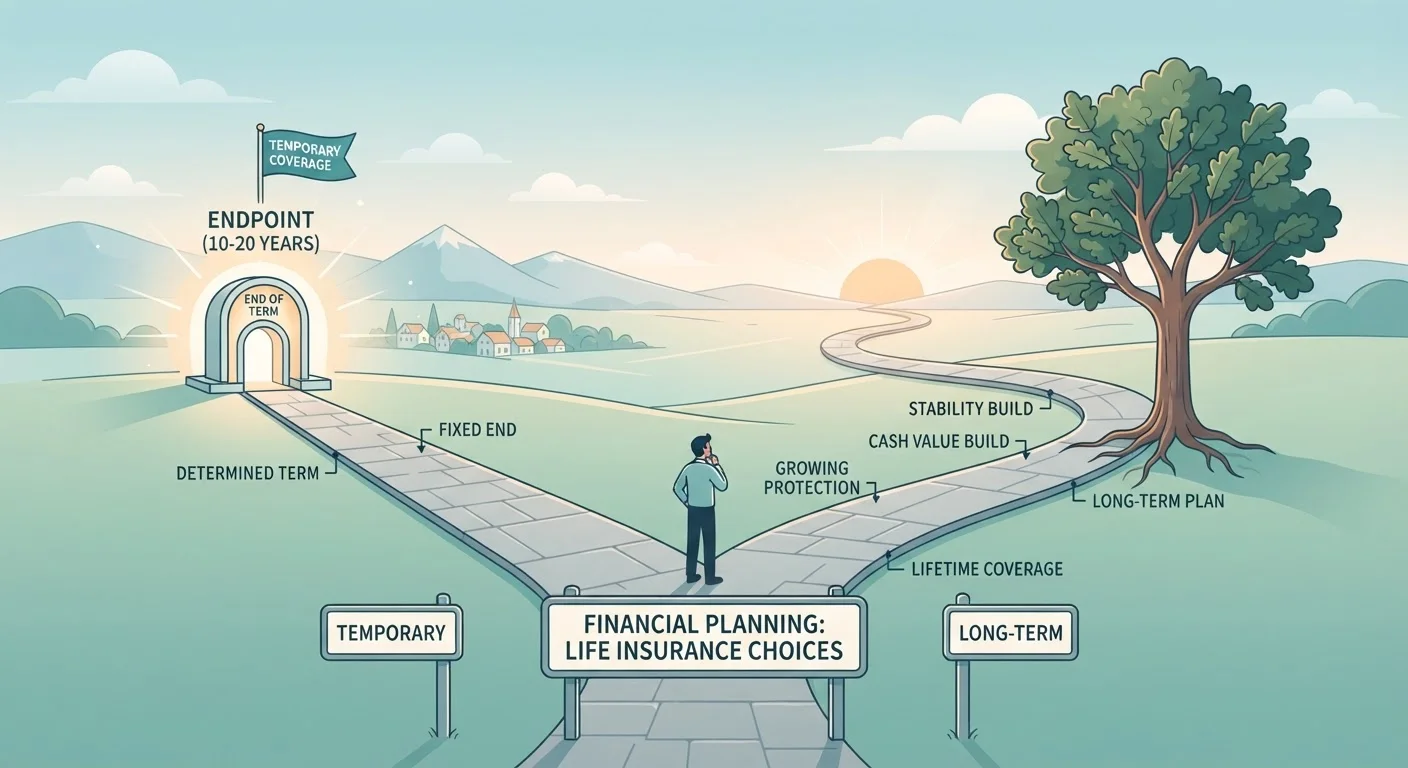
Term Life Insurance
Straightforward, affordable protection for a defined period.
Best for: People who need coverage tied to a specific financial obligation, such as a mortgage or years until children become independent.
Option B
Permanent Life Insurance
Lifelong coverage with a built-in savings or investment component.
Best for: People seeking coverage that never expires, or who want a policy that also accumulates cash value over time.
If you need maximum coverage at the lowest cost
Term Life Insurance
Term policies deliver a large death benefit for a relatively small premium, making them efficient for income replacement during peak earning years.
If you want coverage that never expires regardless of age
Permanent Life Insurance
Permanent policies do not lapse after a set term, so your beneficiaries are guaranteed a death benefit as long as premiums are maintained.
If you have a specific debt or income-replacement window in mind
Term Life Insurance
Matching a policy term to a mortgage payoff date or a child's college graduation year is a straightforward, cost-effective strategy.
If estate planning or wealth transfer is a priority
Permanent Life Insurance
The guaranteed death benefit and potential tax-advantaged cash value make permanent policies a common tool in longer-range estate strategies.
If your budget is tight but you still need meaningful protection
Term Life Insurance
Term coverage lets you secure a substantial benefit amount without committing to the higher premiums that permanent policies require.
How Each Policy Type Actually Works
Term life insurance is exactly what the name suggests: a policy that stays active for a specified term - commonly 10, 20, or 30 years. You pay a fixed premium throughout that period. If you die while the policy is in force, your beneficiaries receive the death benefit. If you outlive the term, coverage ends and no benefit is paid. There is no savings component, no cash buildup - it is pure protection.
Permanent life insurance, by contrast, is designed to last your entire life, provided premiums are paid. The most common forms are whole life and universal life. Both include a death benefit plus a cash value component - a portion of each premium accumulates in an account that grows over time on a tax-deferred basis. You can borrow against that cash value or, in some cases, withdraw from it, though doing so can reduce the death benefit. For a deeper look at how whole life specifically compares to term, see our breakdown of term vs. whole life.
| Criterion | Term Life | Permanent Life |
|---|---|---|
| Coverage duration | Fixed term (e.g., 10-30 years) | Lifelong (as long as premiums paid) |
| Typical premium cost | Lower | Higher |
| Cash value component | None | Yes - grows tax-deferred |
| Death benefit guarantee | Only during active term | Guaranteed at death |
| Policy complexity | Simple and transparent | More complex; varies by type |
| Conversion option | Sometimes available via rider | Not applicable |
| Best planning use | Income replacement, debt coverage | Estate planning, lifelong needs |
The Cost Trade-Off
Price is usually the sharpest difference between the two types. Because term insurance carries no cash value and coverage is temporary, insurers can price it much more affordably. A healthy 35-year-old might pay a fraction of the monthly cost for a 20-year term policy compared with an equivalent permanent policy. That gap can be significant over decades.
Permanent premiums are higher because the insurer is guaranteeing a payout at some point - not just during a window - and because a portion of each premium funds the cash value account. Think of it as paying for both insurance and a structured savings vehicle bundled together.
~5-15×
Premium cost difference between policy types
Industry data broadly indicates permanent life premiums can run several times higher than comparable term coverage for the same death benefit amount.
20 years
Most commonly purchased term length
According to LIMRA, a U.S. insurance research organization, 20-year terms are among the most popular choices for individual term life buyers.
54%
U.S. adults with some form of life insurance
LIMRA's 2023 Insurance Barometer Study found roughly half of American adults report owning at least one life insurance policy.
Whether the cost difference is worth it depends on what you are trying to accomplish. If your primary goal is income replacement while dependents rely on you, the lower cost of term often means you can afford a larger death benefit. If your goals include lifelong coverage or estate planning, the higher permanent premium may be justified. This is general information; your own situation will vary, so working through a pre-decision checklist before you commit is a practical step.
Key Differences at a Glance and What They Mean for You
Beyond cost and duration, several practical differences shape how each policy functions day-to-day and at the end of life.
Renewability and conversion: Some term policies allow renewal at the end of the term, though usually at a higher premium reflecting your older age. Many also include a conversion rider - a feature that lets you convert to a permanent policy without a new medical exam. That flexibility can matter if your health changes during the term.
Cash value access: Only permanent policies build cash value. The ability to borrow against it can provide liquidity in emergencies, but borrowed amounts accrue interest and unpaid loans reduce what your beneficiaries receive. It is not a free resource - it is a loan against your own policy.
Underwriting and risk: Both policy types go through underwriting, where the insurer evaluates your age, health, and lifestyle to set premiums. Understanding that process can help you know why you're offered specific terms. How insurers assess risk explains what underwriters actually look at and how to present your situation accurately.
Policy complexity: Term is straightforward. Permanent policies - especially universal life variants - involve more moving parts, including adjustable premiums, investment sub-accounts, and surrender charges if you cancel early. Before signing anything, make sure you understand what you are actually buying.
Riders Can Customize Either Policy Type
Both term and permanent policies can often be modified with optional add-ons called riders. Common examples include waiver-of-premium riders (which pause premium payments if you become disabled) and accelerated death benefit riders (which allow early access to a portion of the benefit if you are diagnosed with a terminal illness). Riders typically add to the premium cost. Ask your agent to explain any riders included in a quote and what they actually cover.
This article is for general informational purposes only and is not personalized financial, insurance, or legal advice. Coverage terms, premiums, and eligibility vary by insurer, policy, and state. Always read policy documents carefully and consult a licensed insurance professional before making coverage decisions.