

Key Takeaways
Why Storage Quality Gets Overlooked in Small Spaces
In a compact apartment or smaller home, storage decisions feel urgent - and urgency often leads to purchases based on looks, price, or whatever fits. That works until it doesn't. Drawers that wobble after six months, shelves that bow under actual weight, bins that crack in humid bathrooms - these failures are predictable when the underlying quality signals were ignored at the start.
The good news is that small-space storage doesn't require expensive solutions. It requires the right criteria. Understanding what makes a storage product durable and functional - regardless of what it looks like - helps you shop more deliberately, waste less, and end up with a system that actually grows with your space. Before you invest in new storage, it's also worth doing a room-by-room audit of what you actually need to store.
Start With What You're Storing
Before evaluating any storage product, list the actual items you need to contain - their weight, size, and how often you access them. A solution sized for visual appeal rather than actual contents will underperform from day one. Matching the product's weight rating and dimensions to your real inventory is the single most reliable way to avoid early failure.
Storage Approaches Worth Considering
Freestanding shelving with adjustable heights
Adjustable shelving units are among the most versatile storage investments for small spaces. The key quality indicator is the shelf-pin or bracket system: metal pins in reinforced holes will outlast plastic clips significantly, particularly under heavier loads like books, appliances, or pantry goods. Look for units with a clear weight rating per shelf - a number that's publicly stated, not estimated.
Steel or solid-wood uprights tend to resist racking (sideways wobble) far better than particleboard-only construction. If particleboard shelves are used, a thick laminate or edge banding reduces moisture absorption and surface chipping over time. Freestanding designs also move with you, which matters in rentals where wall anchoring isn't always permitted.
Metal shelf pins in reinforced holes outlast plastic clips - especially under heavier pantry or book loads.
Under-bed storage with rigid frames
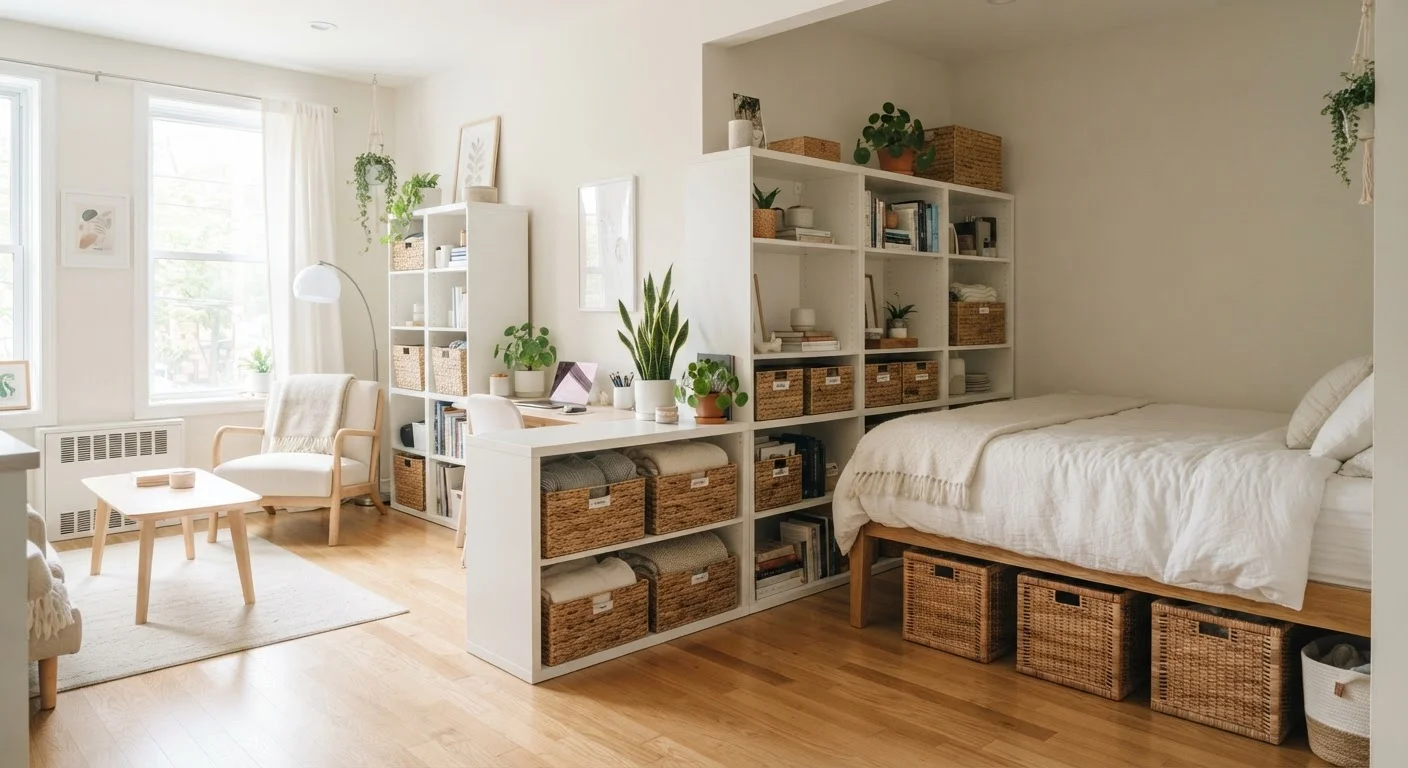
Under-bed space is reliably wasted in small bedrooms. Rolling bins or drawers with a rigid polypropylene or metal frame hold their shape under compression in a way that soft-sided bags do not. Over time, a collapsed fabric bin pushed under a bed becomes difficult to retrieve and harder to organize.
Evaluate the wheel or caster quality if the unit rolls - low-quality casters bind on carpet or crack on hard floors after repeated use. Lids that seal with a friction or snap closure are worth the marginal cost if the items stored are seasonal or infrequently accessed, since they reduce dust accumulation meaningfully.
Rigid-frame under-bed bins hold their shape under compression; soft bags collapse and lose functionality fast.
Wall-mounted systems that use vertical space
In rooms where floor space is genuinely scarce, vertical wall storage is one of the highest-return investments available. Pegboards, rail systems with interchangeable hooks, and floating shelves all move storage off the floor without requiring additional square footage.
The critical variable is anchor type and wall material compatibility. Toggle bolts and appropriate drywall anchors for the weight involved are non-negotiable - a rail system pulling away from the wall is a safety issue, not just an inconvenience. For renters, adhesive-mount rail systems have improved considerably, but they carry strict weight limits that should be observed exactly as stated rather than estimated.
Vertical wall systems reclaim floor space - but anchor type and wall compatibility are non-negotiable safety factors.
Drawer organizers with fixed dividers
Loose items in drawers accumulate friction with every opening - both literally and in terms of daily frustration. Fixed dividers made from bamboo, solid wood, or thick-walled polypropylene hold their position under use in a way that thin cardboard or flimsy plastic inserts do not. Expandable versions are useful for non-standard drawer sizes, but the quality of the extension joint matters: a loose joint means the organizer shifts each time the drawer opens.
For kitchen drawers specifically, moisture and food debris are ongoing stressors. Sealed or smooth interior surfaces clean more reliably and resist staining over years of use - a detail that matters more than appearance at the point of purchase.
Fixed-divider organizers with sealed surfaces outlast flimsy inserts in kitchen drawers by years.
Stackable bins with standardized footprints
Stackable storage bins are especially useful in closets, garages, and utility spaces. The practical advantage of standardized footprints - where bins from the same system nest and stack predictably - is that you can expand the system incrementally rather than replacing it wholesale when needs change.
Evaluate lid design carefully: snap lids that engage on all four corners resist popping open when stacked versus lids that only lock at two points. High-density polyethylene (HDPE) and polypropylene bins hold up better in temperature-variable spaces like garages than lower-grade plastics that become brittle in cold or warp in heat. Clear or labeled-window bins reduce the need to dig through every container to find what you need - a small feature with a large daily payoff.
Standardized footprints let you expand storage incrementally - no need to replace the whole system.
Multi-function furniture with integrated storage
In genuinely tight spaces - studios, small bedrooms, compact living rooms - furniture that performs double duty as storage offsets the cost of both pieces. Ottomans with interior compartments, bed frames with built-in drawers, and benches with hinged lids are all established options in this category.
The durability concern here centers on the hinge or mechanism: low-quality hinges on storage ottomans and benches fail within a year of regular use. Look for hydraulic or piano-style hinges rather than basic strap hinges, and evaluate the frame construction of any piece bearing seated weight. If a piece will also serve as seating, weight capacity should be stated clearly in the product specifications - not left to assumption.
Multi-function furniture lives or dies by its mechanism quality - hinge type predicts lifespan more than anything else.
Building a System That Lasts
The most durable small-space storage isn't a single product - it's a system of complementary pieces chosen with consistent criteria. Before adding anything new, assess what conditions the storage will face: humidity, temperature swings, weight load, and frequency of access all influence which materials and construction types hold up. A solution that works in a dry bedroom closet may fail within a year in a bathroom or laundry area.
Think in terms of replaceable parts rather than single-purpose units. Storage that can be reconfigured - additional shelves, stackable extensions, interchangeable drawers - adapts as your life changes without requiring full replacement. That's ultimately the most cost-conscious approach, too, even if the upfront price is slightly higher. For readers tracking household spending carefully, the everyday money habits that apply to groceries and routine costs apply just as well to home purchases: buy less often, buy better, and treat durability as part of the value calculation.